
Introduce yourself; who are you and what types of books do you write?
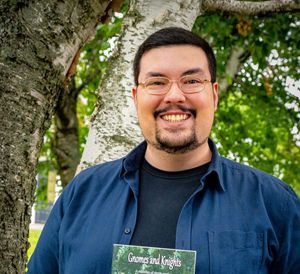
Fraser Sherman, born in England (dad was US civil service, working over there for the military), a Floridian from age 11 on, a resident of Durham NC since 2010 (met a woman. She lived there. I moved; we married. HEA, baby!).
I’ve had several different writing lives. One is writing film reference books — a half-dozen for the McFarland publishing house over the past 25 years. The sixth, Watching Jekyll and Hyde, is currently going through their editing process. I’m a huge movie buff and writing about films is a delight. I’ve also written Sex for Dinner, Death for Breakfast, a book on the James Bond films, and published it through my imprint, Behold the Book.
Fiction is the most fun. I’ve published one novel, the psionic steampunk story Questionable Minds; my second novel, Southern Discomfort, will come out from Behold the Book this year. It’s set in 1973 Georgia, as federal fugitive Maria Esposito stumbles into a town run by elves where a long fae feud is entering its endgame.
19-Infinity is a collection of fantasy stories, all set in the 1900s. Atoms for Peace is a book of interrelated stories set in the 1950s, wondering what America would look like if the science fiction films of the 1950s — Godzilla, Them, I Was a Teenage Werewolf, I Married a Monster From Outer Space— were the stuff of everyday life. Atlas Shagged is another short story collection.
I’ve written about politics most of my life: letters to the editor, newspaper and magazine columns and one book. Undead Sexist Cliches deals with the stupidity of misogyny and sexism and explains why equality is the only reasonable position.
The writing life that doesn’t involve books is nonfiction articles. I was a full-time reporter for a small-town weekly from 2000-2010 and I currently freelance for Carrboro NC’s The Local Reporter. I’ve also written magazine articles ranging from big markets — I had an opinion piece in Newsweek — to obscure venues such as Gulf Coast Condo Owners Monthly. I wrote several how-to pieces for The Writer and a half-dozen RPG-related articles for Dragon.  What are your books about?
Questionable Minds is set in a Victorian London where our world’s mystical theories of psychic power are sound “mentalist” science. My protagonist, Sir Simon Taggart, has a unique mentalist ability, immunity to any sort of psychic attack. He uses that to help Scotland Yard while working to find the one criminal he cares most about — the man who arranged the murder of his wife. When Jack the Ripper begins gutting mentalist women and stealing their powers, it may lead to the opportunity Simon’s waiting for — if he can survive.
Southern Discomfort is set in Pharisee, Georgia, where elves Olwen and Aubric McAlister have run things since they led a band of Irish colonists across the sea to the New World three hundred years earlier. By 1973 the once-isolated community is crowded by new residents, it’s getting harder to conceal the truth about the McAlisters … and then someone murders Aubric. Nobody could penetrate the McAlisters’ magical defenses, yet someone found a way.
Lt. Maria Esposito — Army nurse turned anti-war activist, now a wanted fugitive — thinks the Greyhound bus she’s riding will pass through Pharisee on her way to Atlanta, a city big enough to disappear in. Too bad torrential rains have flooded out the road, trapping her in town. And Olwen McAlister has had a vision that Maria’s the only one who can bring Aubric’s killer to justice. Worse still, the killer knows this and he’s not taking any chances …
My fantasy fiction runs to intrusion fantasy — the world is normal but something weird has happened or intruded on the normality. My character arcs run to reconnection stories, with emotionally cut-off protagonists who have to learn to care again.
What was the inspiration behind writing your first book?
Questionable Minds was born years ago when I watched the Sean Connery film The Great Train Robbery. I began to imagine Connery’s roguish protagonist if he were working on dirty jobs for the English government. As my initial ideas usually do, the concept mutated, from a rogue to the impeccably respectable, extremely rich baronet Simon Taggart.
I’m a big history buff with a fondness for the Victorian era. Reading various books about the theories of mental power popular at the time gave me an idea of where the divergence would lie — the development of psionics — and how it would affect such a rigidly class-conscious society when people in all wakes of life could manifest the powers.
I’m also fond of Victorian fiction so I worked that in. The cast includes Moriarty and other characters from Sherlock Holmes, the murderous fictional schemer Madame Sara, and Dr. Jekyll. Two years after he escaped the malevolent blackmailer Mr. Hyde, he’s leading a life of utter virtue and philanthropy … surely a man like that couldn’t have any dark secrets!
What did you learn while writing your second book?
That I default too easily to making my characters all white. After a couple of drafts, I looked at Southern Discomfort, realized it was a ludicrously white community for a small Southern town and set out to fix that. Things became much more complicated; having two elves in charge had to alter race relations, so I had to work that out. Plus it’s set in the 1970s, when the civil rights revolution has shaken America up, so I had to decide how that would play out. The book’s stronger for it.
I also learned to edit exhaustively for repetitive phrasing, like the number of compound sentences linked by “but.” I had waaaay too many of them.
What is the most rewarding part of being an author?
The biggest thrill is the moment when I realize the story hangs together and that however many added drafts I need, I’m on the right track. The second is seeing it out in the world. The third is that my wife is proud of me.
What elements do you think make for a good story?
A cool concept, the kind that makes people say, “Take my money!”
Characters I want to read about. For me that means the protagonists aren’t gaping jackholes, among other things. And the women have some goal in life besides relieving the male lead’s sexual tension.
The right amount of exposition. Enough that I can understand what’s going on but not so much that it kills the story.
All of this gets graded on a sliding scale. If I really like the book, I’m much more forgiving of the flaws (“The characters were two-dimensional but it’s such an engaging read.”).
What is the hardest part of being an author for you?
It takes me so many damn drafts to finish anything. I’m envious of people who can write more efficiently.
What is your current writing project?
Now that Watching Jekyll and Hyde is done (until the galleys arrive and I begin to proof and index it), I’m working on three. Savage Adventures is a history of the Doc Savage pulps. Let No Man Put Asunder is an intrusion fantasy set in 1976, as two dissimilar people find themselves telepathically linked. The Impossible Takes a Little Longer is set in a slightly altered 1980s where superpowers are normal but superheroes — like my protagonist — are few and far between.
What is the best writing advice you’ve ever received?
The opening hook is the key to the ending. If your hook is a mystery or a question, the ending answers the riddle. If your hook is a character’s suffering, the ending resolves it or the character learns it can’t be resolved. If the opening is something disruptive — terrorist attack, First Contact, demonic possession — the ending restores order or order completely collapses.
Where can readers discover more about you and your books?
My website and blog: https://frasersherman.com/
Behold the Book: https://frasersherman.com/behold-the-book-2/
Facebook: https://www.facebook.com/fraser.sherman
Bluesky: https://bsky.app/profile/fsherman.bsky.social
Nerdy comics blogging: https://atomicjunkshop.com/author/frasersherman/