

Ok Mr. Carney. I see what you're up to.
Canadians are watching how you are handling Donald Trump, and it does not resemble diplomacy, or any of the things you promised Canadians in exchange for their vote. It resembles provocation.
After your government announced a new China trade arrangement, President Trump responded in the most predictable way possible. He warned that if Canada becomes a “drop off port” for Chinese goods into the United States, he would impose 100 percent tariffs on Canadian exports. He framed it as enforcement, not ideology. Canada, he said, would not be used as a back door for Chinese manufacturing to evade American tariffs.
That concern did not come from nowhere. China has a long history of dumping surplus, state subsidized goods into foreign markets when domestic demand slows. Steel. Aluminum. EVs. Solar panels. Consumer electronics. Low prices. Flood the market. Crush competitors. Americans hate this because it guts their factories and wages. Canadians should hate it because it turns our economy into a clearance aisle for products nobody else wants.
So when your government announces closer economic ties with China with no visible safeguards, no transshipment controls, no inspection regime, no penalty structure, and no serious coordination with Washington, Trump does what Trump always does. He escalates. Loudly. Publicly. With tariffs.
Let's be honest about what that means.
A 100 percent tariff is not a warning. It doubles the price of Canadian goods crossing the border. Auto parts. Vehicles. Steel. Aluminum. Machinery. Lumber. Agricultural exports. That is not leverage. That is a shutdown switch. It makes Canadian products uncompetitive overnight and sends buyers elsewhere.
Workers lose hours. Plants idle. Investment freezes. The dollar weakens. Household costs rise. That is how tariffs work.
Yet instead of moving urgently to defuse this, your government appears almost comfortable letting it grow.
Which leads to an uncomfortable conclusion.
You are behaving like someone who cannot get what he wants directly, so he provokes the reaction he needs instead.
This is the classic manipulation pattern of a child who wants attention or power. He does not negotiate. He pokes. He triggers an outburst. Then he points to the explosion and says, look what they did to me.
That is what this looks like.
You are not calming Trump. You are daring him. You are not stabilizing the relationship. You are agitating it. You are not preventing retaliation. You are inviting it.
And that only makes sense if the retaliation serves your purpose.
You govern as a minority. That means restraint. That means cooperation. That means limits. You have never looked comfortable with that. Your ambitions go far beyond climate policy. You have made it clear you want to reshape Canada’s entire economic system to mirror your own ideological model. Carbon markets. Industrial controls. Financial rulemaking. Trade realignment designed to satisfy global institutions rather than protect Canadian households.
That kind of transformation requires power without obstruction.
And power without obstruction requires a crisis.
Trump is useful to you because he is reactive. When you poke him, he roars. When he roars, you get a villain. When you get a villain, you get a narrative. And when you get a narrative, you get the excuse for a snap election framed as national defense rather than political ambition.
Stand up to Trump.
Defend Canada.
Protect sovereignty.
It is a clean script.
You will say Trump is unreasonable. What you will not say is that you knew exactly how he would respond. You knew that announcing closer ties with China without visible guardrails would trigger American fears of transshipment. You knew the phrase “drop off port for Chinese goods” would dominate US politics. You knew a tariff threat would follow. You lit the match and waited for the fire.
Perhaps you will claim this is strategy. That provocation forces engagement. That escalation creates leverage. If that is the case, it is reckless. You do not gamble auto plants, farms, steel mills, and trucking routes on personality management. You do not risk tariff walls so you can manufacture urgency. You do not treat the largest export relationship Canada has as a stage for domestic ambition.
And if this is not strategy but politics, then Canadians are not being governed. We are being maneuvered.
Jobs become bargaining chips.
Prices become acceptable casualties.
Trade becomes theatre.
If this ends in a snap election triggered by a tariff threat you helped summon, Canadians will be justified in asking whether this crisis was mishandled or deliberately cultivated.
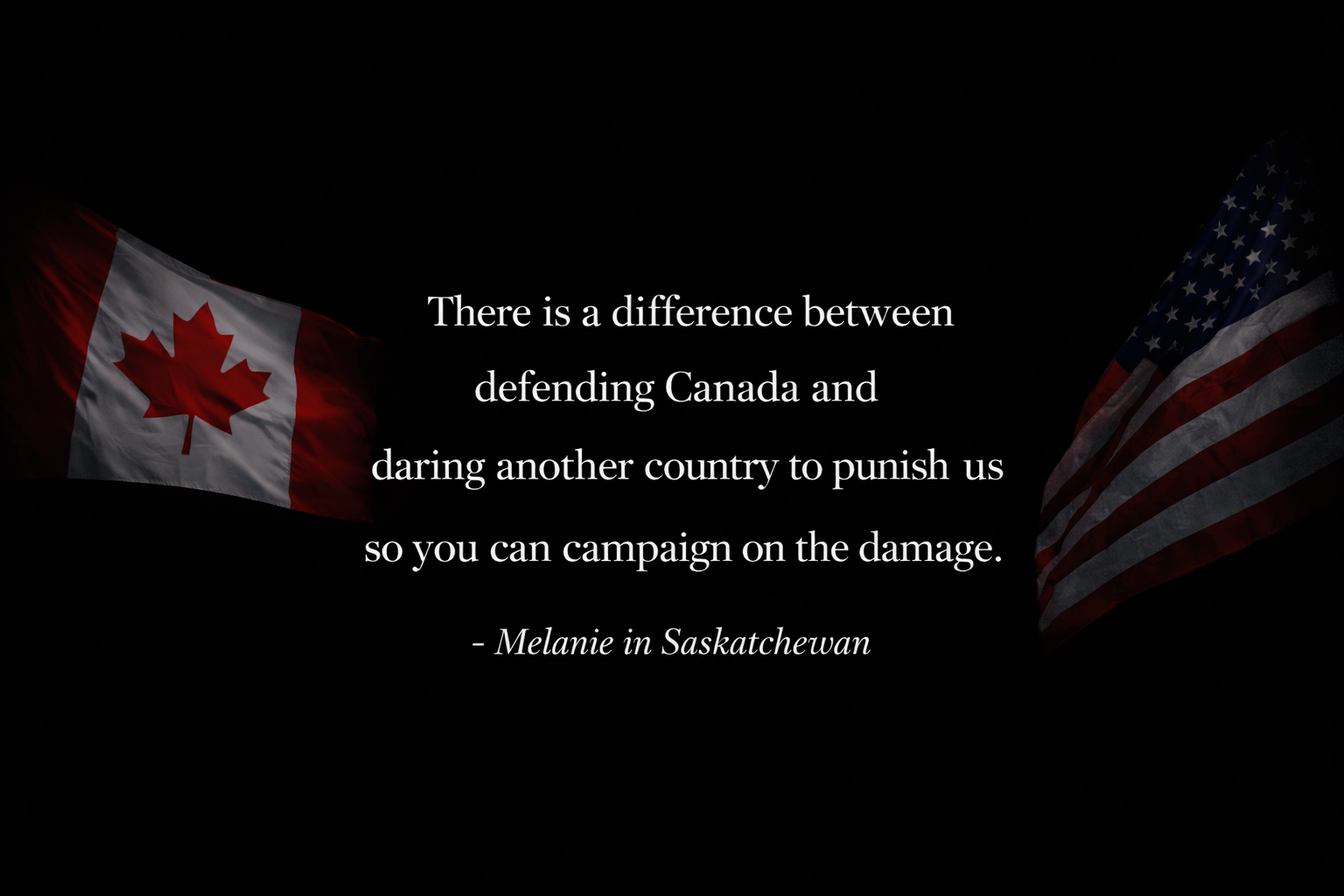
There is a difference between defending Canada and daring another country to punish us so you can campaign on the damage.
So, Mr. Carney and members of your caucus, here is the question you owe answers to for Canadians.
Are you trying to prevent a tariff war, or are you provoking one because it helps you get the power you cannot secure without it. Because provoking economic retaliation to gain political advantage is not diplomacy.
It is manipulation on a national scale.
And Canadians will be the ones paying for the reaction you wanted.