

We learned not to "civilize" other people. Now, we just help them "transition."
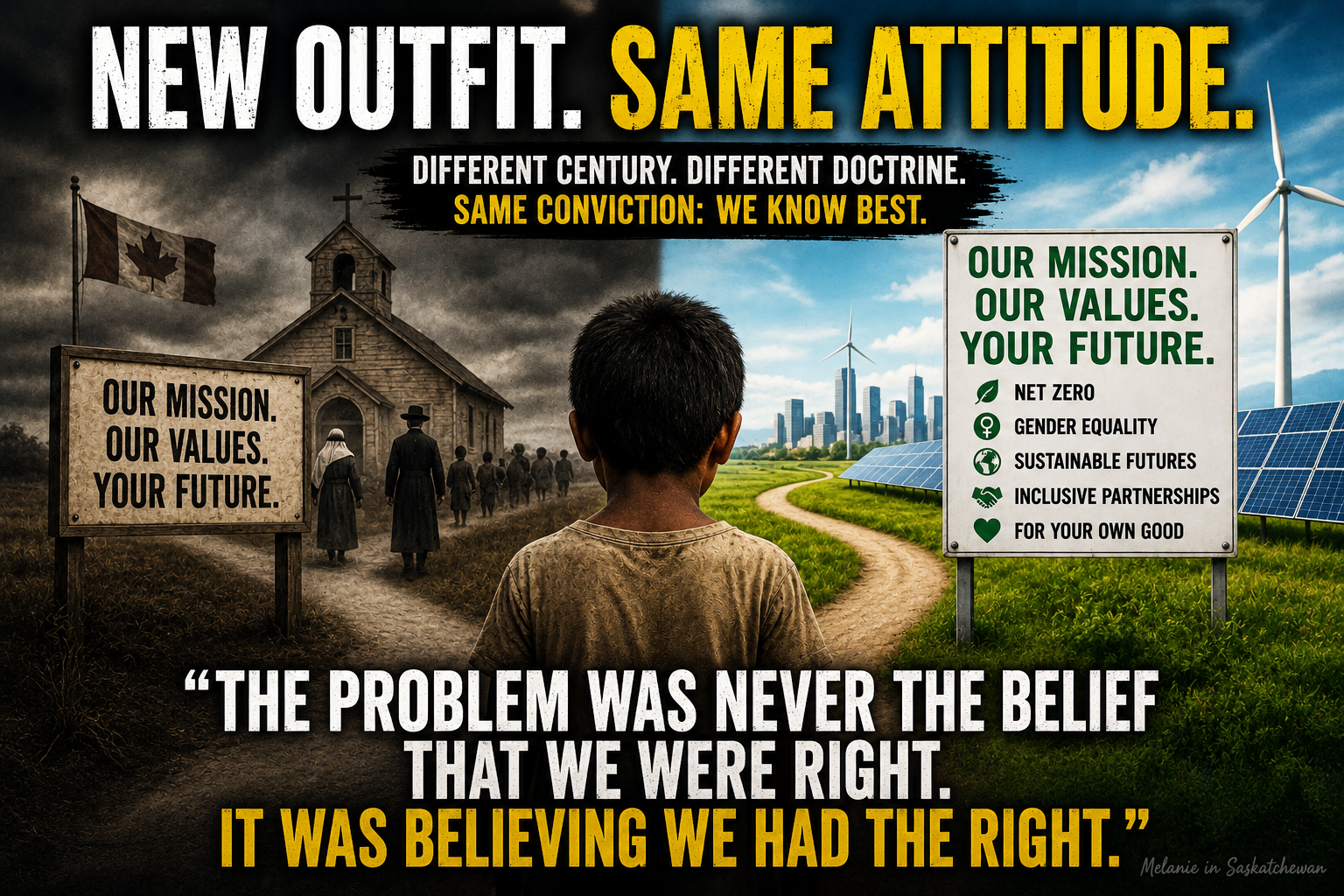 I have a question, and the longer I sit with it, the more I think somebody in Ottawa should be made to answer it without a communications director standing nearby with smelling salts.
Canada has spent years examining one ugly idea from our past: We... knew better.
We apparently knew what Indigenous children should learn, what language they should speak, what religion they should follow and what "civilized" was supposed to look like.
Governments, churches and educators of that time, for the most part believed they were bringing education, faith and progress. History eventually looked at all that confidence and said, "You know what? Maybe not."
So now we talk about paternalism, colonialism and assimilation. We hold inquiries, issue apologies, create commissions and spend billions trying to reconcile with what happened.
And you know, I thought the lesson was fairly simple!
You don't get to decide what another people should become just because you are absolutely convinced your values are superior.
Apparently the Liberal government misunderstood the assignment. Canada didn't stop preaching, we just forcibly changed religions. "We know best" survived reconciliation, got itself a passport and, naturally, we packed up our enlightenment and took it on the road.
Now Canada is scrambling to diversify other meaningful trade from other places than the United States, which frankly, we should have been doing for decades. If your biggest customer starts using tariffs as both economic policy and recreational entertainment, finding a few more customers suddenly seems wise.
So off go Mark Carney and his travelling band of doom goblin ministers. Carney is abroad talking trade, investment and new partnerships while continuing to champion the climate-transition and sustainable-finance agenda that has followed him around the world like expensive luggage. Anita Anand is travelling. Maninder Sidhu is travelling. François-Philippe Champagne is travelling.
Africa, Asia, Europe, and South America. New markets, new partners and hopefully new friends. Excellent!
We can sell them some wheat, potash, uranium and lumber. We will even promise to buy some of their stuff too! Then everyone shakes hands, smiles for the photograph and comes home. That is trade in a nutshell. A lovely concept, isn’t it?
Except Canada apparently cannot just trade with people. Of course not, don't be so ridiculous, that would just be terribly shallow by Laurentian standards. We have to improve our trading partners while we're there.
So out comes the three ring binder with climate action, gender equality, renewable energy, women's empowerment, feminist international assistance, sustainable development, low-carbon growth and enough gender-responsive climate language to make you wonder if somebody at Global Affairs gets paid by the hyphen.
At some point, you would think one person at that enormous conference table might raise a hand. "Uhm, guys?" Everybody turns and gapes. "Didn't we just spend years apologizing for the whole 'we know what's best for you' thing?"
Apparently Canada's lesson from imposing enlightened values on other societies wasn't "maybe stop doing that." It was "next time, attach funding and call it a partnership." We may have retired the Bible, but Canada still needed something to preach from.
Enter Net Zero.
Canada's Africa Strategy includes perfectly normal things like trade, investment, infrastructure and critical minerals. Ok, so far so good. But woven through it are all the things our current Liberal class has decided modern progress should look like: climate action, renewable energy, gender equality, feminist foreign policy, sustainable development and the whole low-carbon package.
Canada has also committed $5.3 billion in international climate finance to help developing countries move toward low-carbon, climate-resilient economies.
And that's when the whole thing starts feeling weirdly familiar. Not because climate policy and residential schools are the same thing, they obviously aren't. It's the presumptuous attitude underneath it. Oh how other nations must dread seeing Canada coming with their whole "Only we know the path," and "Only we know what progress looks like, and look! We have money to help you get there. Gather round, everyone. Canada's Liberal government would once again like to explain progress to the unenlightened" rhetoric.
Only now, nobody brings a Bible. They bring emissions targets. I mean seriously, who's going to tell the Liberals? Because naturally, every new gospel needs missionaries, and once you start looking at Net Zero as a secular religion, the similarities become stubbornly hard to ignore.
Every religion needs original sin. In this one, it's carbon. You are guilty simply for participating in modern life, although some of us are clearly guiltier than others depending on the size of our truck.
Then comes confession, what we now call emissions reporting. Governments and corporations carefully disclose their carbon sins so somebody with an Excel spreadsheet can work out the required penance.
Fortunately, we have indulgences too! Those are carbon credits. You may continue sinning over here provided you've purchased enough virtue somewhere else... Medieval Europe would understand the arrangement immediately.
The faithful even have pilgrimages. We call them COP conferences, where tens of thousands of people fly across the planet to discuss the urgent need for everybody else to fly and drive less.
And naturally there's a priesthood: consultants, NGOs, sustainability experts and international institutions who interpret the doctrine, explain what sacrifices are necessary and, by the most astonishing coincidence imaginable, are often paid to help us make them.
Question the cost, the timeline or whether the same prescription works everywhere and suddenly you're not debating policy anymore, you're a heretic.
Then next come the prophecies. You must repent of carbon, transform your economy, and change your ways, or untold catastrophe awaits, because at the end of the road sits salvation and it's not Heaven. Meet your new savior, 'Net Zero by 2050.'
But don't call this exporting a religion, good heavens, no. We're merely travelling around the world with money, doctrine, moral certainty and a prescribed path to salvation while encouraging other societies to change how they develop. And no, we're not trying to convert anybody. We're just facilitating their transition through the words of ssustainability.
See? It's completely different!
But this is where I keep getting hung up and I don'tunderstand why no member of the Liberal government isn't as well. What if another country's priorities aren't the same as ours? What if they want cheap electricity, factories, roads, fertilizer, natural gas, mines and reliable power grids? What if an African mother trying to feed three children couldn't care less about Canada's latest gender-responsive climate framework and would simply like a cow or goat for milk and a refrigerator to keep it in?
Who decides what progress looks like Them? Or us?
Canada says these are partnerships, and good... they should be. But Canadian development policy does seem to arrive with our own priorities already packed in the suitcase. We call it partnership while showing up remarkably prepared to explain what the other partner ought to prioritize.
Apparently we've become deeply suspicious of cultural paternalism while remaining wonderfully enthusiastic about policy paternalism. We would never say, "We're going to teach you how to live." My God, can you imagine?
Now we say, "We'd like to build your capacity toward an inclusive, gender-responsive, low-carbon future." That's much better and not imposing values at all. It's more like we're facilitating the correct ones, a completely different department altogether.
And just when the historical parallel couldn't get more awkward, along comes Carney.
His father, Robert Carney, was principal of the federally operated Joseph Burr Tyrrell Indian day school in Fort Smith in the 1960s. It was not a residential school, and that distinction matters. He was also a Catholic educator who later wrote about missionary education in Canada’s North.
Mark Carney has said he loved his father but did not share some of his historical views. And no, children do not inherit responsibility for their parents' beliefs like cottages and socket sets. That is not the point, the irony is the point.
One generation of Carney lived inside a Canadian establishment convinced Western education and Christianity represented progress for Indigenous people. The other leads a government operating inside an international establishment remarkably confident about what progress should look like for developing countries.
Different century, different doctrine, different methods. Yet that same little sentence keeps wandering back into the room: "We know the way forward. Let us help you get there." You'd think Canada, of all countries, would develop a nervous twitch when it hears that.
Then Ottawa went and made the joke for me. Canada's "Africa Strategy" contains a section called "Reconciliation." No, really, I’m serious. Canada is discussing colonialism and reconciliation with African partners inside the exact same strategy, promoting our preferred approaches to climate action, renewable energy, gender equality and sustainable development.
I can picture the meeting now. "We've learned some very painful lessons about imposing one society's idea of progress upon another."
Solemn nodding all around.
"Anyhoo..." Three ring binder opens. "Here's the development model we'd like you to adopt so you can benefit from our climate piety. Slide one: NET ZERO." At this point somebody has to enlighten the Liberals, preferably before the irony develops its own Heritage Minute.
"Relax," they tell us. "It’s for their own good," they say. "Look! We're helping," is crowed from the halls of parliament. That's the phrase that keeps coming back... we're helping.
The government believed it was helping in 1883 when it partnered with churches to establish the formal residential school system. Educators believed they were helping as the system expanded through the decades, and missionaries certainly believed they were helping as they worked to Christianize and assimilate Indigenous children. Everybody was terribly helpful, right up until history finally took a look at what all that well-intentioned "help" had actually accomplished.
That’s the problem with moral certainty.
Nobody believes they're imposing anything when they're convinced they are the enlightened ones doing the improving. They're simply nudging everybody else in the proper direction. You know... for their own good. You'd think Canada might hear those words and feel the faintest twitch of recognition, but apparently not.
So let's skip ahead thirty or fifty years. Imagine some of today's fashionable certainties don't age particularly well. Imagine developing countries eventually say affordable energy, industrial projects or resource development were delayed because wealthy Western countries tied financing and assistance to priorities wealthy Western countries could afford.
Then somebody calculates the cost, and that's when future Canadians discover what Grandpa left them in the will. There'll be hearings, an inquiry, and most likely a commission. This is Canada after all, one expensive investigation naturally requires another expensive investigation into why the first expensive investigation wasn't sufficient.
A Special Rapporteur will be appointed, Consultants will breed like rabbits, then somebody will write a 413-page report containing 94 Calls to Sustainable Reconciliation. A future prime minister, probably a liberal, will stand behind a podium and apologize for Canada's "well-intentioned" attempt to impose Western environmental priorities on developing countries.
There'll probably be a national day of recognition. And Canadians born decades after any of this happened will get the bill. Because apparently Canada's most dependable renewable resource is intergenerational guilt.
So what will reconciliation cost this time? Billions? Tens of billions? Perhaps none of this happens. Maybe Net Zero works exactly as advertised. Maybe today's policies are eventually considered visionary. Maybe developing countries freely choose exactly the path Ottawa prefers... that's entirely possible. Then again, maybe they don't.
But you'd think reconciliation would have taught us something deeper than congratulating ourselves for noticing a previous generation's wrongs. That's easy, they're dead. The harder lesson is admitting we can be wrong while we're still alive, a concept you will never hear anyone in the Liberal wing agreeing that being wrong is even a possibility.
Putting "sustainable" in front of an idea does not make it universally correct. Experts aren't immune to arrogance, institutions aren't immune to groupthink, and politicians do not acquire moral infallibility because somebody handed them a lanyard at Davos.
What if, and bear with my sarcasm here, what if the lesson was supposed to be humility? What if other societies decide for themselves what progress looks like for them? And maybe "we're doing this for your own good" should make Canadians profoundly uncomfortable no matter which century it is said in.
Because we've heard it before, only in this new version the Bible became the briefing binder, salvation became sustainability, conversion became transition and the missionaries became government ministers. Now it's delivered with better vocabulary, and better tailoring with better taxpayer funded expense accounts, all with the same breathtaking confidence: We know what's best for you.
Seriously, who's going to explain this to the Liberals? Maybe nobody will need to, because history eventually does. The problem is, history takes its sweet time. By then everybody responsible is retired, writing memoirs and explaining how terribly good their intentions were, or they're dead.
And the rest of us are standing there holding the invoice. Perfect. We finally achieved the circular economy, but don't you worry... this time we're enlightened. I'm pretty sure that's what they thought last time too.
So, about that question I had: if "we know best" was the mistake last time, why is Mark Carney and his gang of Liberal yes-men so damn certain it isn't the mistake this time?
The most unsettling part isn't even the hypocrisy. It's watching a government forever lecturing Canadians about the lessons of history remain completely oblivious to the echo of its own footsteps. So perhaps someone needs to sit the Liberals down, lay the similarities out in front of them like they're five, and hope they finally get the message, because it's becoming painfully obvious that hints go sailing right over their heads.
Melanie