

When your MP takes orders from a foreign president, democracy becomes a suggestion, not a system.
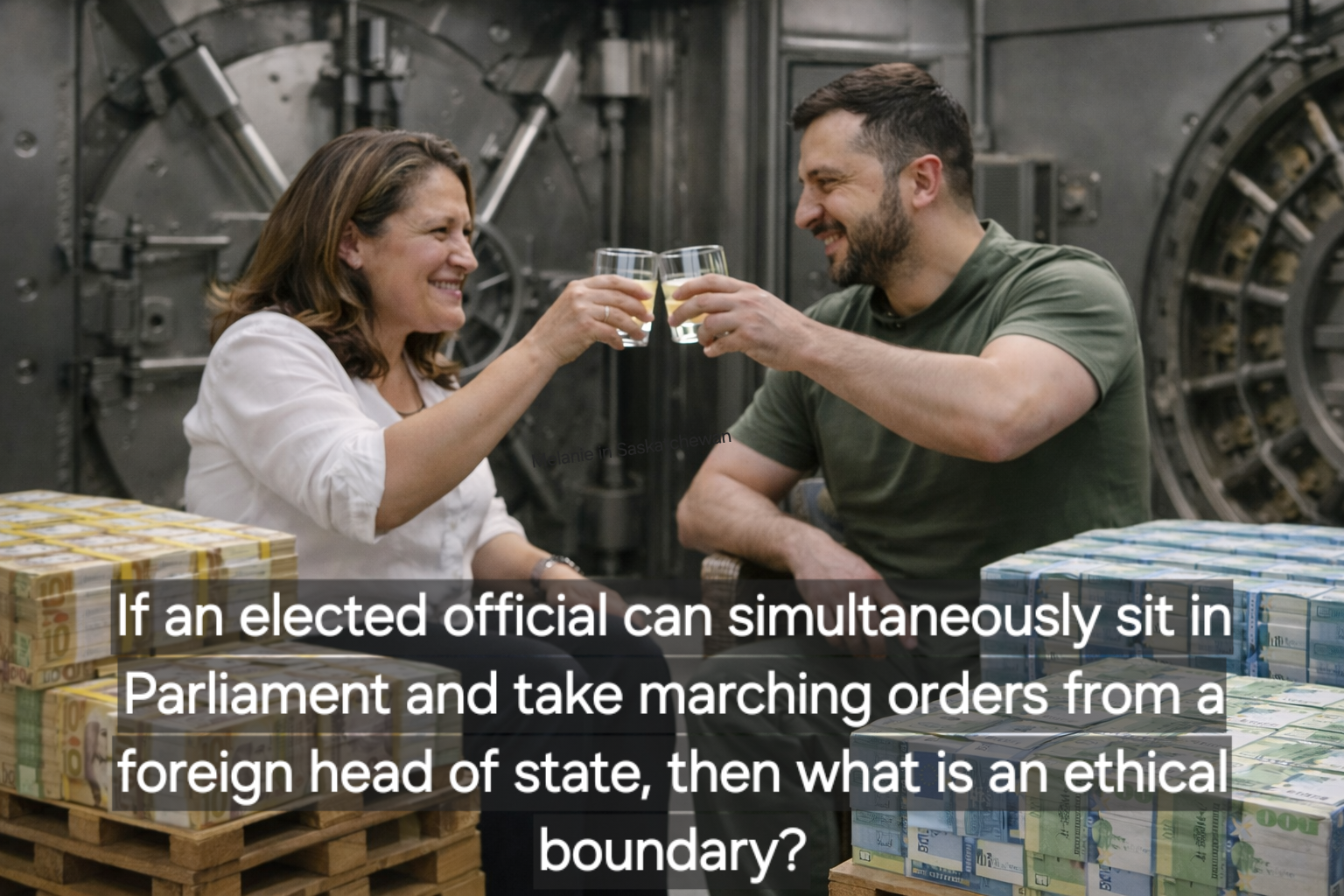 If you thought globalism meant jet-setting diplomats and multinational symposiums, wait until you meet Chrystia Freeland 2.0, now officially Ukrainian economic adviser courtesy of a Telegram decree from President Volodymyr Zelenskyy. In the latest episode of More Than Just A Passport, Freeland, still a Member of Parliament in Canada’s House of Commons, has accepted an advisory post with the government of a foreign state while continuing to hold her seat in Ottawa. And liberals wonder why skeptics are suspicious.
Let’s pause and examine what’s happening here. Freeland isn’t some leg-hitching backbencher attending a NATO meeting. She is a sitting federal MP... currently aligned with the governing Carney Liberal Party, and she has now been christened “advisor on economic development” for Ukraine. Zelenskyy, in a state communication, hailed her experience in investment and economic transformation as critical for Ukraine’s wartime rebuilding efforts. Fine. But there’s a problem: this foreign appointment is a glaring conflict of interest, or, at the very least, an optics catastrophe the size of a grain elevator in Saskatchewan.
Why This Smells Like a Conflict (and Not the Kind Ethics Commissioners Like)
Canada’s federal ethics framework is clear: the Conflict of Interest Act and the Conflict of Interest Code for Members of the House of Commons are designed to prevent elected officials from having conflicting duties or loyalties between their responsibilities to Canadians and outside interests. These rules, administered by the Office of the Conflict of Interest and Ethics Commissioner, exist precisely to avoid elected representatives serving two masters, especially when one is a foreign government. And even more so when the people surrounding the foreign government leader, one who travels the world begging for cash from anyone who will listen, are being rounded up and charged with money laundering and corruption.
Under this framework, MPs must disclose and divest from activities that might put their public duties at odds with other interests. As elected stewards of Canadian taxpayers, their primary job is to serve Canadian interests, not advise the executive branch of a foreign state whose survival hinges on Canadian aid and geopolitical support.
Now ask yourself: can an MP genuinely champion Canada’s interests in Parliament while simultaneously steering economic advice for another country that lobbies Canada for billions in aid? That’s like holding barbed wire in one hand and a balloon in the other and expecting the balloon to float peacefully.
Even more eyebrow-raising is that Freeland hasn’t resigned her seat. She stepped down from Cabinet last year to become Canada’s special representative for Ukraine’s reconstruction, a role that itself blurred boundaries by simultaneously being Ottawa’s envoy and Ukraine’s cheerleader. But now she’s been publicly appointed by a foreign president leading a nation at war, with the authorization of a national government, not just Ottawa, and remains a Canadian MP.
Why Canadians Should Care
Here’s where we dispense with diplomacy and get blunt: the average Canadian, whether taxpayer, pensioner, student, or worker, did not elect Freeland to preside over Ukraine’s economic blueprint. They elected her to represent their voices, scrutinize budgets, and hold the government accountable for how Canadian money is spent. Instead, we now have a Canadian MP whose primary current project appears to be serving a foreign war economy’s needs.
Even if Freeland’s intentions are noble (some might argue helping Ukraine is noble), good intentions do not override ethical obligations. The appearance of divided loyalty is itself corrosive. Canadians should not have to wonder if foreign interests influence their own parliamentarians during crucial votes on military aid, reconstruction funds, or trade policies.
No Legal Barrier? Fine, But What About Ethics?
Critics will sputter, “There’s no explicit prohibition on an MP advising a foreign government.” True; the Conflict of Interest Act does not literally say “Thou shalt not be a foreign adviser if thou art an MP.” Technical loopholes exist in every statute. But the spirit of the law, and the very raison d’être of the Conflict of Interest Code, is to prevent conflicts between public duties and other roles.
If an elected official can simultaneously sit in Parliament and take marching orders from a foreign head of state, then what is an ethical boundary?
Time to Resign — Not Vacation
Freeland should do the honorable thing: resign from the House of Commons. Not her Cabinet, she already did that, but her actual seat. If you move to accept a paid or unpaid role in the government of another state, particularly one whose fate is directly tied to Canadian foreign policy and funding decisions, you should not remain one heartbeat away from voting on those policies in Ottawa.
This is not some brash nationalist rant. This is basic good governance: no Westminster democracy should allow sitting MPs to hold quasi-government positions abroad without resigning. It undermines public trust, blurs lines of accountability, and makes the already opaque world of political influence seem like a revolving door of insider perks.
Canada deserves MPs who answer only to Canadians. If Freeland’s heart is truly with Ukraine, and not a photo op for liberal internationalism, then maybe she should give Canadians the choice to elect someone whose first loyalty is unequivocally domestic.
Melanie in Saskatchewan