

Carney's new investment gatekeeper still chairs a company collecting federal support.
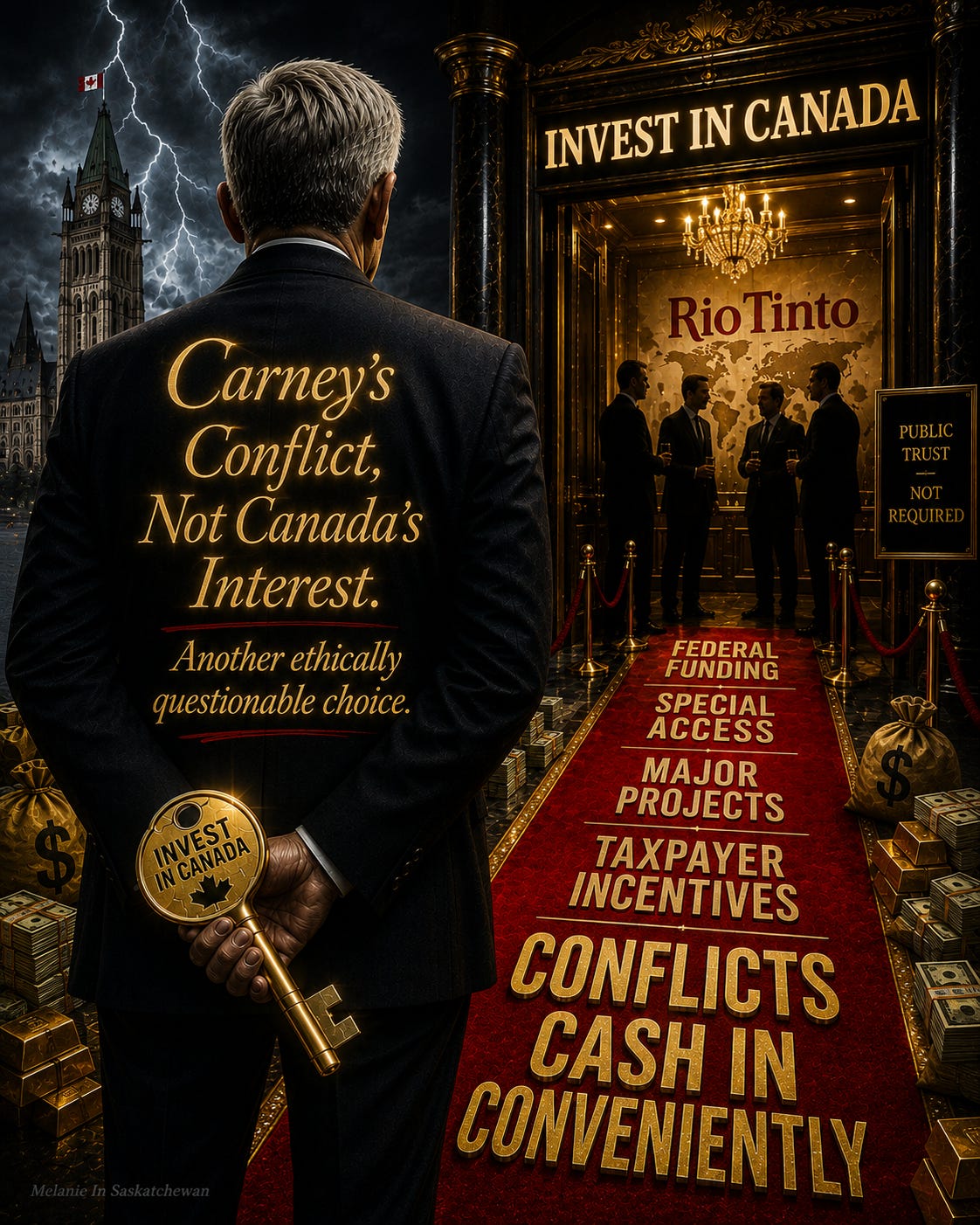 Imagine your town council hires the owner of the biggest construction company in town to chair the office that helps builders find public money, reach government officials and get projects approved.
Maybe he’s exceptionally qualified. Maybe every rule is followed. Maybe whenever his company comes through the door, he politely excuses himself and goes for coffee.
Most normal people would still ask one fairly obvious question before handing him the keys: Where’s the firewall?
On August 31, Prime Minister Mark Carney appointed Dominic Barton as the part-time Chair of Invest in Canada for three years. Invest in Canada isn’t a ceremonial maple-leaf brochure rack. It’s the federal agency responsible for attracting and assisting foreign investors. And Carney is expanding its role.
The government says the agency will guide investors from “initial interest to shovels in the ground,” work with some of the world’s largest investors and coordinate with the Major Projects Office on energy, critical minerals, artificial intelligence and infrastructure.
Ottawa also says approximately $280 billion in federal capital investments and incentives over five years will help generate more than $1 trillion in total public, private and institutional investment.
Invest in Canada doesn’t control that $280 billion. That’s an important distinction.
But it is being positioned as a doorway into the investors, projects, governments and agencies swimming around in that enormous pool of money. And the man Carney just put in charge of the doorway? He helped design it… Barton built the concierge desk folks.
In 2016, Barton chaired Justin Trudeau’s Advisory Council on Economic Growth.
That council recommended creating a new federal foreign-investment agency. Its proposal was remarkably candid about what that agency should do.
It would develop a pipeline of investment deals and help close them. It would help investors navigate financial incentives and regulatory approvals. It would coordinate services across government, involve senior officials in priority deals and provide investors with a single point of contact offering “concierge” service throughout the investment life cycle. Not a pamphlet… not a phone number... a government concierge with access. And so, Ottawa subsequently created Invest in Canada.
Ten years later, Carney has chosen the architect of that concierge model to chair the board supervising it, just as its reach is being expanded. That’s certainly efficient. But Barton has another job. Actually, two.
He remains Chair of Rio Tinto and Chair of LeapFrog Investments. Rio Tinto is a massive multinational mining company with major Canadian aluminum, mining and critical-mineral operations.
Energy, critical minerals, and infrastructure.
Those words may sound familiar. Possibly because they’re among the sectors Invest in Canada has now been told to help attract billions of dollars into. It’s interesting how small Canada becomes when government incentives are involved.
Rio Tinto already knows Ottawa’s funding window and Rio Tinto’s intersection with the federal government isn’t theoretical. In 2023, Ottawa committed up to $222 million through the Strategic Innovation Fund toward Rio Tinto Fer et Titane’s Sorel-Tracy project involving critical minerals and lower-emission technology.
In May 2026, Ottawa announced another $100 million for Rio Tinto Alcan’s ELYSIS demonstration project in Jonquière. Federal records also show an $18.95-million contribution to Rio Tinto Alcan in March for gallium-extraction research and development. And in August, Rio Tinto IOC was among participants in federally supported feasibility work involving mining-enabling infrastructure in Labrador.
None of this proves Barton improperly obtained a nickel for Rio Tinto. Most of these commitments predate his Invest in Canada appointment. That’s important, because there is no need to manufacture a scandal when the actual arrangement raises perfectly legitimate questions all by itself.
The issue is overlap.
Rio Tinto operates in precisely the kinds of sectors Carney wants Invest in Canada and the Major Projects Office to accelerate. It participates in federally supported projects. Its chairman now also chairs the federal agency helping global investors navigate Canada and get projects from interest to “shovels in the ground.”
Maybe every intersection will be managed flawlessly. Excellent! Show us how you plan to do that. Apparently we’re supposed to just infer the firewall.
A potential conflict is not the same thing as proving somebody committed an illegal conflict of interest. I have found no evidence Barton has improperly exercised his new position, mind you he was appointed yesterday. Unless someone has invented time travel between cabinet meetings, there hasn’t exactly been much opportunity. But conflict rules exist precisely because governments aren’t supposed to wait until something goes wrong before figuring out how to prevent it.
So, suppose Barton recuses himself whenever Rio Tinto appears directly on a file. Good. But what about a Rio Tinto partner or competitor? Infrastructure serving several mining companies, including Rio Tinto? An aluminum-sector incentive, a critical-minerals strategy, a foreign investor considering a partnership with the company, or a policy affecting the entire industry?
“He’ll recuse himself when appropriate” sounds wonderfully reassuring until somebody asks the rather inconvenient question of who decides what appropriate means.
And that’s the problem.
As of September 1, I could not locate a published conflict screen, ethics agreement, recusal protocol or public declaration specifically explaining how Barton’s continuing Rio Tinto and LeapFrog roles will be handled. The appointment is brand new. An internal arrangement may exist, and some disclosures may not yet be due.
So the absence of a publicly available firewall today does not prove there isn’t one. It proves Canadians haven’t been shown one. For some reason, that rather predictable question didn’t make it into the glossy announcement.
And then there’s the Invest in Canada CEO, because apparently one obvious governance question wasn’t enough.
Carney also appointed Gurinder Grewal as Invest in Canada’s full-time CEO.
The government’s announcement describes Grewal as the Founder and Managing Partner of MEM Growth Partners. The CEO runs Invest in Canada’s day-to-day operations, yet the announcement doesn’t explain whether Grewal has resigned from MEM, taken leave, divested interests or established a conflict screen concerning the firm. Those arrangements may exist or may still be underway.
Again, that’s not evidence of wrongdoing. It’s merely another example of Ottawa making an appointment involving private investment interests to a federal investment agency and somehow failing to anticipate that Canadians might ask about the private investment interests.
Who could possibly have foreseen it?
This really shouldn’t be complicated. Carney’s government should publish Barton’s terms of appointment and explain exactly how his continuing interests with Rio Tinto and LeapFrog will be handled. If there is a firewall separating his private corporate responsibilities from his new public role, show Canadians what it is, how it works and who is responsible for enforcing it..
Tell Canadians who identifies files requiring recusal, who replaces Barton when he steps aside, what information is withheld from him and how broader sector-wide matters are treated. And the government should explain Grewal’s continuing relationship, if any, with MEM Growth Partners.
Nobody needs to accuse Dominic Barton of corruption, and nobody needs a conspiracy theory. The facts are interesting enough on their own.
Barton helped design Ottawa’s investment concierge. Carney has now put him in charge of the agency operating it while dramatically expanding its role in the government’s investment strategy. At the same time, Barton remains chairman of Rio Tinto, a multinational operating directly inside several of the sectors being promoted and already involved in federally supported projects.
Maybe the firewall is magnificent. Maybe every possible overlap has already been anticipated, documented and sealed tighter than a Liberal minister’s briefing notes during Question Period.
Wonderful.
Then show it to us.
Canadians have been lectured about transparency, accountability and public trust for years. We shouldn’t have to rely on what increasingly seems to be Ottawa’s favourite conflict-of-interest policy:
Trust us.
Melanie in Saskatchewan