

 I opened my first Instagram account in 2016 as a young teenager. At first, it was simple. I saw the photos my friends posted, along with the occasional celebrity update, and that felt like the entire world. Online “stranger danger” did not feel as alarming as it does now, though perhaps it should have been. I even formed friendships with people across different countries, something that felt exciting and expansive at the time. As I spent more time online, I gradually became exposed to a specific kind of man who seemed permanently aggrieved. They were cynical and carried a constant sense of victimhood. It was difficult to find a single genuinely joyful or generous thought in what they shared.
We called them internet trolls. At the time, their presence did not seem especially alarming. They could even be entertaining in a sharp, sarcastic way. What set them apart, however, was their consistent inability to celebrate their own successes or anyone else’s. And as time passed, internet trolls began forming their own sub-communities. They renamed themselves based on their niche ideologies and began actively recruiting more members into their dangerous online spaces that included manosphere forums and incel boards.
 The Red Pill
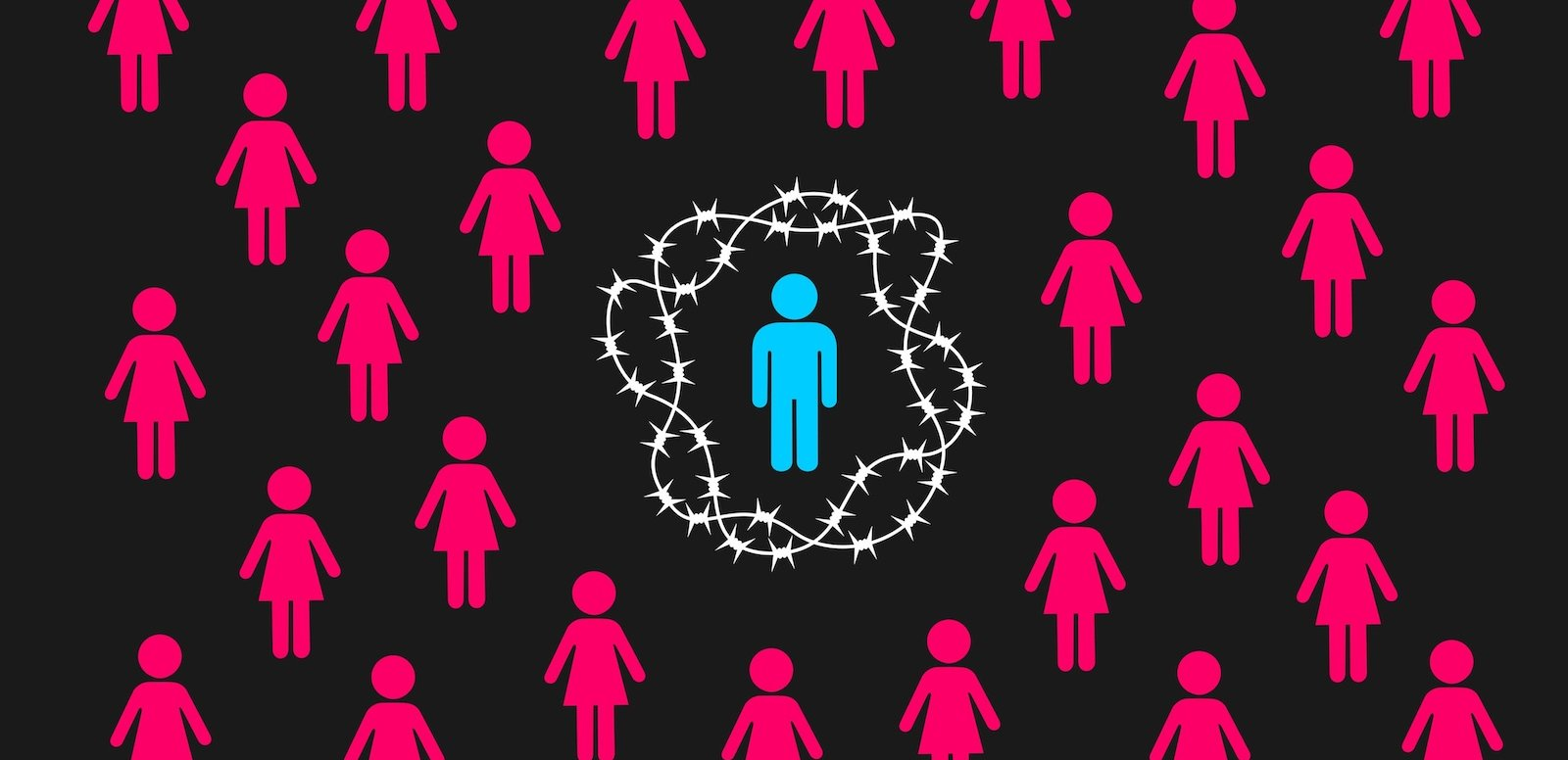
In the 2020s, pill culture began spreading online. Starting with the red pill, which references the 1999 blockbuster "The Matrix", in which Neo, played by Keanu Reeves, is offered a chance to see the world the way it is if he takes the red pill, and if he takes the blue pill, to return back to his normal existence. Pills work in an odd way. Neo, in the movie, 'feels something he can't explain... that there's something wrong with the world', which is why he chooses the red pill, because it offers him the 'real' truth and the ability to see the 'real' world.
Now I cannot emphasize enough on how this is just a movie. It's not real, it's science-fiction. Unfortunately, for young boys who lack a sense of belonging or community, it began to function like a religion. The ideology offered a rigid worldview, and sadly, the wrong sense of purpose to them. Many contemporary extremist movements operate primarily online and incel culture is no exception. These spaces exist largely on anonymous forums and platforms, and members rarely meet offline but remain deeply connected digitally, making the internet their primary mode of contact and radicalization.
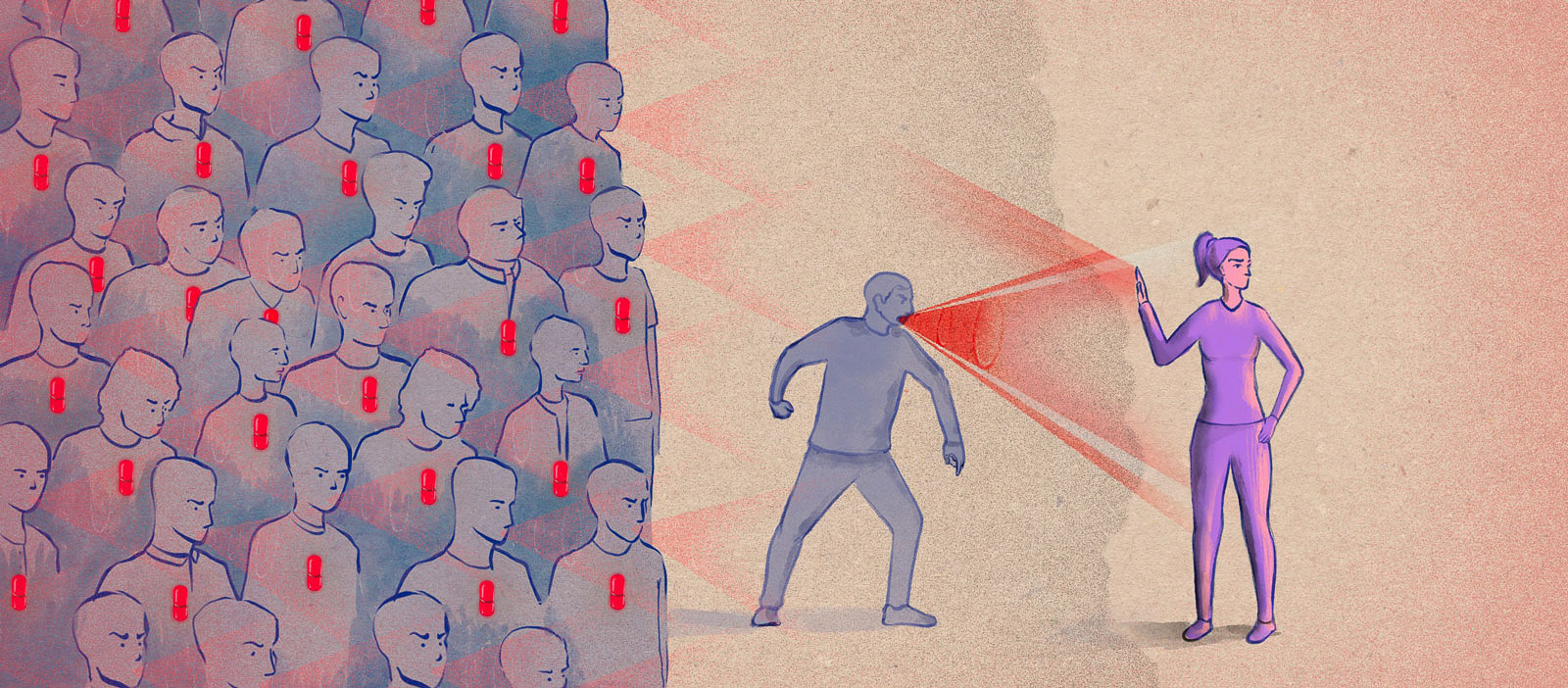 The red pill movement is thus a manosphere-based subculture that believes society is biased against men due to feminism, advocating that men are the truly oppressed gender. It promotes 'taking the red pill' to recognize this supposed reality, often involving misogynistic, anti-feminist views and, in some cases, overlapping with far-right and extremist ideologies. Adherents, often referred to as 'red pillers', believe in a society where feminism has caused a decline in traditional masculinity, arguing that men must protect themselves from female manipulation and social bias. Which brings us to the question: are these 'pills' simply identity markers, or are they constantly evolving dangerously into creating gateways towards fatalistic, nihilistic worldviews with real world consequences?
Let's take the Plymouth Shooting in the UK in 2021. Jake Davison killed five people, including his mother and a three-year-old-girl, and was known to be fascinated by violent heroes of 'incel' ideology. On the afternoon of the shootings itself, he viewed an online thread asking why 'incels' felt the need to end their own lives and looked up posts on kidnapping. Davison's internet history referred to 'violence, misogynistic views, and indicated an extremely hostile relationship between him and his mother... he referred to people idolized in the incel community for perpetrating mass killings.' This case reflects a broader pattern of documented overlap between incel forums and extremist violence.
Adolescents and community
Being a teenager is one of the most confusing parts of your life. You're not a child, nor are you an adult. You're stuck in the middle where if you act childish, you're criticized, and if you act like an adult, you're still criticized. You can't win. Teenagehood is usually where people begin to find communities where they feel they belong. Teenagers seek community to fulfill a fundamental need for belonging and identity formation. Driven by brain development focused on social acceptance, they connect with peers to reduce isolation and gain validation. But all validation is not good validation.
 Red pill communities validate the most vile and misogynist beliefs a teenage boy could have learned from his peers, the adults around him and the internet. The adolescent brain is hardwired to prioritize social interaction and acceptance, and when dangerous misogynist thoughts are being validated, it's only a matter of time before the boy is completely unable to be removed from his mindset. In this mindset, he believes he is truly right, and anyone who challenges him has simply taken the 'blue pill'. The community utilizes a combination of cult-like psychological tactics and social isolation to prevent members from leaving, often using disproof and contrary evidence to further radicalize them. By treating any counter-argument as proof that the person simply hasn't “woken up yet…”, the community turns skepticism into a reason to invest further.
The Black Pill and its damaging effects
Black pill, the extremist version of the red pill, refers to the nihilistic, fatalistic ideology adopted by members of the incel subculture that represents an extreme, despair-driven extension of the red pill philosophy. Black pill suggests that sexual desirability is determined entirely by genetics and physical appearance and that it's impossible for certain men to improve their romantic prospects. For teenagers going through both physical and emotional change, it functions as a psychological trap that validates their deepest insecurities and preys on it by creating social isolation. The black pill ideology offers an all-encompassing view that explains that their failure with the opposite sex is not theirs to blame, but external, unchangeable factors (genetics/social structures) fault instead.
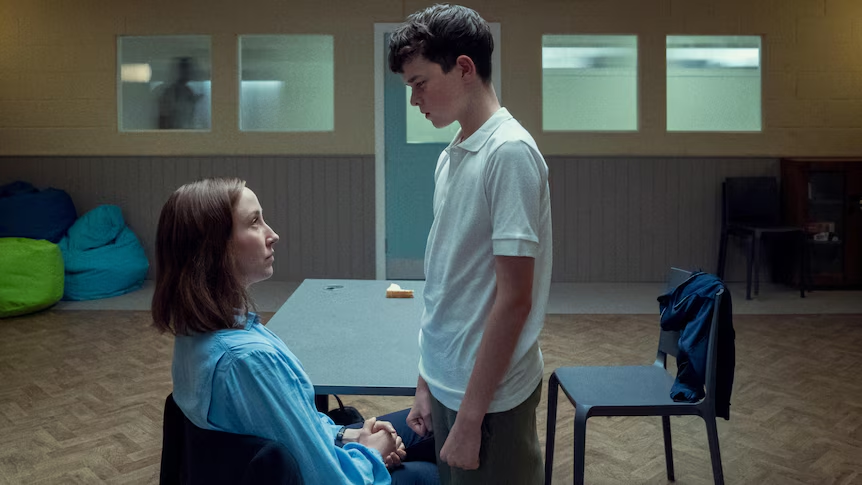 This creates a damaging cycle in which teenage boys absorb misogynistic ideas they have encountered throughout their formative years and come to see them as confirmed truths. When those beliefs go unchallenged, they can solidify into rigid attitudes that shape how these boys relate to others, potentially increasing the likelihood of controlling or violent behaviour in intimate relationships.
The Pink Pill
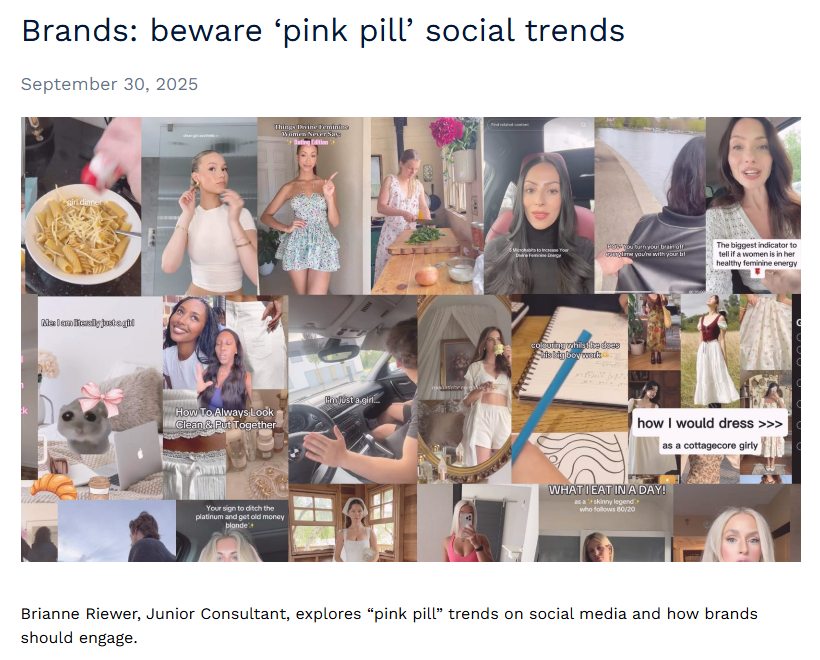
As a twenty-something year old, I, like my peers, spend a lot of time on the internet. And within my hours of doomscrolling, there's a new type of content that's been popping up on my social media. Misogynist posts are normalized now, they shouldn't be, but they are. But seeing Pink Pill content was new, and upon a little bit of research, I was surprised to find barely any information about it online. It was something new, something still in its budding stage, but something that had to be nipped immediately.
Pink pill content is the female equivalent of the incel black pill subculture. It signifies a 'pink pilled' realization by some women (termed 'femcels') that, regardless of their adherence to traditional femininity or beauty standards, they may never find romantic success or validations from men. Somehow, even though the pink pill was 'for' women, it was still about a man. Sigh.
Not unlike the black pill that takes advantage of young boys in their formative years, the pink pill takes advantage of young girls in their formative years. The tricky navigation of teenagehood just became trickier. Let's just bury emotional maturity now, shall we? We're teaching young girls that it's better to internalize their feelings and blame external factors for their inability to find romantic partnerships and turning them into spiteful women. And while this doesn't directly correlate to female violence, like the black pill does, it still has quite unpleasant consequences.
Unlike the red pill that asks men to 'wake up' to perceived societal disadvantages, the pink pill, like the black pill, focuses on the specific, despair-filled, experience of women who feel excluded from romance. Pink pillers believe deeply that men are inherently exploitative, violent and incapable of genuine emotional connection. They use blanket statements such as 'all men cheat' and 'all men want is sex', which justifies men's actions when they proceed to prove them right. We can no longer hold men accountable if they're just following their 'biology', right?
 Reliance on pseudo-scientific charts
Black pillers and pink pillers both draw heavily on distorted interpretations of pseudo-scientific charts to justify their fatalistic worldviews and make it look empirical.
The most common is the '80/20 rule', a distortion of the Pareto Principle developed by Vilfredo Pareto. Originally an observation about wealth distribution, it is reframed in dating discourse to claim that 80% of women pursue the top 20% of men. In black pill spaces, this becomes "proof" that most men are genetically doomed, and in pink pill spaces, it is used to argue that 20% of women are left competing for scraps.
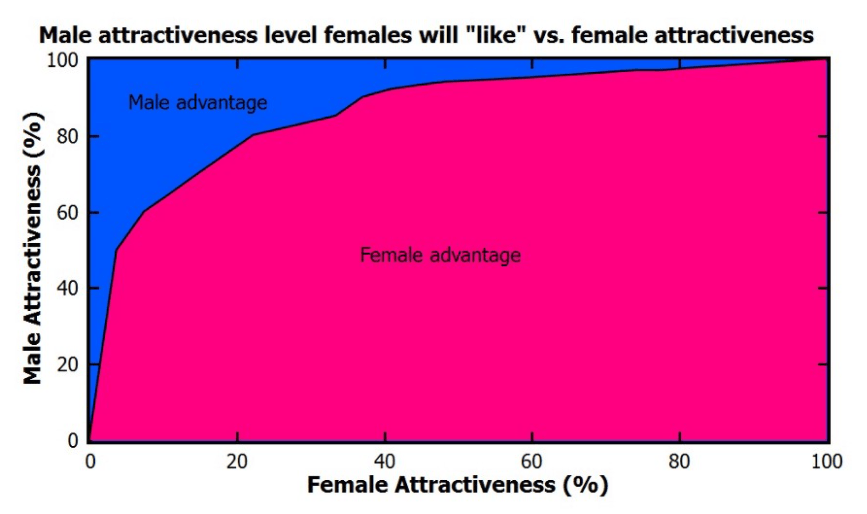 Another widely circulated chart is the 'sexual marketplace value' (SMV) chart. This assigns numerical value to men and women based on age, looks and perceived fertility. It typically shows women's "value" peaking in early adulthood and sharply declining with age, while men's "value" rises later with status. These graphs ignore culture, class, race, personality, socialization and character, reducing human relationships to market transactions.

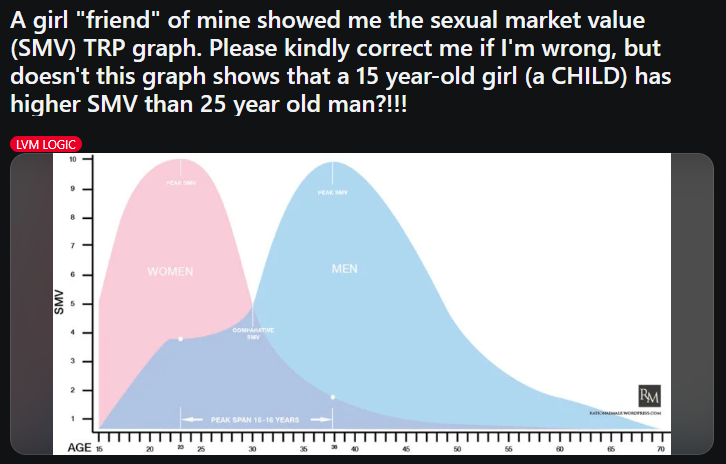 Both ideologies rely on distorted charts, claiming that women are biologically wired to seek only the "highest-status males". These are presented as hard science, despite being speculative and unsupported by rigorous social science research. The pattern is the same across both black and pink pill spaces; to flatten complex social dynamics into deterministic charts.
Distinguishing between feminism and pink pill ideology
Unfortunately, pink pill spaces often present themselves as a branch of feminism. But it must be noted that the resemblance is purely language, and not even the slightest bit theoretical or political. Feminism is diverse and historically rooted in organized movements for social and legal reform. It is grounded in decades of scholarship and political struggle aimed at dismantling oppressive systems. Pink pill ideology does not emerge from that tradition. It is primarily an online subculture shaped by algorithmic amplification and identity formation around shared romantic frustration. It builds community through pessimism and grievance.
The distinction becomes clear through how feminism and pink pillers treat the patriarchy. Radical feminism treats patriarchy as a social system that must be challenged and overthrown. Its premise is that gendered behaviour is socially produced and therefore changeable. Pink pill ideology frames men as biologically fixed and inherently predatory. This leans towards fatalistic essentialism rather than structural critique. If men are unchangeable by nature, then political transformation becomes meaningless.
By adopting feminist terminology while abandoning its structural and political goals, pink pill spaces create the impression of feminism without any substance. The result is an ideology that speaks in feminist language but replaces transformation with resignation.
Unfortunately, pink pill ideology doesn't just cause damage on the internet, it also causes real world issues. Firstly, as mentioned before, pink pillers frame men as biologically predatory and emotionally unavailable. When these failures are presented as fixed and universal, the patriarchy can never be dismantled. However, the biggest damage the pink pill causes, is the pitting of women against each other.
Pink pill spaces reinforce fatalism and competition amongst its believers. When women are constantly exposed to narratives of inevitable betrayal and hierarchical desirability, it causes a sense of loneliness and hopelessness. Women begin to only see themselves through the lens of attractiveness rankings and ageing and vulnerability becomes a sign of decline. This causes divisions among women itself. Feminism has always been about giving women a world where they are able to freely choose what they want to be, without any undue influence. However, married women, women in relationships and women that hold different feminist perspectives become labelled as complicit and naïve to pink pillers, since they do not subscribe to their ideology.
Is the pink pill simply the other side of the same coin as the black pill?
Structurally? Well… yes. They sound similar enough. They both rely on fatalism and biological determinism. They both reduce complex systems into singular one-lined, attraction markets, "proven" through inaccurate pseudo-scientific charts. However, in the outcome, they differ. Black pill ideology has produced direct violence towards women. Pink pill ideology has not produced comparable physical harm towards men.
Pink pillers may express hostility towards men, but it doesn't translate into systematic discrimination or legal subordination, like misogyny does. Instead, it intensifies women's isolation, reinforcing the very hierarchies that feminism seeks to dismantle.
We also need to recognize context. Many women that enter pink pill spaces do so after prolonged exposure to sexism and objectification. Simply because someone is not conventionally attractive, that does not give society the right to treat them any different. However, it is not so simple for women. Women are judged heavily based on how young they look, how put together they look, how they smell, how they do their makeup, their hair, how their clothes hang on them. And over time, negative experiences concerning these judgments produce exhaustion and a need to find a community of women who all feel the same. Finding community is healthy, but joining a community that actively preaches damaging ideology is not.
In that sense, the pink pill ideology doesn't emerge from nowhere. Women who feel that they have followed every prescribed feminine rule and still encountered devaluation may come to see fatalism as self-protection. The belief that men cannot change can feel safer than hope that has been disappointed.
However, when that protective anger solidifies into the conviction that transformation is impossible, it makes it harder and harder for us to ever leave the patriarchy. When structural harm is reinterpreted as natural law, political change becomes impossible, and in an attempt to shield themselves from further damage, women internalize the same logic that supports patriarchal hierarchies. But we cannot just stop at identifying the issue. Resistance to this ideology would mean creating healthier online spaces where men and women can process exhaustion without allowing it to funnel into fatalism; a space where we can speak honestly about the sexism we face on a daily basis, while still understanding that social systems are a construct and are therefore changeable.