
Flagstaff, Arizona is a beautiful town in a beautiful setting, surrounded by National Forests and only 90 minutes from the Grand Canyon. It has become a sort of retreat for those who want to escape the sizzling summer of the greater Phoenix area. And, it has the historic route 66 that runs through the heart of the town thus making it one of those places that has been celebrated in literature and song.
Route 66 still holds the imagination of those who just wish to “chuck it all” and head out on the road. Starting at Lou Mitchell’s diner in Chicago and ending at the Santa Monica pier in California, the “mother road” was at one time, the way to make your way across ¾ of the United States. Some parts were paved, some were bricked and even some parts had cobbles, but it was, like her sister road the Lincoln Highway, drivable for the automobile. The road came into being during the 1920s and only became fully paved during the 1930s, just in time for the great Dust Bowl migrations from Oklahoma to California.
The highway, in many ways, gave America a cultural sense of self. Up to that point, we had the railways that were much like the airlines of today. The idea was to get from point A to point B with some comfort, much speed and efficiency. Though travel by rail was indeed something to enjoy by the early 1900’s, it was a group effort. People would ride that train to a destination, again much like people clambering aboard a plane. But it was the automobile highway, with the notion that a person could determine where they wanted to go, how far they wanted to go or even how fast they wanted to go that was unique about Route 66.
And it wasn’t until World War II when Americans were surprised to view the Autobahn of Nazi Germany for the first time. Here was a system that was built in that idea of efficiency, like the railroad, in order to move troops and war material. That idea was embraced, especially as it became clear that truckers could now move more material to more places with such a system. And so, the Interstate was created.
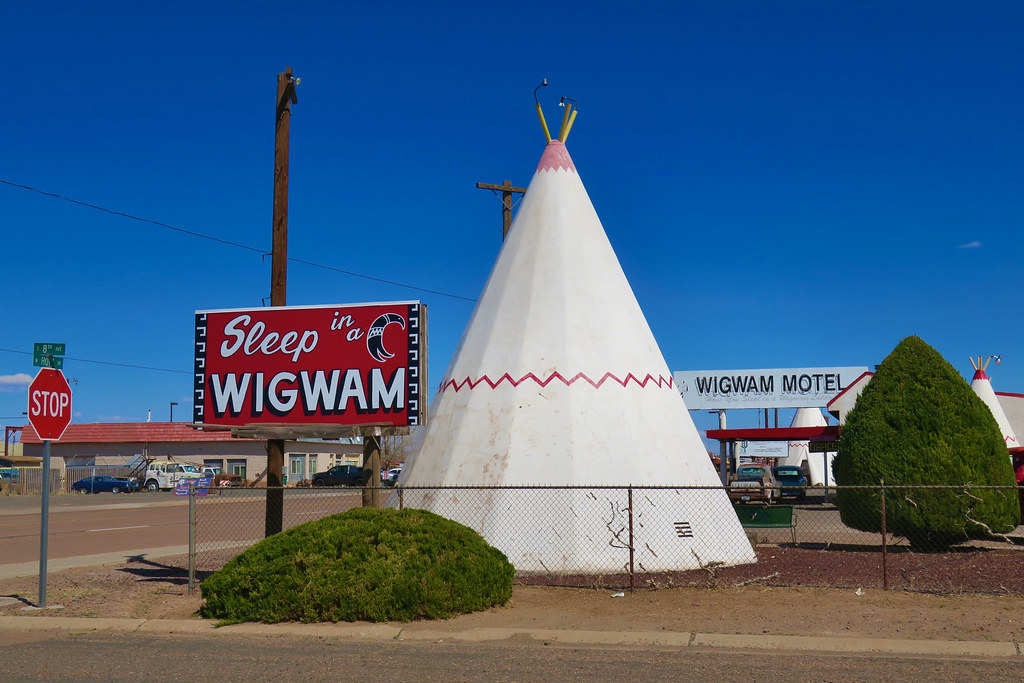
When interstate highways started being built, Route 66 became archaic. It was designed for an era in which travel was more adventure and less “getting there.” And I think that is what people still yearn for when the effort to retain sections of the old road are made. In Flagstaff, along the old route, there are still some of the motels that have great neon signs with covered wagons and small, individual cabins. Thankfully, these places are being restored, as their owners know there are plenty of people who long for nostalgia. People who ran these early tourist stops created points of interest: the leaning water tower in Britten, Texas or the Wigwam motel in Holbrook, Arizona. Such places were fun and fit hand in glove with the novelty of the auto. How wonderful that many of these places were not abandoned, but in fact have been kept alive and made part of a happy history of a more carefree America.
The highway as a single entity is no more. Some parts were subsumed into the interstate system and usually a “historic Route 66” sign will be displayed. Yet, there are still stretches of original road that invite the true fanatic to drive along. And there is something to be said about driving along those stretches of road that once was the superhighway of America. Faraway and truly lonely places were interconnected. The people who lived in those lonely places were treated to the exotic, curious traveler. In turn, the more enterprising of those people in the lonely places did their best to entice those travelers to spend the night, get a meal or take in the sights.
While out in Flagstaff, I drove along a section of Route 66 as it curved through the sparse pine woodland. Looking out the window, I imagined what it must have been like for those people, driving 40 miles per hour, no air conditioning but windows wide open. The radio playing local stations, local music and in the town, a chance to rest in some “western” motel and find a good restaurant with a nice sized steak. It was a time of adventure and when adventure was allowed to take time. I was lucky to grow up at the sunset of such a type of adventure, when the road was king and a trip west was exciting. And I know that love of such travel still is a big part of why I am a travelling musician today. How ironic that my brief run on Route 66 in Flagstaff would soon be over, to be replaced by my heading on I-17 to Phoenix, then to the airport and five hours later, whisked back to Chicago. All the convenience, all the speed, but very little of that exciting adventure when one did “get their kicks on Route 66.”
READ MARTIN'S OTHER BLOG HERE.