
Thank you for listening to the Making Lemonade Podcast!
Please remember to subscribe, share, review, rate and, if you can, support the making of this podcast by donating here on BMAC, or by becoming a member of the Lemonade Makers. You'll find information on how to do that at the top of this page.
I'd love to hear from you - your thoughts and reflections on what you've heard (things you've liked/haven't liked, things you'd like to hear more/less of), your own experiences, and suggestions for people who you think would make brilliant guests.
You can contact me by emailing [email protected] or by messaging me on...
Instagram or TikTok - @markmakeslemonade
Twitter/X - @immarkosullivan
If you've been affected by anything you've heard in this episode, please take care of yourselves, and consider visiting (or contacting) any of these organisations:
www.mind.org.uk
https://www.samaritans.org
TRANSCRIPT
[00:00:00] Hi everyone. Before we jump in a note on our content this episode contains themes and discussion that might be upsetting or triggering for some listeners. Please check the show notes for more detailed descriptions And look after yourself.
Hi everyone. Um, [00:00:30] right, this episode's a, a strange one because it's,
it's me and my guest talking about someone else's lemons and lemonade. And it's also actually a bit of a reunion. People who've been listening to this podcast since the beginning may recall, if you think way back, me talking about a person called Bridget, who was a friend of our family when I was growing up, and who, who had a massively profound [00:01:00] effect on me and my childhood and my life.
Bridget was. Elderly, unmarried. She shared a house with her brother who was also quite old who was also retired. And
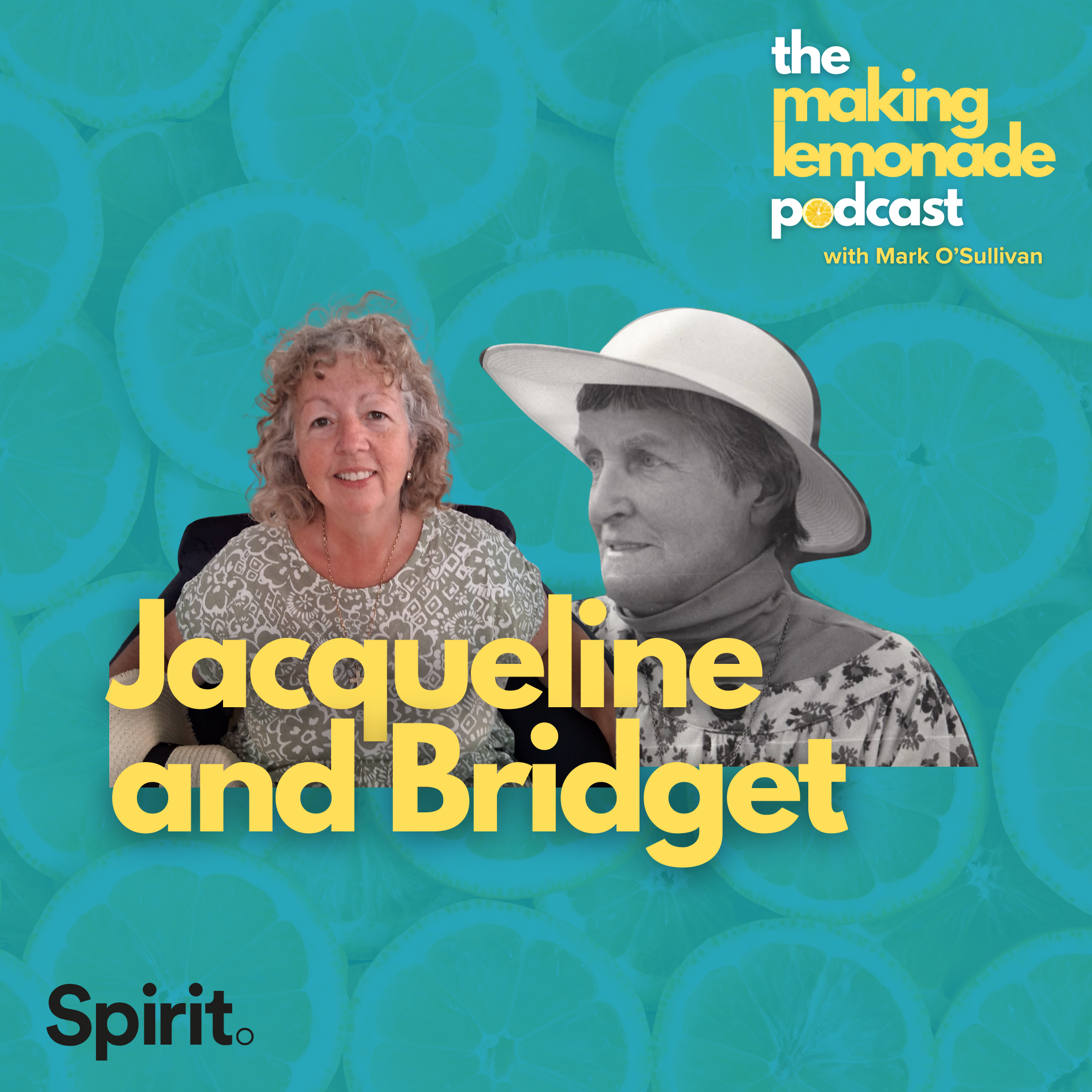
all of the children from our estate at some point had spent time around Bridget's house playing, being creative. But a few of us stayed on much longer. And the person I'm talking to [00:01:30] today is Jacqueline Duffy. Jacqueline is actually Bridget and Jim's great niece.
And, and when I was growing up and going around Bridgette and Jims, I used to hear about Jacqueline and her family a lot and used to meet them occasionally. And Jacqueline, I'm sure she won't mind me saying, is, is uh, about 17 years older. Than me. And the last time we spoke was when Jim Bridget's brother had died, which was a couple of years after Bridget herself had died.
We haven't spoken [00:02:00] since, but just as I started making this podcast, I got a message on Instagram from someone saying, are you the Marco Sullivan? Who? Dot. And it was Jacqueline. I can't tell you how pleased I was to hear from her, because I'd always wanted to know more about Bridget and Jim.
I'd always wanted to talk to someone about Bridgette and Jim who knew them, and no one knew them better than Jacqueline.
What I never appreciated was quite how many lemons life had thrown [00:02:30] at Bridget and Jim and, uh, and their other siblings. And Jacqueline has been researching their lives and, um, wanted to share with me some of what she's found out. I really hope you enjoy this episode. I to say I enjoyed recording it would be such a massive understatement.
I could have carried on talking for hours and hours. It's a story of resilience as you'll hear, and kindness and the [00:03:00] perfect story of turning those lemons into lemonade.
Jacqueline, I was trying to work out, how many years ago did we last talk? It would've been when Jim died, wouldn't it?
It was at Jim's funeral and Jim died. Oh. I've just, I've got my book out with all my birth certificates and everything. Jim died 2002.
Was it as late 2000? Thought it was earlier. So two, three years.
[00:03:30] James.
23 years. And I've actually got a photograph of you either his in the, in the garden, either at his funeral or it's Bridgets and you are just walking through. You're a young man. I
you know, I still miss that garden. It was so lovely.
I think of that garden and their house.
Oh, all the time. All the time.
do you remember she used to hang things on the back of doors as well. She had little screws and Well,
I've got, I've got that wall hanging with the knight on it.
Have
you? Yeah.
And do you remember that picture that looked like a [00:04:00] nun? And it was terrifying, wasn't it? The eyes followed around the room.
Yeah, it probably was a nun
Yeah, I remember it really well. So, so that Howling Nun is probably from True Life because of course she was reared by the nuns.
Jacqueline, if you, right, if you had to explain how we know each other, 'cause I was thinking about this all morning. I was thinking how on earth do we explain this relationship? Um, so I thought best thing I can do is just hand it over to you and see if you can explain [00:04:30] it.
Yeah, of course. Yeah, of course.
Okay. I imagine that my, that Auntie Bridget, who I also call Auntie Birdie.
Yeah.
Because when we were children, we called her Auntie Birdie. She, um, was a member of the Parish Catholic church.
And that's, I believe, where she met your mom and dad.
Yeah.
That's how she knows you.
That's right.
Now you, I am about 17 years older than you. I was born in. Don't broadcast this, but I was born in 59. Yeah, that's, you were [00:05:00] born
76, so about 17 years. Yeah.
Yes. Yeah. So, we, I always knew the minute she met you.
We knew she met your mom and got on really well with mom, and she started looking after you. And your mom was a nurse. Of course.
Yeah.
And Bridget loved your mom. I mean, really loved her. And, uh, she was always worried about her health because your mom had bad asthma, didn't she?
That's right.
Yeah.
Bridget had started looking after you in the day, and of course you were this beautiful [00:05:30] little blonde mop. Um, you were like, um, the guy out of Oliver Twist, you know, is that the right one I'm thinking about? Yeah. Just this, I'll take that, Bob. Yeah, no, you were, you absolute. And we always heard about you.
Um, and so I probably met you when you were about three or four. That's the earliest I can remember. So I, one of the things I was always very grateful for was her, her, me, you and her becoming close because I was 17.
in those years wasn't going as [00:06:00] much. Later on when my children came along, I went more often, but there was that feeling that we'd done so much and we meant so much to her. It's a bit, you know, that that song puff the Magic Dragon.
Yeah. It always makes me cry that song. And when Jackie Paper comes no more still breaks my heart. And so I think when you came along I thought, oh, this is great because we are not going so much. We knew how much we meant to her and then now she's got you. So we took a great [00:06:30] interest in you and she always talked, I dunno what she said about us, but she always talked very highly of you, how artistic you were, how creative, and just how much she adored you and Jim too.
Well it's, it is same. And you know, I even. I was aware of you from a very, very, very young age. It, whether or not I saw you that often, she was, they were both always talking about you and your brothers and yeah. So I think, I think we all meant an awful lot. An awful lot to them [00:07:00] and um, yeah.
Yeah. And yeah, and I think so before my parents and Bridget and Jim lived on that road, they all lived actually on the same road in a different part of town. And they were, they all moved there when that street was demolished. So I think they'd known, yeah, I think they'd known each other for decades.
And there's a story of, I dunno if you remember where Bridget and Jim lived. It was on a kind of a circle and we lived one side of the circle and [00:07:30] they lived the other side. That's right. And there were these old people's flats midway between. That's right. And yes. Yeah, there's a story of, my mum used to take me round to see Bridget for coffee every morning.
And one morning my mum, um, Bridget was at her house by herself and I just walked in and she thought my mum was kind of following after, but sort of 10 minutes went and 20 minutes went. And I was only sort of two or three. I was tiny. And, um, Bridget, she always used to tell this. She phoned up my mum and said, [00:08:00] um, you, um, have you got Mark with you?
She said, oh, my mom said, yeah, he's been, he's been playing in the garden good as gold. So quiet. And she said he's not, he's here. And I'd walked around and I crossed the road myself. And apparently as my mum ran round. There were two of the old ladies hanging out of their window saying, it's all right. He's gone to Bridget's.
And it's watched me walk around '
cause I just knew
where to go. Oh.
So Bri,
when I, I talk about Bridget a lot. I tell and actually it's one of the reasons that [00:08:30] we've connected because obviously you, you sort of, I think you saw one of my TV programs and got I
did. I did.
And got in touch. I did. And can
I, and can I tell you I was gonna tell you this face to face if we met, but when it started your pro, the program started and you said it wasn't a member of my family, it was somebody close to my family, or known to my family.
For a second, my heart stopped. I thought, please don't tell me [00:09:00] he's gonna say something about Bridget and Jim, something bad. 'cause I was thinking, I was thinking all of these memories I've got and then I saw Tony. And I thought Tony wouldn't be there. She wouldn't be there if it was them. So I thought, oh, that's good.
But I was terrified because I was thinking, these people that I've adored, please don't tell me that somehow they've done this something or this to you. But, um, then I breathed a sigh of relief and I suppose because I was relieved, I wanted to sort of, you know, just catch up with you then and, and make, you know, [00:09:30] just find out what your memories were.
And I've, I've thought of you and your family an awful lot over the past 20 years or so, and there've been a few times when I've tried to look you up and thought, well, I wonder like, which Google search will do it because. Bridgette and Jim meant so much to me, and I kind of a bit like my own parents who, as you know, sort of died before Bridgette and Jim both died.
Yeah. There's so much I don't know about them all, and I, I'm one of those people that [00:10:00] really loves to know people's history and, and how, how people have got to be the people they are. And so when you reached out and sent me a message, oh, I couldn't tell you how over the moon I was. And and then of course it was around about the time that I started doing this podcast and you started listening to it and sending me really lovely messages about it.
So I thought at some point I've got to get you onto the podcast to, for us to talk about Bridget and her lemons and her lemonade, but [00:10:30] also what it's meant for you and for me and how it's shaped out how those people have shaped our lives.
But it's lovely 'cause I can talk to you and you are not, you know, you you want to hear those things too.
Oh, I do. And you, you mentioned your mom and your dad now, Bridget lived in Ance Road.
That's right in, well, is that, that's where we lived, around the corner. Yeah.
Is that there? Bridget lived there, I think on her own to start with. And then Jim joined. Now there's quite a, a, you know, a big sort of circle that they went through [00:11:00] in their lives to get reconnected.
she was very, Bridget was very, um, very intelligent. And she, she did, she joined a lot of groups.
Yeah.
And she did the what's that?
National Savings and Investment. She used to go door to door with the little stamps. Did you get the little stamps from her? And she used to put them in a book, send us them at Christmas and encourage us to save. So I think that's, that's, good for her because Bridget and Jim could have been, uh, two lonely people living in a street that people said, we don't know much [00:11:30] about them.
They keep themselves to themselves. And some people, I don't think even realize they were brother and sister for a while. I
think a lot of people would've assumed they were a couple, you know, because Yes. That would be your automatic assumption, wouldn't it?
Yes.
Yes. So yes. So what was their story?
It's very sad, mark. So I don't know if you know any of it at all, but it, you know, we've got some lemons here for you. It really is heartbreaking. So, you know, you take it, you know, take it all in when you are listening to it again. Bridget. Was [00:12:00] born. Now let me see when she was born. Bridget was born in 1916, and Jim was born in 1919.
And their mom, mother and father, her mother was Mary, father was William. They lived in Wicklow in a, a, a little townland called Kpea in Wicklow. And sadly their mother died and Bridget was just, just five, five years old. No mother died. And there were there were five girls and three boys. [00:12:30]There was eight of them, and their mother died.
And, uh, the church in those days, and it really, up until even the sixties and seventies, the Catholic church would not allow a man to keep his children unless he quickly remarried. There was a bit of bitten that bitterness with with Jim, particularly in later years. He said, you know, dad, our father could have done more to have kept us or to have kept in touch with us.
And he'd sort of looked into it a bit. So sadly what happened is, you know, Bridget was my granny's [00:13:00] sister. Yeah. That's, that's my connection to Bridget. So my mum's great aunt, and, uh, she she was only five, and my granny was about 10 or 12 when her mother died. So there were three older, there was a boy called William, there was Anne, who I, I believe you've met.
Very colorful, very scary, very colorful. She is an example if you set her against Bridget, of someone who didn't cope with what happened to them. Whereas [00:13:30] Bridget had such resilience and courage and endurance that she did so side by side I've been able to see how one fared better than the other. Maybe the factors that were involved in that.
So my granny was the oldest and she was just about 11, 12. She was taken, all of them, EV except the boys. Not the boys, including Jim. All the five girls were taken by the church and put in the all, and put in the workhouse to start with. And then they were [00:14:00] split up and sent to different parts of Ireland.
That's the way it worked. And they were in the clutches. They were in the clutches of the Sisters of Mercy. Now, maybe I shouldn't say things like this in the middle of this because my mother used to call 'em the Sisters Without Mercy.
Oh, I thought, I think I agree with that. Yeah. Stories I heard. Yeah, they,
they.
Imagine a little 5-year-old, I mean, you've got a daughter. I've got a daughter, a 5-year-old. Your, your mum's died. They take you and they split you up. You [00:14:30] don't see your father again for years. Bridget got sent to Galway. Yeah. I'd never really got to the bottom of where Anne got sent, but she didn't go to Galway.
My granny was sent to Dublin to be a servant in a house. She was only 12 years old, so she was probably in the workhouse for a while and then trained up a little bit or put into an industrial school, as they call them here. Yeah. Trained up to wash and scrub and clean. And then she was, my granny was put into a, a house in Dublin to be a, a [00:15:00] housemaid and no mother and she, tiny, petite little woman, couldn't, she really wasn't made for that.
Made, she wasn't a big strong country girl. So Bridget ended up in Galway and, uh. She ended up, she went from the orphanage into the industrial school where they trained them up. And then she was placed in a school called St. Raphael's in Lock Ray in Galway. And she was there until she was [00:15:30] 14. Jim had been placed, uncle Jim had been placed with a relative, but he said it wasn't a good experience.
They didn't want the girls, they only wanted the boys, wasn't a good experience. Uncle Jim was very shy, very reserved sort of person. And, but he could get very cranky about things, you know. Oh, he had a fiery temper,
didn't he?
He did have a fiery temper, yeah. But he, he had, he said later in life, you know, Bridget saved me.
She just found me and saved me because he, he, his [00:16:00] experience was to be crushed and to be shy. So what happened is Bridget's 14, she's in, uh, in St. Raphael's. She's, it's a school. It's still there, it's still a school now, I think, for boarders as well. And she was working in the kitchens and she was stretching, washing, doing washing dishes, and she was stretching over the fire where the plates were stored and her dress caught fire.
I know, I, I knew you were gonna say that because you're gonna talk about her, her [00:16:30] neck on you balance.
Yeah. Not just her neck. Yeah. So she always like my mom. And my granny, they were, you know, in those days going back 30 forties, people were ashamed, particularly Irish people were very ashamed to, to tell the story that happened to their family, even though it wasn't their fault.
And they were at the mercy of the Catholic church. Yeah. So my mom would used to squash Bridget down all the time. Oh, don't don't believe it was, that didn't happen. She's just saying that, don't believe it. But of course I would get Bridgette to myself a [00:17:00] lot, so I'd be down there. We used to go down three times a year.
Loved it. Oh, absolutely loved it. I remember one day, mom, she'd tell us at the last minute, and I pulled out a suitcase, the suitcase from under the bed, opened it up in my excitement and got sick because we were going to Auntie Bridget's. And, um, so she, she, um, yeah. So anyway, she, she was badly burned and she ran.
She ran down the corridors and she said there was a man [00:17:30] working in the building and he took his cap off and threw it along the floor and tripped her up. Or a coat. She said half, but maybe coat, and then he got his coat and damped the flames out. Yeah. She was burnt from her knees to her neck. And when you knew her, you probably could see that her fingers were quite gnarled.
Yeah.
Um,
yeah.
But, and she had to learn to write with her. She was right-handed and she had to learn to write with her left hand. What she said to me, and I, I see it as a real comfort, I [00:18:00] asked her, what does it feel like to be on fire, you know, to be burned. Yeah. And she said, listen. She said, I didn't feel a thing, take comfort from this.
I didn't feel a thing. She said, I, I thought it was something solid and I was trying to push it away. While I was running, I was trying to push it away, she said, and then I don't remember anything for nine months. So she said being in a fire is, it wasn't scary but surviving a fire was really, [00:18:30] really tough.
This was 1930 in, in rural island where, penicillin was only discovered in 1928. How did she survive? I do not know. She was in a coma, she said, for about nine months. And she says that, she said that she remembered as she was coming, becoming more awake. The nuns. They were nursing her, the nuns turning her over.
She said, and if I didn't move quick enough, they'd slap me to make me move helpful. And and yeah. And [00:19:00] she said her legs, the skin on her legs were just, was just gone. Everything was gone on her legs. They were the worst affected because I suppose, I don't know the dress, it came up from there. Yeah.
So then she had to have, she had 50 surgeries to, um, and of course I saw her with no clothes on the skin. You know, she was always like this pulling up her.
That's what I, because I remember her neck. The skin graft. Yeah.
Yes. Yeah. Well that skin graft there was cold as [00:19:30] ice, just cold as ice. So I used to get, sit with her and I'd say, let me feel, let me feel.
And it was a whole panel there like that. That's right. That had come from her back. So where her back hadn't been really damaged, she then had to have all her skin grafts come from her back. And they were used for her legs. She was literally like a patchwork quilt. She was just flat. I mean, and nowadays you'd have special garments to wear.
Yeah, to try and ease it. You'd have all sorts of pain relief. [00:20:00] She had none of that. And, um, there, she stayed in hospital for two years and no visitors, no one came. Her father didn't come, nobody. She was just on her own in there. And she, she, she then spent the next 10, 15, maybe 20 years in and out of hospital.
And she told, she always said it to me, oh, she'll get upset now. She always said, don't let anyone know that you have nobody [00:20:30] because they'll use it against you. So do you know what she used to do? God love her. She used to. Get herself a card, ask somebody to go and get, bring her a card. One of the staff she wanted to write a letter to, her sister wanted to write a letter to her father.
And she got the card and she wrote the card and she wrote it to Dear Bridget, thinking of you, we are gonna get there to see you soon. She get sealed it up, gave it to the porter, it got posted [00:21:00] out, and it came back to her and she opened it up. Oh, that's lovely. This is from my sister. She sent letters and ods and flowers to herself so that people wouldn't know that she had no one.
I mean, what a thing. To even have the full and after and after all, she'd been
through already to be doing that. Yes.
Hey everyone.
[00:21:30] Just before we get back to the episode, I wonder if I could ask you a favor.
Every week I'm getting messages from people who are just discovering the podcast, which is so wonderful, but you can help more people to discover it by doing a couple of things. The first thing you can do is share it on whatever social media platforms you're on. The second thing you can do, and this is so important, is leave a review on whatever service you listen to your podcasts on.
If you could also leave a rating, and if that could be five stars, that would be great. And when I say five stars, I do mean if [00:22:00] it's out of five, obviously if it's out of a hundred, don't leave five stars because, um, that won't look great. and the third thing you can do, which would be such a massive help, is join the people who are helping support the podcast by clicking on the link to buy me a coffee, where you'll find show notes for each episode and also. A place where you can buy me a coffee or a couple of coffees, or even join the people who are becoming lemonade makers supporting the podcast on a monthly basis.
If you can do any or all of [00:22:30] that, I'd be so grateful. And now let's get back to the episode.
But she, you know, you hear that said here, you know about anyone who's come in, you know, touch with the nuns. My, my uncle, my mom's brother had an experience with the Christian brothers
He wouldn't go to school and they took him away from my granny and put him into Tain and he joined the band and he got really a good, he could read and write music and he traveled all over the country [00:23:00] playing in the band. And when I was 20 something I asked him, I said, did anything ever happen to you when you were at Artane?
And he said, oh, you must be joking. He said, Artane was only two miles from home. He said, they, I was in the band, they valued that they needed me 'cause I was the trumpet player in the band. He said, and we lived two miles away. He said, I'd have been over that wall and home, and my mum would've dealt with it.
He said they had, they had enough children from the countryside they could pick on. They didn't have to pick on [00:23:30] me. So that same mentality is there that Yeah, once you're in the clutches of these things, bridget ended up in England. And my, my thoughts are, it was Letchworth because she went there for burns for the burn specialism.
I think they're round about that area. There was burn specialists from the First World War
really?
And that's how, that's how she ended up in Hartfordshire. And I've got somewhere in my notes that she was in based in [00:24:00] Letchworth. Now round that area, there's a lot of American air bases it could be that it was, that they were there, they were, you know, centered there because obviously men from the first World War had terrible, terrible burns. Yeah. And so she was in, in, she came to England and she had various surgeries and I've seen her in um, a uniform Looks like a, she's she in the army. Do you remember the dressing table? I can picture that.
I can picture that photograph. And isn't there a, isn't there a man in that [00:24:30] photograph as well with her?
There is a man I know. And I used to say to her, was that your sweetheart? She never used to say, but I know who he is.
Um, I've got his name. She, what happened when, when she, um, before she left Ireland, she went to Dublin and my granny was living in Dublin, so she reconnected with her. And um, then she went to a college. I've got the certificate here. She went to a college and she trained. At St. Patrick's Infant Hospital and nursery [00:25:00] college in Dublin.
It's all in tat. Look at that. And, uh, she, yeah. And she, this is to certify that she's undergone a course of training and instruction for 12 months in nursery management, hygiene, the care and feeding of infants from birth to four years of age. Infant ailments, home nursing, cookery, need work good conduct.
Good work.
And so that's what began a lifetime of looking after children and caring for them.
Absolutely. Yeah. Yeah. And our, her sister [00:25:30] Ann did the same a few years. Before her and, uh, it took them all over the world. I've got pictures of a van in Australia. I've got a in next to pyramids. Bridget was in Italy.
So she went into she used to say that she worked for France, a relative of France, peak, peak friends biscuits. Now, I don't know whether that was true or not, but there are pictures of her with other people's children, and I believe the man in the photograph, she may well have [00:26:00] looked after his children.
He was a lot older than her. When you actually look at it, and I've got a more casual one where they're standing in the garden, a garden together, and she's chatting and he's in his uniform and she, she is in a more casual, I mean, she was very pretty.
She was, she really was
very pretty. And she always had the frilly blouses, so people possibly just thought it was here.
But there was, I don't, I, he was married and, and I think she was looking after his children, and of course I, I'm sure that [00:26:30] you remember, she'd whip your, I dunno if you ever stayed overnight, but we were there staying for a week or so. She'd whip off the socks, which, and she'd be at that stink. And my mom used to say the strength she'd got scrubbing.
But of course when they were in the orphanage, they were all scrubbing and cleaning and doing everything, but she could get a pair of socks. Spotlessly clean. Do you know
what, if I was staying around that I'd, I, it was very, very rare for me to stay the night. 'cause obviously we only live around the corner, but I [00:27:00] have memory of being really small and my mum asking because my mum was gonna be laid back, my mum asking her if, if I could have a bath at theirs.
And so Oh, she
loved that, don't you? In the bath there? Had a,
had a bath and then got dry and then baby lotion. Everyone had to have baby lotion on, didn't they? On their skin. Got
Nivea ni was it Nivea Ni was up.
Oh, we
Nivea lotion.
Had she gone up or down into baby lotion? I dunno. But anyway, that's um, and then and then do you remember she had one of those wicker baskets on wheels?[00:27:30]
Yes. Yes. And she
put me in that with a blanket around me and took me home.
Oh no.
Oh, what a lovely memory. I can remember
that so clearly.
She was so nurturing and, and taught us so much. I mean, when, when I think all those years being in, in cervical, in between, she was going in for surgeries and she, she, um, told me that, um, in Hartford's year that when she would come out of hospital and she'd go back to her lodgings and her suitcase [00:28:00]would be on the doorstep and she'd knock and, and they'd say, no, can't have sick people here.
They'd put her out onto the street in the evening and she'd have to go and find somewhere to stay. Somebody just come out of
hospital as well.
Yeah. And been through all Yeah. And that surgery. Yeah. And she didn't know anybody there except she had a sister who who was in, in that area. Um, she was in, started off in Luton and she got moved to sort of letchworth somehow.
But I think Bridgette might have orchestrated that,
was that. Um,
so she was. That [00:28:30] was Anne. Yeah, because
I think so she was, think Anne's buried in Electrify. I remember going to the cemetery with them.
Yes, she is buried there. Anne never, you couldn't you couldn't, there was no warmth to Anne.
No.
And you couldn't get, you couldn't get close to it.
Bridget was very warm and Bridget was I suppose years of looking after other people's children, but, and I think she probably was fond of them, but she loved us. And you know, like you say, getting into bed at night, the sheets like tucked in, like, [00:29:00] oh, you couldn't breathe. I couldn't move. And then Nivea, Nivea all over your face.
And then Auntie Bridget loves you. Why Auntie Bridget? And she used to put us to bed at seven o'clock. I mean, we, we lived in London and, uh, in Brixton we were brought up and we were used to bed times and routines, and we were used to a lot of freedom. I mean, I even, me and Frankie came back from Bridget's on our own on the train when I was only about 10.
He wanted to go home and he was making a fuss night, and she said, oh, I'm not taking him home today. He can wait till the end of the [00:29:30] week. And I, I said, I'll take him. And I took him home at 10 up to Morgate, across London. But in Bridges, the freedom we had was something else. We, um, and the, she brought, she brought us up there when we were there.
It was like as if we were her charges. Yeah. She, the way she had worked in these posh people's houses. So we would get up at six o'clock in the morning and in the dining room, she had that lovely table, you know, the full,
yeah.
Expensive looking thing. [00:30:00] And there would be variety packs.
Yeah.
We never got variety packs in our house.
You're lucky if you've got Tesco's Corn Flakes. Um, and so the variety packs would be there and she'd leave you out your bowl and your plate and your spoon and a, a napkin in a napkin ring.
The napkin rings. I remember so clearly. In fact, I, somewhere I've got, because when I had my first holy communion, Bridget and Jim got me, uh, a napkin ring in silver with with, [00:30:30] from them kind of engraved in it.
They loved a napkin ring, didn't they? They
did love a napkin ring, and those were all, you know, laundered and iron. And, and yet she, you never saw her doing these things. She must have done it when we went to bed, but we'd get up in the morning and it'd all be laid out. And me and Sean, I was probably about 6, 5, 6, and he would've been eight.
We would let ourself out the door and we'd go down the fields. Is it where the reservoir are? That's the
lagoon,
the lagoon. We would go down there on our own and we'd [00:31:00] walk down the grass thing and we'd see up on the, 'cause it was a valley, wasn't it? That's
it.
We'd see something shining and Sean would say, that could be gold coin.
We'd go up there and we'd go up and we'd get drenched and we'd come back down again and we'd get drenched. And we were there at six o'clock in the morning. I mean, who would let children out at that age? I just, as long as we didn't wake her up she wasn't told us we could
Yeah. Go. She didn't like getting up early, did she?
No, she wasn't in the mornings.
So what we would do is we'd come sneaking back in, um, after, you know, a [00:31:30] time the post would come, the newspaper would arrive and Bridgette would go downstairs in her dressing gown and she'd have a tray. That's it. With all cloths on it. Yeah. Do you remember the tray cloth?
I do. And I, that has effect that has so influenced me. People say you do like to make a bit of a deal when you are making someone a cup of tea. I like a tray. I like a cloth. Love a doy. I love a Doy jug. Jar everything. I love everything. And my brother Sean actually said that, uh, last time I was worked with him, he said, [00:32:00] oh, we get this from Bridget.
Gotta make it an occasion. Make it an occasion. So she'd take, she'd put her toast, her lime marmalade in. That's all coming back to me.
Yeah.
Yeah. We, we never had that. We had jam from the supermarket. Yeah. That lime and then, um, her toast. It was always brown. Nice quality cut loaf. Yeah. And I, a bo egg I think as well.
Back up to bed and sit in the bed and wo be tired. Anybody who went near us, so was her [00:32:30]time timed. Just go in and then, and then we'd be gone for hours and she'd just let us do anything we wanted to. She'd go, we'd go in the point, you know, the paint shed. Yep. That lovely smell of poster paint. Oh, I
can smell those oil paints now.
Yes, absolutely. And she'd have these great big boards, which must have been expensive, and you could fold them bifold like screens, and she'd let us paint all over them. She, which she, we'd go in her wardrobe and she had these really fancy kimonos. She used to have
Mary Qu Pink [00:33:00] Stadium. She used to have Mary Quant pieces, didn't she?
Yes.
Oh, well, yes, because she, they were just given away in those days. She had a, a, a load of, um, purses from the 1920s and thirties. I was watching Doubt Abbey the other day. And one of the way I said to my friend, my Auntie Bridget had four of those, and she just let people take them. And there's a, a family around the corner called the Mullins', and Eileen Mullins was older than me, about 10 years, and she used to come around.[00:33:30]
She looked after them when they were young. And uh, I can remember in about 68, 69 her and her friend with mini dresses and painting flowers. You know, when you're going to San Francisco and putting on all this lovely stuff she had and her just saying, take it, take it. You know, everything was allowed. And um, and we used to play, we used to run arounds, play murder in the dark.
And Jim would be say, what, what, what? Bloody children. And she'd, oh, there're only children, Jim, there are only children.
Do you know what [00:34:00] she understood? And she's the first, you know, I've, I've tried to do some of this as a parent. I've tried. She understood that children don't need constant to be constantly occupied.
They don't need for you to be structuring activities for them. Children need to play. And children can play with anything. A cardboard box in Bridget's Garden, there was a, she got, they got a new washing machine in this huge [00:34:30] cardboard box, and she said, why don't you have it? And I must have had that cardboard box for six months.
I painted it, I did different things to it. I made it into a puppet theater at one point. And she just, you know what? Nothing was too much trouble. Was it? If you, if you wanted to paint, you could paint. If you wanted to do some weaving, you could do weaving if you wanted to use the spinning wheel. Which is still, oh,
I loved that.
Oh, my friends are still
amazed that I know how to use a spinning [00:35:00] wheel.
But Where did she get that from, you know, when she was brought up in such an environment with nuns who were, you know, if, if not cruel. Certainly indifferent. Yeah.
I think because she was bright and, um, she was, she must have had that sort of temperament. They must have been let off some of it. She used to go back and visit a sister called Sister Stanislav. And uh, yeah, I remember. And she visit, yeah, she visited her for years. And she [00:35:30] must have been kind to her.
Yeah, but they were, but then maybe when she went to be this nursery nurse with families, maybe that's how the middle classes were living. Maybe they were living like that. We didn't know any middle class people. We were used to amusing ourself. We could have done anything outdoors. You know, mom and dad would just go out and don't come back till dinner time.
But there wasn't equipment, you know, we didn't have access to pens and papers and books. Yeah.
I think what I learned, what really [00:36:00] was listening to her, I was able to listen and ask her questions and get the feedback. And of course, later on in life, I became a social worker.
And the influence that had on me, uh, Bridget, because I knew that taking a child away from their family was devastating. And it, and the gap closes. You take a child out of the family, the gap closes, and no matter how much they try to get back in, sometimes the, it's, it's not able, they're not able to do that.
[00:36:30] So I learned that from Bridget, that family is important, friendship is important talking. She wasn't a bit ashamed of what happened to her. She wasn't ashamed. She just, and she wasn't angry. She, I never heard her say an angry word. She carried on going to church. She carried on visiting the convent because she said those nuns are the, were not the nuns that were there all through my childhood, you know?
So, you know, and she, she was very attractive, which is, you know, for resilient in terms of resilience. an [00:37:00] easy child is good. Even as an adult. She still had very dark, dark hair when she was older. Yeah. And Jim never lost the color of their hair, his me look, 50 shades of, of gray.
Oh, meaty. And, um, yeah. And so, that's, you know, that's the, the goodness that she gave back to me. But where did she, where was that in Bridget, that she could find all that love and gentleness and turn our lives and her lives into, into lemonade?
You are right, because I would [00:37:30] absolutely not be the person I am.
I would not be a person who's made something of their creativity and their willingness to play. Were it not for Bridget. I, you know, I just would not be this person. Were it not for her. And Jim as well, you know, there was as, as scared of him as I was when I was little. 'cause he felt like this very grumpy man as I got to know him as I got older.
[00:38:00] And I don't, I'm not sure he softened, but I think he was maybe able to sort of, we were able to connect with each other in a way that he couldn't and I couldn't when, when I was younger. And, you know, his sense of humor and his wordplay. Do you, do you remember him like wandering around whistling Yes.
And singing things like. Yeah, you get, so the one I sing to my kids sometimes is in her Easter bonnet with all the shit upon it. [00:38:30] Um,
so Lady of Spain. Lady of Spain, I adore you. I won't do anything for you. And when he was singing, I knew he was in a good mood. Uh, maybe 'cause I was a girl. He was always, you know, warm to me. And Frankie as well. Him and Frankie were very close. Yeah. Used to take him to play golf. You know. What, how did that, how did somebody, how did they influence you so much?
It WII mean, God know. I don't know. I dunno how it happened.
I dunno what the, [00:39:00] the sort of alchemy was, but. Whatever it was, I was just, I was happier around at their house than anywhere else. I felt more able to be myself and to express myself, because I was one of those kids that, you know, realized quite early that I was creative and I was expressive.
Lots of people don't like that. Lots of people are kind of, oh, drama here, here we go, drama again. Oh. You know, putting on a show. Oh, great. [00:39:30] Perfect. And all I got from Bridget was acceptance and encouragement. Always ways.
Mm. Um,
yeah. No, I don't think anyone, honestly, anyone has influenced my life as much as Bridget.
I wish we'd told her because she just year after, I mean, I was. She was probably 45 when I was born. She was my godmother. And um, we had the next 25 years of her staying [00:40:00] like that. In between you, you were part of the picture. No jealousy, you know, how did she create that? When we were at home, me and my brother Sean, he,
He says he can't, he can't even remember me. Um, he said, I don't even remember living with you, but he remembers the things we did at Bridget. Yeah. Because at home it, we were more chaotic, you know, and
and I think when we were at Bridges, now I think about it. We didn't fight at all. There
was none of that was there. I think,
yeah, I think it was because [00:40:30] she treated us. I remember once, um, Sean being annoyed about something.
My mom had come to collect us and Sean had said something and he was annoyed about it, and Bridget said, Sally, he's just trying to assert himself. Let the boy assert himself. That was it
though, wasn't it? She, she understood
kids.
She really did. And. Oh, it's so lovely talking about her.
She made us feel like we were the most important people and I never felt, I never felt [00:41:00]patronized or no infantalized by her.
Even as a Tiny's kid, I never felt like it was a grownup talking down to a child. It was not. It was the opposite of that. It was, you were important and what you said and thought and felt was important.
You are absolutely right. That's exactly it. Because she would sit and she'd tell me too, too many grownup things.
You know, my mum was the same, you know, sometimes I'll say something, [00:41:30] well, of course, you know, they committed suicide. My brother said, who committed? How do you know these things? But I would sit and listen and because I was willing to listen and not get shocked over the burns or anything and what happened to her and not get angry.
I was too young, probably still to get angry now, you know, I dunno if you've read about tomb, where they're looking, digging up for the babies in tomb in Galway, it's only about four miles from where Bridget was. Right. [00:42:00] And the only reason I know that they couldn't have had anything to do with her is they're the Bon Secour nuns and she was with the Sisters of Mercy.
But there are 800 bodies that have been found and no death certificates, and they've all been, uh, found in a, in a CS pit. From the 1930s up until the 1960s. It's an absolutely terrible story. And, and that, and Bridget was there, Bridget was burnt, you know, she was there in that period. And in [00:42:30] fact, there's this, a photograph taken in about the time Bridget would've been six of all these children sitting in, in the nursery, in the orphanage.
And they're all looking dressed and people on, you know, on Instagram, oh, they look happy and well cared for. They were not the reports of the malnutrition and the cruelty and the neglect. So to think that Lovely Bridget was, was just there without anyone to love her. And then along come us.
We loved her, you know, well, we must have meant so much to [00:43:00] her. I wish someone had interviewed her and say, God, are you able to have, you know, you sure you want these kids running around your house? And you know, uh, it is, and you able to manage this, you know, would've been lovely to hear. 'cause I'm sure it would've just been constant, positives.
I think so,
yes.
Oh, this has been so lovely. I know there's so much more to talk about, but I feel like we've made it, we've got
boxes of stuff. Got boxes. Actually, mark, I would like you to help me mm-hmm. [00:43:30] Because of I'm procrastinating now for ages. I'm doing a memoir of Bridget and her family, and I've got it all here on a box in boxes, and when it's done, I'm gonna donate it to the, uh, national Archive for Ireland.
Because these are important stories. Yeah. And lots of people can talk about, you know, like philomena, the, the film, the terrible things. But sadly, Bridget in each member of the family, they all had something quite [00:44:00] remarkable happen to them.
so if I can get myself a deadline, I could share it with you and you could tell me what you think of Bridget's bit.
I would love that. That so procrastination is part of the process.
Yeah. Is it,
get your procrastination out the way, don't procrastinate with your procrastination, you know, let it run its course. And then, um, the, I used to, when I started out writing, I used to collect quotes from other writers about how they write.
[00:44:30] And I think the best one, and I'm gonna get it wrong here, is that the, um, the secret to writing? No. The formula for writing is something like the application of bum to seat. You've just gotta start
just, yeah. Just get on with it
and it doesn't, yeah. And the first thing you ever write, like the first thing you write on any, like, when I'm writing a new script, the first draft is always shit.
It just is and you've actually gotta do that and get that out, and then you go back and you go, oh, I can [00:45:00] make that better here and there. Yes. So it doesn't, doesn't matter if it's shit to begin with, because that's part of the process as well.
Well, that's been absolutely lovely. I think I, I just had a little list. I just sat down this afternoon and rolled a couple of bits down, but there's loads of photographs and, and you know, and signs that other people valued her as well, which is, yeah.
So that's, that was it. Resilience, endurance and, uh, kindness. In, in, in her, you know, in her heart, . [00:45:30] Oh, just listening back to that recording is, um, p it's really moving. It's so, such an emotional thing for me. what special, special people, Bridget and Jim were, and I think we both feel so lucky to have had them in our lives
and never appreciated what they'd been through and what their stories were. But it sort of makes complete sense now after everything they'd [00:46:00] been through. They both, especially Bridget, dedicated their lives to. Being there for others, and as I said in the episode, I would not be the person I am had it not been for them.
Ooh, hope you enjoyed it. Thanks for being here as ever. Thanks for listening. Thanks for sharing the podcast. I'll see you next time on Making Lemonade.
Making Lemonade is presented and produced by me, Marco Sullivan. Music is by Dan Brees. [00:46:30]Music is by Dan Brees, and additional support by Ian.