

Imagine waking up tomorrow with a tiny computer implanted in your brain. You open your eyes, think about checking your messages, and your computer responds without you touching a single button. You want to search for something, and suddenly you can control a cursor with your thoughts. Sounds amazing, right? But what if someone could also access the information coming from your brain?
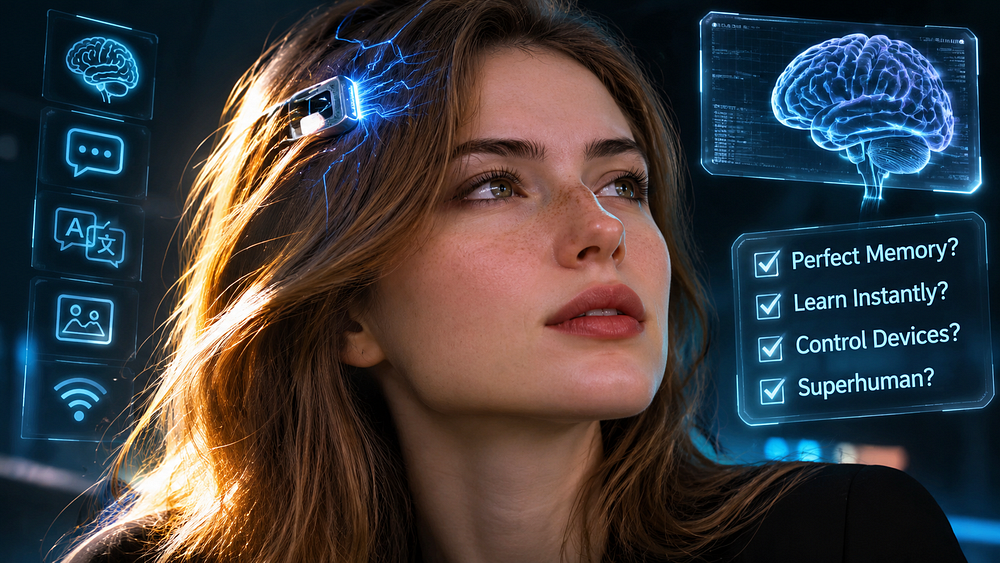
For most of human history, the idea of connecting the human brain directly to a computer belonged to science fiction. We watched people in movies control machines with their minds, communicate without speaking, and access information as if their brains were connected to the internet.
But something interesting is happening: scientists are working to make parts of that future real.
Companies such as Neuralink, founded by Elon Musk, are developing brain-computer interfaces that connect neural activity to external devices. These technologies are not designed to turn ordinary people into superheroes, at least not yet. Their main goal is much more meaningful: helping people with severe disabilities regain some independence.
But let’s imagine what might happen if this technology became advanced enough for anyone to use.
Would you become smarter? Could you control your phone with your thoughts? Would you remember everything? And perhaps the most unsettling question: Would you still have complete control over your own mind?
1. You Could Control Your Phone With Your Thoughts
Imagine reaching for your phone, but before your hand even moves, you have already opened an application.
You think about sending a message, select a contact, and begin composing your thoughts into text. No keyboard, no touchscreen, and no voice commands.
This is one of the most interesting possibilities of brain-computer interface technology.
A brain-computer interface, commonly called a BCI, records brain signals and translates certain patterns into commands that a computer can understand.
For example, some implanted systems are being developed to recognize signals associated with intended hand movements. A person imagines moving their hand, and the system translates that activity into movement of a computer cursor.
Neuralink’s Telepathy technology is being investigated for this purpose, particularly for people living with paralysis.
Its clinical trial participants have demonstrated the ability to control computer cursors and perform basic clicking actions using their brain signals.
Think about what that could mean for someone who has lost the ability to move their hands.
Something as ordinary as opening a laptop, sending a message, or browsing the internet could become possible again.
And honestly, if I could open my phone without searching for it under the sofa cushions, that would already be a pretty impressive upgrade.
2. You Might Communicate Without Speaking
Imagine having a conversation with someone without moving your lips.
You think about what you want to say, and a computer translates your brain activity into words.
This is not entirely science fiction anymore.
Researchers have developed experimental brain-computer interfaces that can translate patterns of brain activity associated with attempted speech into text or synthesized speech.
This could be life-changing for people who have lost the ability to speak because of conditions such as paralysis or neurological disease.
For someone who cannot communicate verbally, being able to express a complete sentence through a computer could restore an important part of everyday life.
But there is an important distinction: these systems do not simply read every private thought inside someone’s head.
They are designed to decode specific signals or intended actions under carefully controlled conditions, often after training and calibration.
Your brain is not an open book that a computer can freely browse.
At least, not with the technology available today.
3. Could You Download Knowledge Directly Into Your Brain?
Now let’s get into the part that sounds like something from The Matrix.
Imagine wanting to learn Spanish and simply downloading a language package into your brain.
One minute you speak only English, and the next you understand Spanish perfectly.
No textbooks, no vocabulary exercises, and no spending three hours trying to remember the difference between two similar words.
It would be incredible.
But can a brain implant actually do that?
Not with today’s technology.
Learning a language involves much more than storing vocabulary. It requires complex changes in memory, understanding, attention, sound processing, and communication.
A brain-computer interface that translates certain neural signals into computer commands is not the same thing as a device that can insert knowledge into your memory.
However, future neurotechnology may help researchers understand how the brain learns and how certain types of memory work.
Perhaps one day, technology will support learning in ways that are difficult to imagine today.
But downloading an entire university degree into your brain before breakfast? Unfortunately, you still have to study.
4. You Might Remember Almost Everything
How many times have you forgotten someone’s name immediately after meeting them?
Or walked into a room and completely forgotten why you went there?
Now imagine a future where a brain-connected device helps you record and organize certain experiences.
You could potentially search through your digital memories, revisit important moments, or receive assistance when trying to remember information.
This idea is particularly interesting because memory is not like a video recording stored somewhere inside the brain.
Human memory is complicated. We reconstruct experiences, connect information, forget details, and sometimes remember events differently over time.
A digital memory assistant might help you organize external information, but that doesn’t mean it could perfectly record every experience and replay it inside your mind.
Still, the possibility of combining human memory with digital storage raises an interesting question:
If you could remember every important moment of your life, would you actually want to?
Sometimes forgetting is not a weakness. It is part of being human.
5. You Could Control Machines Without Moving a Muscle
This is where brain-computer interfaces become particularly impressive.
Imagine controlling a robotic arm simply by thinking about moving your own hand.
For someone with severe paralysis, this could mean being able to interact with objects, operate a computer, or perform certain everyday tasks.
Researchers have already demonstrated brain-computer interfaces that allow people with paralysis to control computer cursors, robotic devices, and other assistive technologies.
In some research, brain signals have also been translated into speech, helping people communicate despite severe physical limitations.
The technology is still developing, and different systems offer different levels of control.
But the underlying idea is extraordinary: even when the body’s normal communication pathways are damaged, certain signals from the brain may still be used to control external devices.
Imagine a future in which someone who cannot move their arms could operate a wheelchair, communicate with family, or use a robotic hand through a brain-connected system.
That is not simply a technological upgrade.
For many people, it could mean getting a part of their independence back.
6. What If Someone Could Hack Your Brain?
Now let’s move to the darker side.
We spend a lot of time worrying about someone hacking our phones, computers, and online accounts.
But what happens when technology becomes directly connected to the human brain?
Imagine a future in which millions of people have implanted devices connected to computers and wireless networks.
What if someone found a vulnerability in that technology?
Could they access sensitive neural information? Could they interfere with the device? Could they manipulate the way it communicates with external systems?
These are serious questions for researchers, developers, and regulators.
Brain-computer interfaces can collect highly sensitive information about neural activity. Protecting that information is not the same as protecting an ordinary browsing history.
However, we should not confuse realistic cybersecurity concerns with science-fiction scenarios.
Today’s systems do not give hackers unrestricted access to someone’s thoughts, personality, or memories.
The more immediate concerns involve protecting neural data, securing connected devices, preventing unauthorized access, and ensuring that users remain in control of their technology.
And honestly, the idea of having to install antivirus software for your brain sounds like a future nobody asked for.
7. Could You Become Addicted to Your Brain Implant?
Think about how difficult it can be to put your phone down.
You check one notification, then another, and before you know it, an hour has disappeared.
Now imagine that the device you depend on is not in your pocket.
It is connected directly to your brain.
A future brain-computer interface might offer constant access to digital information, communication, entertainment, and personal assistance.
That could make everyday tasks easier, but it might also create a new form of dependence.
Would people feel uncomfortable without their implants?
Would they become frustrated when the system stopped working?
Would someone eventually feel that their natural abilities were no longer enough?
These are not established outcomes of current brain implants, but they are reasonable questions to consider as the technology develops.
We already know that people can become deeply dependent on digital devices.
A direct connection between the brain and technology could make the relationship even more complicated.
8. What If Rich People Become Smarter Than Everyone Else?
Here’s another possibility worth thinking about.
Imagine that advanced brain implants eventually become available to the general public.
At first, they might be expensive, difficult to access, and limited to specialized medical applications.
But what if future versions offer significant advantages in communication, memory assistance, or interaction with digital systems?
People who can afford the technology might gain access to capabilities that others cannot easily obtain.
This could create a new kind of inequality.
We already see differences in access to education, healthcare, and technology. If brain-connected devices eventually provide meaningful cognitive assistance, access to them could become another major social issue.
Would employers prefer people with certain implants?
Would schools begin offering special programs for students who use them?
Could society start treating people without implants as technologically disadvantaged?
These questions might sound futuristic, but the discussion about fair access to emerging technologies needs to begin long before they become widely available.
9. Your Brain Is Not a Smartphone Battery
There is one important detail that futuristic conversations sometimes ignore.
Implanting a device into the brain is a medical procedure, not simply installing a new application.
Invasive brain-computer interfaces require surgery, and surgery carries risks.
Depending on the device and procedure, potential complications may include infection, bleeding, inflammation, tissue damage, and problems with the implanted hardware.
There are also questions about how these devices will perform over many years, whether they will need repairs or replacement, and what happens if someone decides they no longer want the implant.
The long-term effects of some newer technologies are still being studied.
This is why clinical research and careful medical supervision are essential.
A brain implant should never be treated like an ordinary consumer gadget that you can buy, test for a week, and return if you don’t like it.
Your brain deserves considerably more respect than your smartphone.
10. Would You Still Be Yourself?
This is probably the biggest question of all.
Imagine a future where your brain is connected to an advanced AI assistant.
It helps you remember information, organize your thoughts, communicate with other people, and interact with technology.
It becomes so useful that you cannot imagine living without it.
But at what point does assistance become dependence?
If a device helps you make decisions, does it influence how you think?
If it changes the way you communicate, does it change how other people understand you?
If it becomes part of your everyday mental experience, would you still feel completely independent?
These questions are not easy to answer because the human brain is deeply connected to our identity.
Our memories, emotions, experiences, and decisions all contribute to the person we become.
Technology may eventually become more integrated into our lives, but that doesn’t mean we should stop thinking carefully about what makes us human.
Perhaps the goal should not be to replace our natural abilities, but to use technology to help people regain abilities they have lost and improve the quality of their lives.
Final Thoughts
A computer chip in the brain sounds like something from a science-fiction movie, but brain-computer interfaces are already being studied in real clinical settings.
For people living with paralysis or severe communication difficulties, this technology could offer something incredibly valuable: greater independence and the ability to interact with the world in ways that were previously difficult or impossible.
At the same time, the technology raises serious questions about privacy, safety, accessibility, and the relationship between humans and machines.
I find the most fascinating part of this future isn’t the idea of becoming superhuman.
It’s the possibility that someone who has spent years unable to communicate might one day be able to send a message to their family simply by intending to move a cursor.
That is a technological achievement worth getting excited about.
But personally, I would still have a few questions before allowing a computer to become a permanent part of my brain.
For example, what happens if it freezes?
Do I restart my brain?
And more importantly, who is responsible for the software updates?
Now I’m curious: If you could have a safe brain implant that gave you one extraordinary ability, what would you choose: perfect memory, instant language learning, controlling devices with your thoughts, or something completely different?
I’d love to hear your thoughts in the comments. ❤️
Sources and Further Reading
Neuralink — Telepathy: Control Your Computer With Your Thoughts
FDA — Neurological Devices and Implanted Brain-Computer Interfaces
NIH — Brain-Computer Interface Restores Natural Speech After Paralysis

✨ Enjoyed this story? Let’s create more together! ✨
Hey there! I’m Luna, a passionate writer and a full-time computer engineering student. While continuing my education, I’m also pursuing my passion for writing and creating content.
If you enjoyed this article and would like to support my writing, even a small contribution would truly mean a lot to me. ❤️
As a student, I sometimes struggle financially, and honestly, I really could use your support. Even the smallest contribution helps me stay motivated to keep writing, creating, and sharing more stories with you.
If you’d like to support me, you can do so here:
→ https://buymeacoffee.com/luna0
I would truly be grateful for your support. Thank you so much for reading my work, supporting me, and being a part of this journey. ❤️😊