
We've gathered anonymous feedback from over 100 students who played The Great Gambit. Here is a link to the report. Note: All comment sections(comments from students) in the report are scrollable.
We also asked students to reflect on deeper learning outcomes. Two key questions explored what students took away from their gameplay experience:
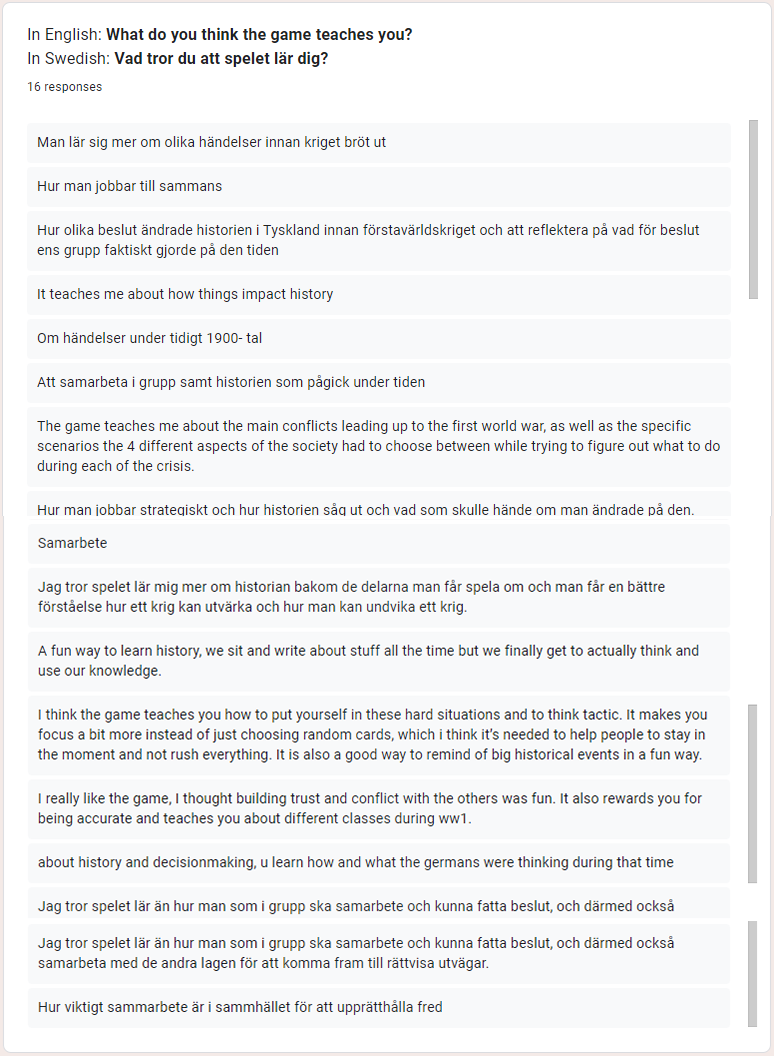
Here’s a translation of the responses from the original Swedish:
You learn more about different events before the war broke out.
How to work together.
How different decisions changed history in Germany before World War I and reflecting on what decisions your group actually made at that time.
It teaches me about how things impact history.
About events in the early 1900s.
To cooperate in a group and the history that was happening during that time.
The game teaches me about the main conflicts leading up to the first world war, as well as the specific scenarios the 4 different aspects of society had to choose between while trying to figure out what to do during each of the crises.
How to work strategically and how history looked and what would happen if you changed it.
Cooperation.
I think the game teaches me more about the history behind the parts you get to play, and you get a better understanding of how a war can develop and how you can avoid a war.
A fun way to learn history, we sit and write about stuff all the time but we finally get to actually think and use our knowledge.
I think the game teaches you how to put yourself in these hard situations and to think tactically. It makes you focus a bit more instead of just choosing random cards, which I think is needed to help people stay in the moment and not rush everything. It is also a good way to remind of big historical events in a fun way.
I really like the game, I thought building trust and conflict with the others was fun. It also rewards you for being accurate and teaches you about different classes during WW1.
About history and decision-making, you learn how and what the Germans were thinking during that time.
I think the game teaches you how, as a group, to cooperate and make decisions, and thus also cooperate with the other teams to reach fair outcomes.
How important cooperation is in society to maintain peace.
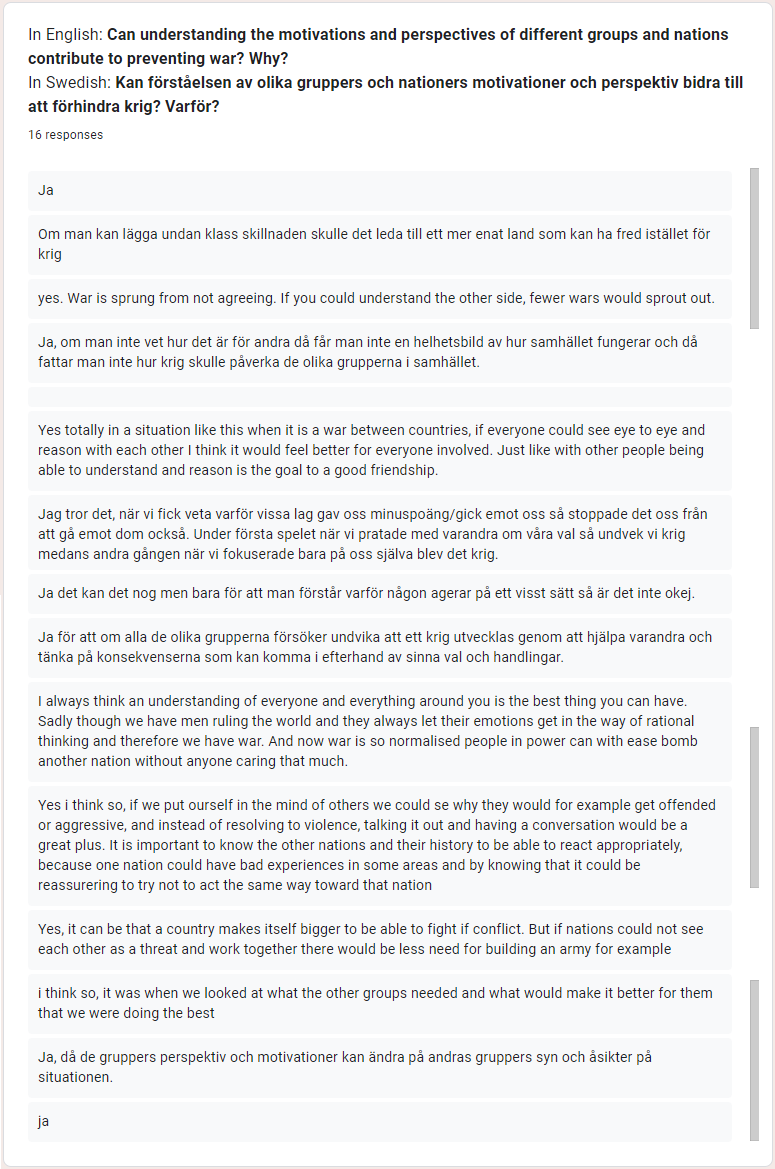
Yes.
If you can put aside class differences, it would lead to a more unified country that can have peace instead of war.
Yes. War is sprung from not agreeing. If you could understand the other side, fewer wars would sprout out.
Yes, if you don’t know how it is for others, you don’t get a complete picture of how society works, and then you don’t understand how war would affect the different groups in society.
Yes, totally, in a situation like this when it is a war between countries, if everyone could see eye to eye and reason with each other I think it would feel better for everyone involved. Just like with other people being able to understand and reason is the goal to a good friendship.
I think so, when we found out why certain teams gave us negative points/went against us, it stopped us from going against them as well. In the first game, when we talked to each other about our choices, we avoided war, but the second time, when we focused only on ourselves, it resulted in war.
Yes, it can, but just because you understand why someone acts in a certain way doesn’t mean it’s okay.
Yes, because if all the different groups try to avoid a war from developing by helping each other and thinking about the consequences that may follow from their choices and actions.
I always think an understanding of everyone and everything around you is the best thing you can have. Sadly though we have men ruling the world and they always let their emotions get in the way of rational thinking and therefore we have war. And now war is so normalised people in power can with ease bomb another nation without anyone caring that much.
Yes, I think so, if we put ourselves in the mind of others, we could see why they would, for example, get offended or aggressive, and instead of resolving to violence, talking it out and having a conversation would be a great plus. It is important to know the other nations and their history to be able to react appropriately because one nation could have had bad experiences in some areas, and by knowing that, it could be reassuring to try not to act the same way toward that nation.
Yes, it can be that a country makes itself bigger to be able to fight if conflict arises. But if nations could not see each other as a threat and work together, there would be less need for building an army, for example.
I think so, it was when we looked at what the other groups needed and what would make it better for them that we were doing the best.
Yes, because those groups' perspectives and motivations can change the views and opinions of other groups on the situation.
Yes.