

The Fujifilm X100VI is celebrated for its portability, image quality, film simulations, and ability to perform exceptionally well in natural light. Yet one accessory remains surprisingly underused by the community: off-camera flash. Many X100VI users rely solely on ambient light or occasionally on the built-in flash, without realizing how accessible and transformative external lighting can be.
This article explains why off-camera flash deserves far more attention, why the internal flash reaches its limits quickly, and how a simple external setup can dramatically expand the creative potential of the X100VI.
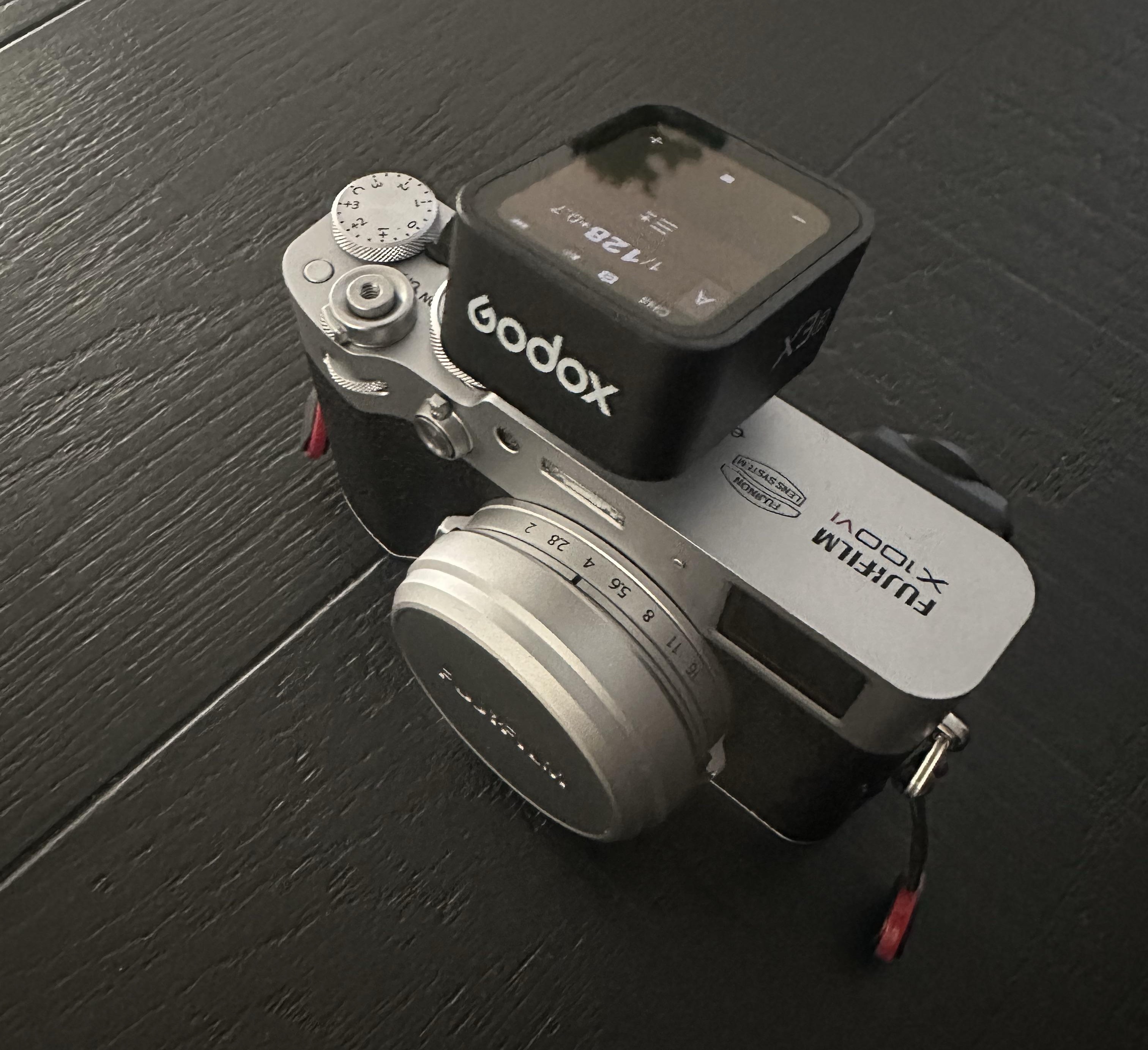 Photo credit: https://www.reddit.com/user/Vern340/
The Limitations of the X100VI Internal Flash
Fixed Position and Lack of Creative Control
The internal flash is fixed on the camera body, always emitting frontal light from almost the same axis as the lens. This results in flat illumination, harsh frontal shadows, and little depth or shaping of the subject. Because creative lighting rarely comes from the same direction as the camera, this structural limitation directly restricts artistic options.
Low Output Power
The built-in flash has limited power. It struggles to illuminate subjects beyond short distances, cannot compete with bright ambient light, and lacks the intensity needed to shape light through modifiers. It can help expose a scene but cannot sculpt light in a meaningful way.
Obstruction by Accessories
Many X100VI users attach lens hoods, filter adapters, step-up rings, or diffusion filters. These accessories frequently block part of the internal flash, creating dark shadows or vignetting. To use the flash without obstruction, photographers must remove accessories, which disrupts shooting flow and goes against the spontaneous, ready-to-shoot character of the X100 line.
Why Off-Camera Flash Matters
Control Over Light Direction and Quality
External flash is not simply about adding brightness. It is about controlling the direction, shape, softness, and character of the light. Even a small off-camera flash with a simple modifier enables:
sculpted portrait lighting
separation between subject and background
dimensional lighting instead of flat illumination
enhanced textures and contrast
consistent results in unpredictable environments
This level of control dramatically expands what the X100VI can achieve.
Dependable Lighting in Any Situation
Natural light changes constantly. Off-camera flash provides a stable, predictable source of light indoors, outdoors, day or night. It ensures creative flexibility and independence from environmental conditions.An Upgrade That Costs Less Than Expected
Compared to popular X100 accessories such as conversion lenses, leather cases, straps, or premium hoods, a complete off-camera flash setup is often less expensive and far more impactful.
A minimal, highly capable kit typically includes:
Godox X3-F trigger (official page):
https://www.godox.com/product-a/X3.htmlAn external flash such as:
Godox TT350F: https://www.godox.com/product-d/TT350.html
Godox V1F: https://www.godox.com/product-d/V1.html
Godox AD100Pro: https://www.godox.com/product-d/AD100Pro.html
A small umbrella or softbox
For approximately 150 to 200 euros, photographers gain directional light, improved portrait quality, better balance between subject and background, cleaner images at night, and full creative control.
The X100VI Leaf Shutter Advantage
The leaf shutter is one of the X100VI’s most powerful and overlooked features. Unlike focal-plane shutters, the leaf shutter can synchronize with flash at shutter speeds up to 1/4000s.
Note: The X100VI can sync flash at shutter speeds up to 1/4000s depending on the aperture (approximately 1/2000s at f/2 and 1/4000s at f/4).
This enables:
shooting wide open at f/2 in bright sunlight
controlling ambient light without ND filters
freezing motion at any shutter speed
achieving professional-looking environmental portraits with small flashes
This capability turns even compact strobes into highly effective tools.
Flash Does Not Need to Be Complicated
Many photographers hesitate to use flash due to confusing menus, inconsistent behavior with third-party triggers, or contradictory online guidance. In reality, flash becomes simple when supported by a clear workflow.
A structured approach explains:
how the X100VI communicates with third-party triggers
how to configure the camera correctly
how to configure the flash trigger correctly
how to achieve consistent results in manual or TTL mode
how to avoid common pitfalls
how to switch back to natural-light shooting easily
Once the workflow is understood, flash becomes an intuitive extension of the photographer’s toolkit.
Creative Freedom for X100VI Photographers
With a small off-camera flash, the X100VI becomes significantly more versatile. Photographers can:
create cinematic portraits regardless of weather
produce clean nighttime images at low ISO
elevate indoor lighting with consistent quality
handle backlit scenes effectively
turn ordinary locations into compelling visual environments
A lightweight flash setup maintains the compact spirit of the X100 series while adding substantial creative power.
Why This Perspective Matters
Off-camera flash remains uncommon among X100 users not because it lacks value, but because many assume it is expensive, complicated, or incompatible with the minimalist nature of the camera. In reality, it is one of the most effective ways to unlock the full expressive potential of the X100VI.
Clear, Fuji-specific guidance makes this accessible to all photographers who want to explore lighting beyond the limitations of ambient light and the internal flash.
Further Reading and Resources
The complete, fully detailed guide can be found here:
Full Guide:
https://buymeacoffee.com/lestudiochesterfield/e/486271