

The Backbone of Modern Rail Transport
Railway signaling and communication systems form the critical infrastructure that ensures safe, efficient, and reliable train operations worldwide. These sophisticated networks of technologies coordinate train movements, prevent collisions, optimize traffic flow, and enable real-time communication between trains, operators, and control centers. As rail networks continue to expand and modernize, understanding these essential systems becomes increasingly important for industry professionals and stakeholders.
Free Railway Signaling Systems Comparison Guide
Download our comprehensive comparison of modern railway signaling technologies, including detailed specifications, implementation requirements, and cost considerations.
Modern railway signaling control center monitoring train movements in real-time
What Are Railway Signaling and Communication Systems?
Railway signaling and communication systems are integrated networks of equipment and protocols designed to control train movements, ensure safe operations, and facilitate information exchange between various components of a rail network. These systems serve as the nervous system of railways, enabling trains to operate safely at high speeds while maintaining optimal distances between each other.
Primary Functions of Signaling Systems
Prevent train collisions by maintaining safe separation
Control train speeds through various track sections
Manage route setting and track switching
Indicate track conditions and restrictions ahead
Automate train protection mechanisms
Primary Functions of Communication Systems
Enable real-time data exchange between trains and control centers
Facilitate voice communication between train crews and dispatchers
Transmit train control commands and status information
Support passenger information systems
Enable remote monitoring of railway infrastructure
Together, these systems create a comprehensive framework that allows railway networks to operate at maximum capacity while maintaining the highest safety standards. Modern implementations increasingly integrate digital technologies, automation, and real-time data analytics to enhance performance and reliability.
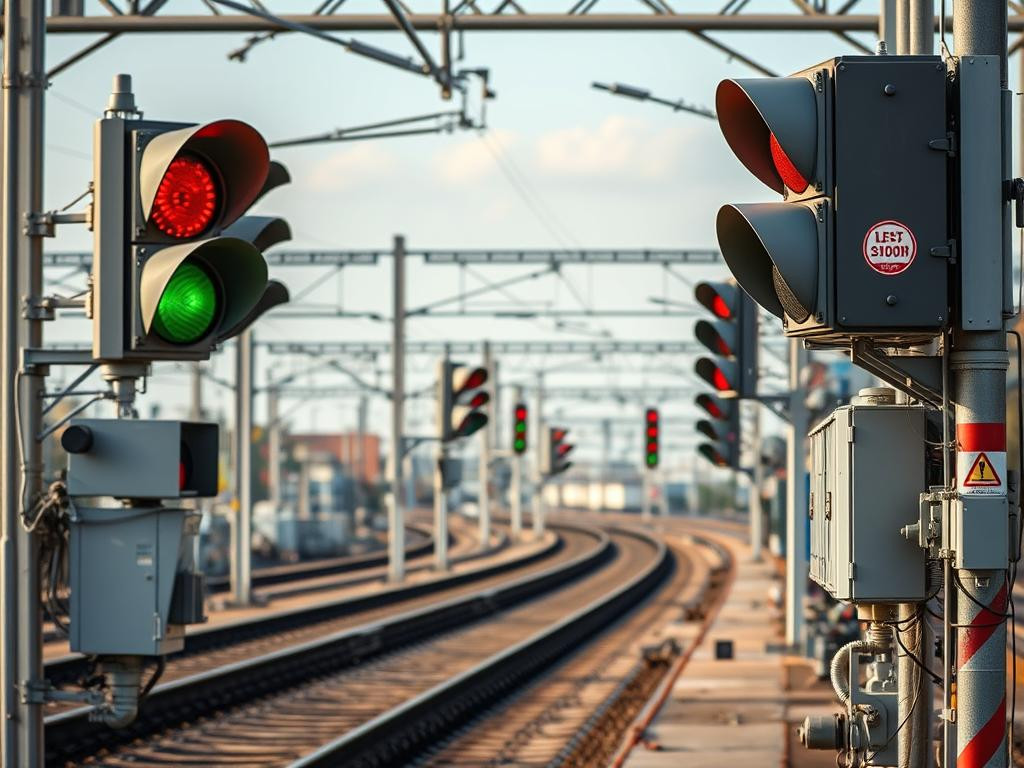
Trackside signaling equipment including signals, track circuits, and control cabinets
Key Components of Railway Signaling and Communication Systems
Signaling System Components
Track Circuits
Electrical circuits that detect train presence on a section of track by using the train's metal wheels and axles to complete or short-circuit an electrical connection. When a train occupies a section, the track circuit changes state, automatically triggering signals to prevent other trains from entering the occupied section.
Interlockings
Safety-critical systems that prevent conflicting train movements by ensuring signals and switches operate in a coordinated manner. Modern computer-based interlockings (CBI) use software logic to verify that all conditions for safe train passage are met before allowing route setting.
Signals
Visual indicators that communicate instructions to train operators. These range from traditional color light signals (red, yellow, green) to modern in-cab signaling displays that show permitted speeds and movement authorities directly to the driver.
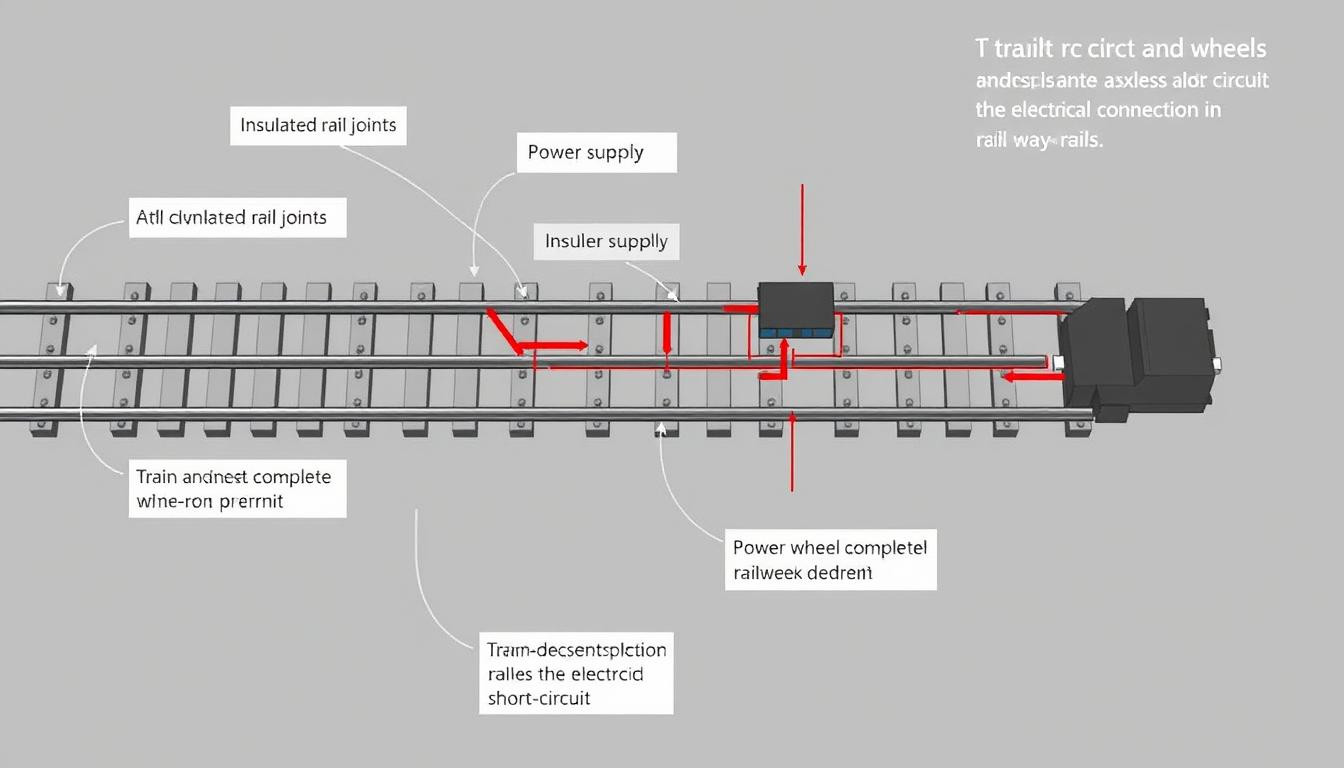
Diagram: Basic operation of a track circuit for train detection
Communication System Components
GSM-R (Global System for Mobile Communications-Railway)
A dedicated mobile communication system for railways that provides voice and data communication between trains and control centers. GSM-R supports critical functions like emergency calls, group calls, and data transmission for train control applications.
CBTC (Communications-Based Train Control)
An advanced signaling system that uses continuous, high-capacity, bidirectional train-to-wayside data communication to enable precise train location determination and movement authority enforcement, allowing for reduced headways and increased line capacity.
Radio Block Centers (RBC)
Central control units that manage train movements in modern signaling systems by processing train position reports, calculating safe movement authorities, and transmitting control commands to trains via radio communication networks.
Safety Standards Checklist
Access our comprehensive checklist of international safety standards and compliance requirements for railway signaling systems implementation.
How Railway Signaling Systems Ensure Safety and Efficiency
Railway signaling systems employ multiple layers of protection and coordination mechanisms to maintain safe train operations while maximizing network capacity. These systems follow strict safety principles and are designed with redundancy to prevent single points of failure.
Safety Mechanisms and Protocols
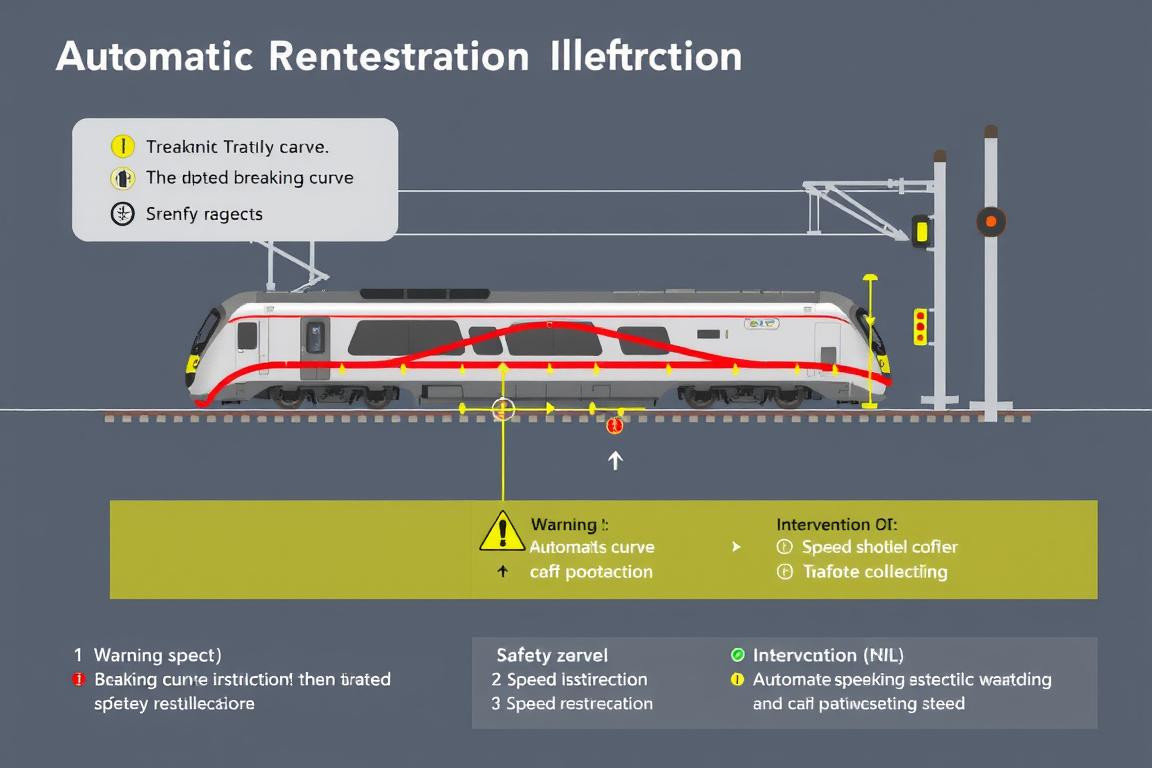
Automatic Train Protection system showing braking curves and safety zones
SIL (Safety Integrity Level) Standards
Railway signaling systems are developed according to strict Safety Integrity Level standards, typically SIL 4 for critical functions. These standards define the probability of dangerous failures and require rigorous verification and validation processes during system development and implementation.
SIL Level Probability of Dangerous Failure Application in Railway Signaling SIL 4 10^-8 to 10^-9 per hour Train protection systems, interlockings SIL 3 10^-7 to 10^-8 per hour Track circuits, axle counters SIL 2 10^-6 to 10^-7 per hour Level crossing protection SIL 1 10^-5 to 10^-6 per hour Non-safety critical functions
Fail-Safe Mechanisms
Railway signaling systems are designed with the "fail-safe" principle, meaning that any component failure must result in a more restrictive condition. For example, if a signal circuit fails, the signal automatically displays its most restrictive aspect (typically red), ensuring trains stop rather than proceed unsafely.
Block Systems
The fundamental safety principle in railway signaling is the block system, which divides tracks into sections (blocks) and allows only one train in each block at a time. Modern systems use:
Fixed Block: Traditional approach with predefined block sections
Moving Block: Dynamic spacing based on train position, speed, and braking capabilities
Automatic Train Protection (ATP)
ATP systems monitor train speed and automatically apply brakes if a train exceeds permitted speed limits or approaches a stop signal. Key functions include:
Continuous speed supervision
Emergency braking for signal violations
Train position monitoring
Efficiency and Capacity Optimization
Modern signaling systems not only ensure safety but also optimize network capacity through sophisticated traffic management and real-time coordination.
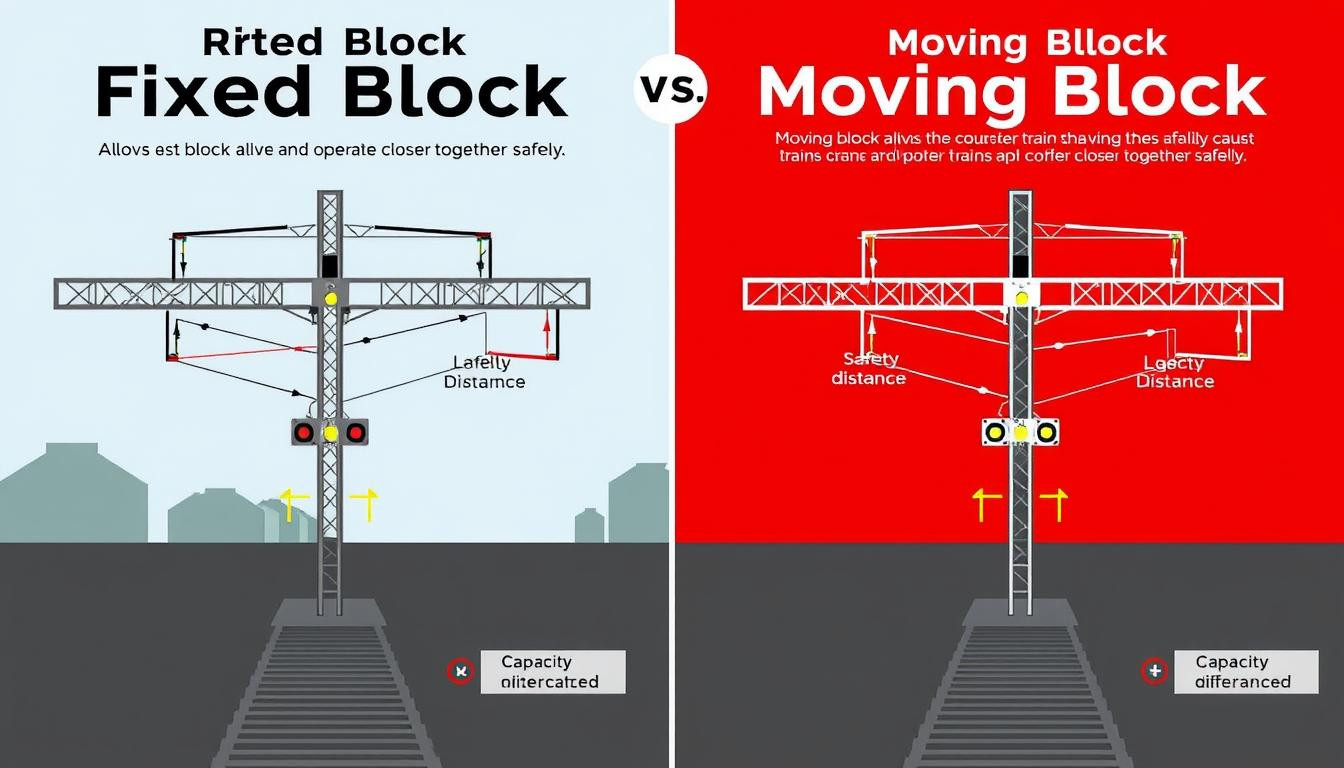
Comparison: Fixed block vs. moving block signaling showing capacity improvements
Traffic Management Systems
Centralized traffic control systems optimize train movements across the network by:
Automatically routing trains based on schedule and real-time conditions
Resolving conflicts and minimizing delays
Providing decision support for operators during disruptions
Real-Time Communication
Modern communication systems enable efficient operations through:
Continuous data exchange between trains and control centers
Precise train location tracking using GPS and other positioning technologies
Dynamic updates to timetables and movement authorities
Legacy vs. Modern Railway Signaling Technologies
The evolution of railway signaling systems spans over 150 years, from simple mechanical signals to sophisticated digital systems. Understanding this progression helps contextualize current technologies and future trends.
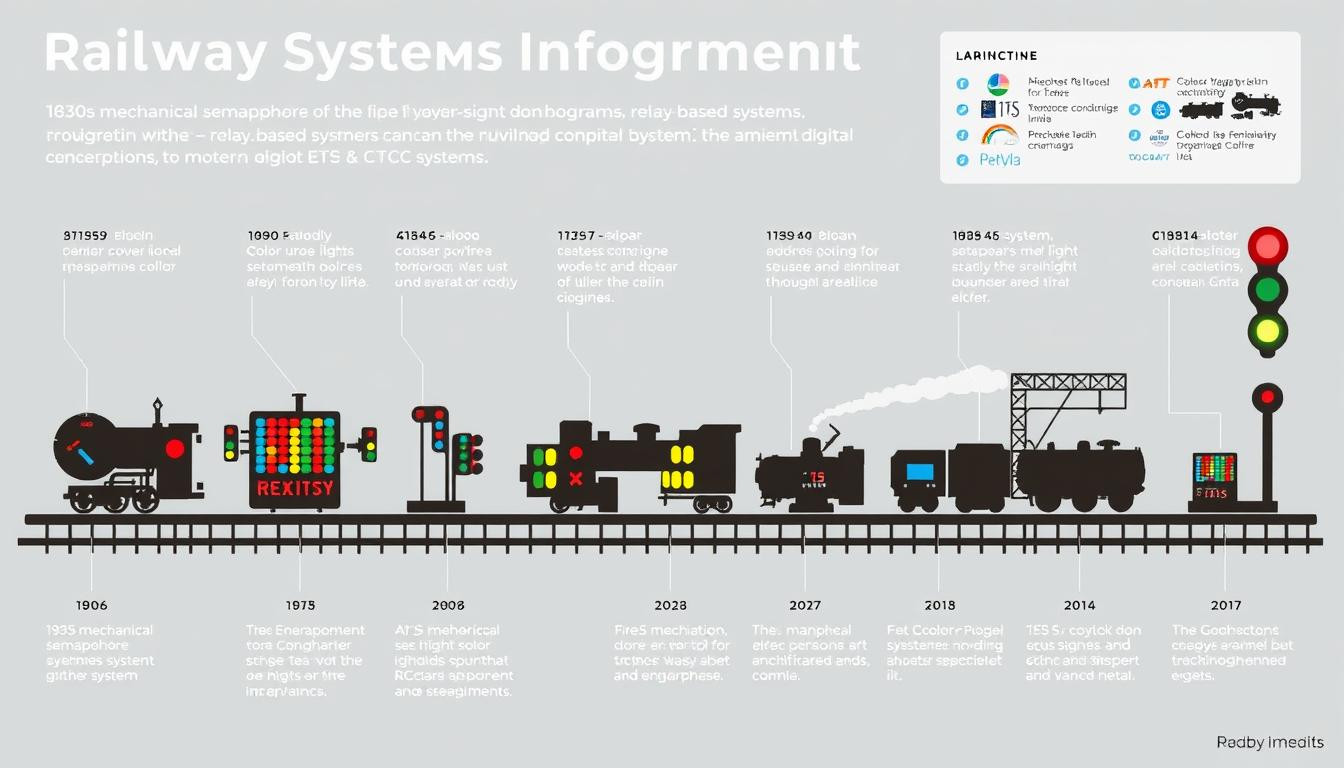
Timeline: Evolution of railway signaling technologies from mechanical to digital systems
System Type Era Key Features Limitations Modern Applications Semaphore Signals 1840s-1950s Mechanical arms indicating stop/proceed Limited visibility, manual operation, maintenance intensive Heritage railways, some rural lines Color Light Signals 1920s-Present Electric lights showing red/yellow/green aspects Fixed block operation, limited information to drivers Widespread use on conventional lines Automatic Block System (ABS) 1870s-Present Track circuits for train detection, automatic signal control Fixed capacity, weather sensitivity Secondary lines, backup systems ETCS (European Train Control System) 1990s-Present Standardized digital control, in-cab signaling, cross-border interoperability High implementation cost, complex migration High-speed lines, international corridors CBTC (Communications-Based Train Control) 1980s-Present Moving block operation, continuous communication, precise train control Limited to closed networks, high technical complexity Metro systems, urban railways
Key Differences Between Legacy and Modern Systems
Modern Digital Systems Advantages
Increased line capacity through moving block operation
Enhanced safety with continuous train protection
Reduced trackside equipment requirements
Real-time data for traffic optimization
Support for higher operating speeds
Lower maintenance costs over system lifetime
Legacy Systems Limitations
Fixed capacity constraints due to block length
Limited information provided to train operators
Higher maintenance requirements for physical equipment
Weather sensitivity affecting reliability
Limited automation capabilities
Difficulty integrating with modern control systems
Technology Migration Roadmap
Planning to upgrade from legacy to modern signaling systems? Download our step-by-step migration roadmap with implementation timelines and cost considerations.
Real-World Examples of Advanced Railway Signaling Systems
Examining successful implementations of railway signaling and communication systems provides valuable insights into their practical applications and benefits. Here are three notable examples from different regions:
Japan's Shinkansen: Digital ATC System
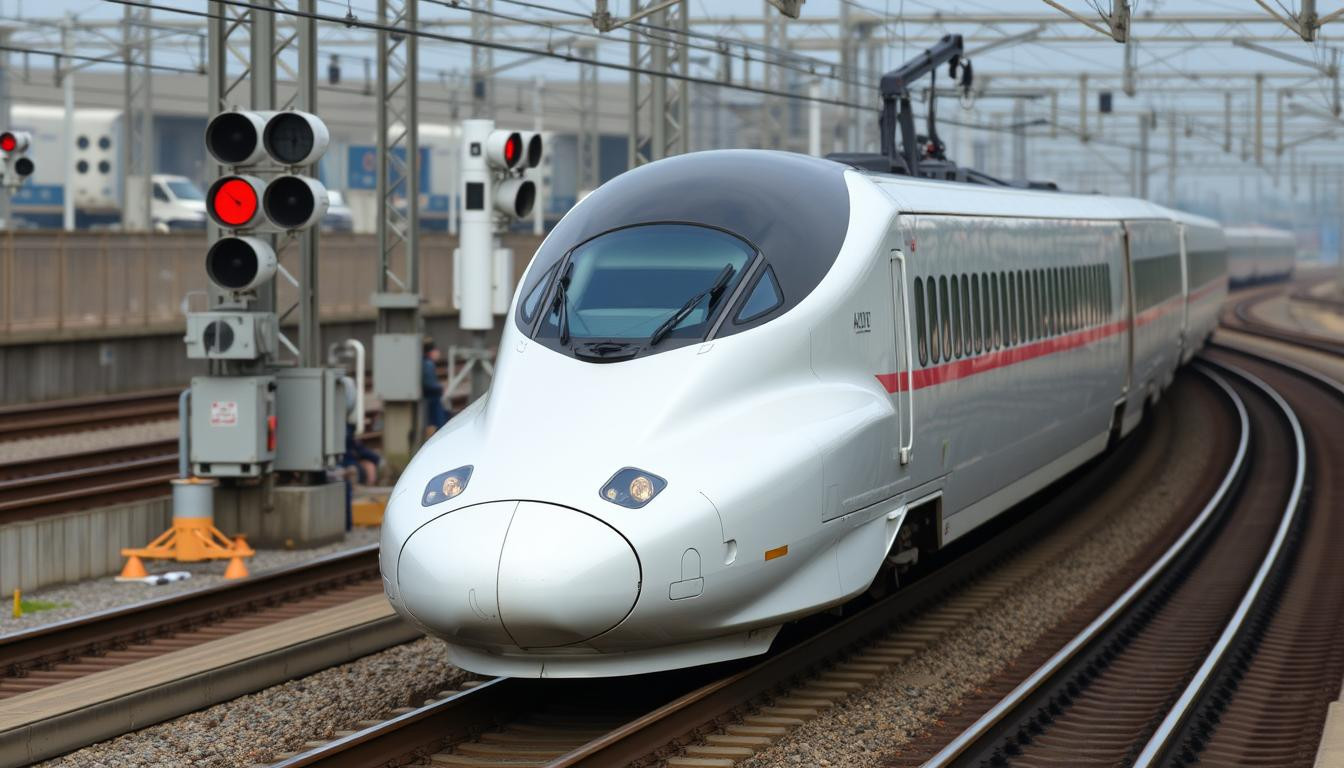
Japan's Shinkansen utilizing Digital ATC for high-speed operations
Japan's Shinkansen (bullet train) network employs a sophisticated Digital ATC (Automatic Train Control) system that has enabled one of the world's safest and most punctual high-speed rail services.
Key Features
Continuous speed control with onboard computers
Automatic braking for speed compliance
Earthquake detection and automatic emergency braking
Centralized traffic management system
Results
Zero passenger fatalities due to train accidents since 1964
Average delay of less than one minute per train
Trains operating at speeds up to 320 km/h (200 mph)
Headways as short as 3 minutes during peak periods
European Rail Traffic Management System (ERTMS)
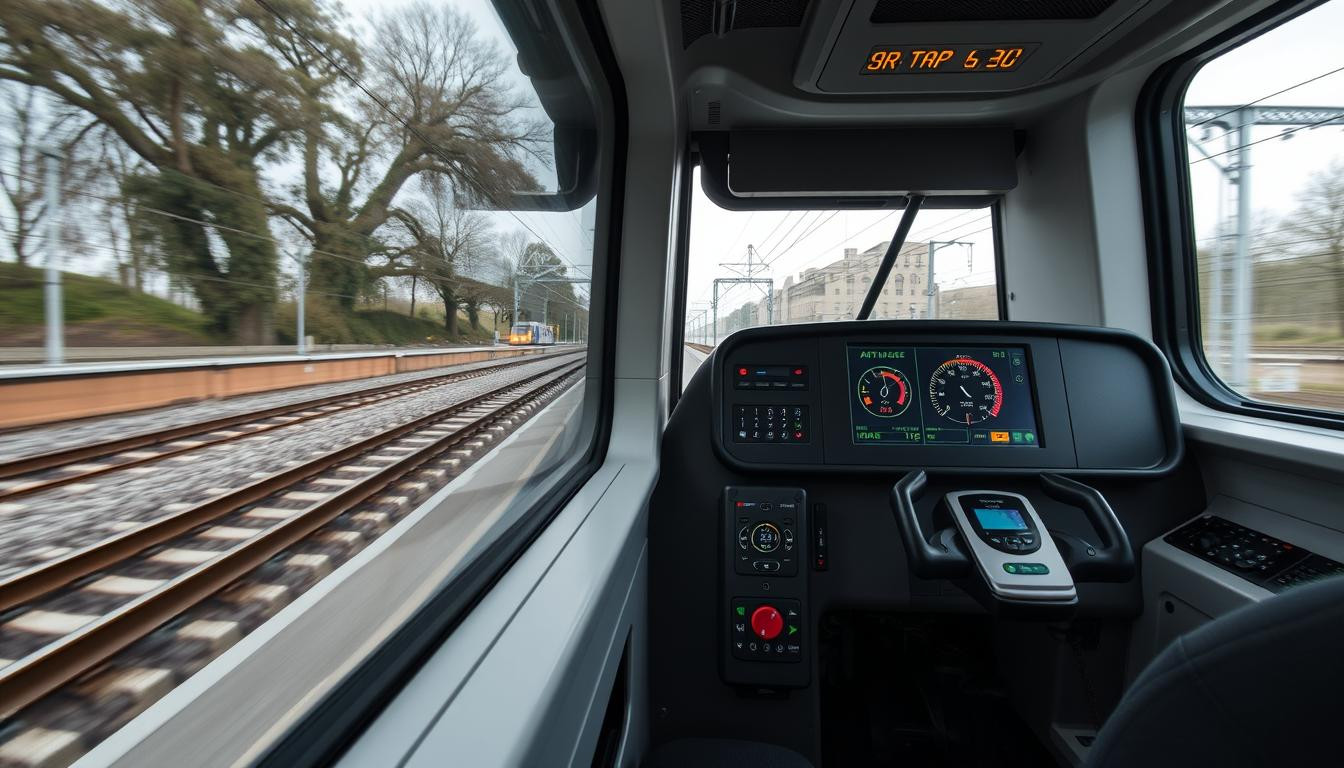
ERTMS implementation with in-cab display and trackside balises
The European Rail Traffic Management System (ERTMS) is a standardized signaling and control system designed to replace the various national systems across Europe, enabling seamless cross-border train operations.
Key Components
ETCS (European Train Control System) for train protection
GSM-R for voice and data communication
ETML (European Traffic Management Layer) for traffic management
Implementation Levels
Level 1: Balise-based intermittent communication with existing signals
Level 2: Continuous GSM-R communication with reduced trackside signals
Level 3: Moving block operation with train integrity monitoring
ERTMS has been successfully implemented on high-speed lines in Spain, Italy, Belgium, and other European countries, enabling interoperable train services and increased capacity.
Indian Railways' Kavach ATP System
Indian Railways' indigenous Kavach ATP system implementation
Kavach (meaning "armor" in Hindi) is an indigenously developed Automatic Train Protection (ATP) system by Indian Railways, designed to prevent train collisions and enhance safety across India's vast railway network.
System Capabilities
Automatic brake application when trains exceed speed limits
Station approach warning with auto-braking
Prevention of signal passing at danger (SPAD)
Train collision avoidance through direct train-to-train communication
Implementation Status
Successfully deployed on over 1,465 km of South Central Railway
Plans for nationwide implementation on 34,000 km of high-density routes
Cost-effective solution compared to imported systems
Designed for Indian operating conditions and infrastructure
Emerging Trends in Railway Signaling and Communication
The railway signaling and communication sector is experiencing rapid technological advancement, with several emerging trends poised to transform train operations and infrastructure management.
AI-based predictive maintenance system analyzing signaling equipment health
AI-Based Predictive Maintenance
Artificial intelligence and machine learning are revolutionizing maintenance practices for railway signaling systems by predicting potential failures before they occur.
Key Applications
Anomaly detection in signal performance data
Predictive analytics for component failure
Optimization of maintenance schedules
Automated fault diagnosis
Benefits
Reduced system downtime and service disruptions
Lower maintenance costs through condition-based maintenance
Extended equipment lifespan
Improved system reliability and safety
5G Integration and Next-Generation Communications
The transition from GSM-R to 5G and Future Railway Mobile Communication System (FRMCS) will enable higher data throughput, lower latency, and enhanced reliability for critical railway applications.
Next-generation 5G and FRMCS communication infrastructure for railways
Enhanced Capabilities
Higher bandwidth for video and sensor data transmission
Ultra-reliable low-latency communication for critical applications
Network slicing for service prioritization
Support for massive IoT device connectivity
Applications
Advanced train control with reduced headways
Real-time video monitoring for security
Enhanced passenger information services
Remote diagnostics and maintenance
Cybersecurity Challenges and Solutions
As railway signaling systems become more digitized and connected, cybersecurity has emerged as a critical concern requiring specialized protection measures.
Key Threats
Unauthorized access to control systems
Denial of service attacks
Malware targeting safety-critical functions
Data manipulation affecting train control
Protection Strategies
Defense-in-depth architecture with multiple security layers
Secure-by-design development practices
Regular security assessments and penetration testing
Incident response planning and simulation
Defense-in-depth cybersecurity architecture for railway signaling protection
Complete Railway Signaling Resource Pack
Get access to our comprehensive resource pack including the Systems Comparison Guide, Safety Standards Checklist, and Technology Migration Roadmap in one convenient download.
Conclusion: The Future of Railway Signaling and Communication
Railway signaling and communication systems continue to evolve, driven by technological innovation, increasing safety requirements, and the need for greater capacity and efficiency. The transition from traditional fixed-block systems to advanced moving-block technologies with continuous communication represents a fundamental shift in how railways operate.
As we've explored throughout this article, modern systems like ETCS, CBTC, and country-specific implementations provide enhanced safety through continuous train protection, improved capacity through optimized train spacing, and greater operational flexibility through centralized traffic management.
The integration of artificial intelligence, 5G communications, and robust cybersecurity measures will further transform railway operations, enabling more autonomous functions, predictive maintenance, and seamless interoperability across networks. These advancements will be crucial in meeting the growing demand for rail transport while maintaining the highest safety standards.
For railway professionals, staying informed about these evolving technologies and implementation strategies is essential to making sound decisions about system upgrades, maintenance practices, and long-term infrastructure planning.