

TLDR: Industrial and B2B manufacturers are replacing expensive live-action plant video shoots with CAD-to-3D animation pipelines that convert existing engineering files into high-fidelity product videos within 72 hours. These assets communicate complex mechanical functionality with precision that camera footage cannot achieve, accelerating purchase decisions in high-consideration B2B sales cycles. This article explains why the transition is accelerating, how the production pipeline works, and what video specifications maximize conversion in industrial digital advertising environments.
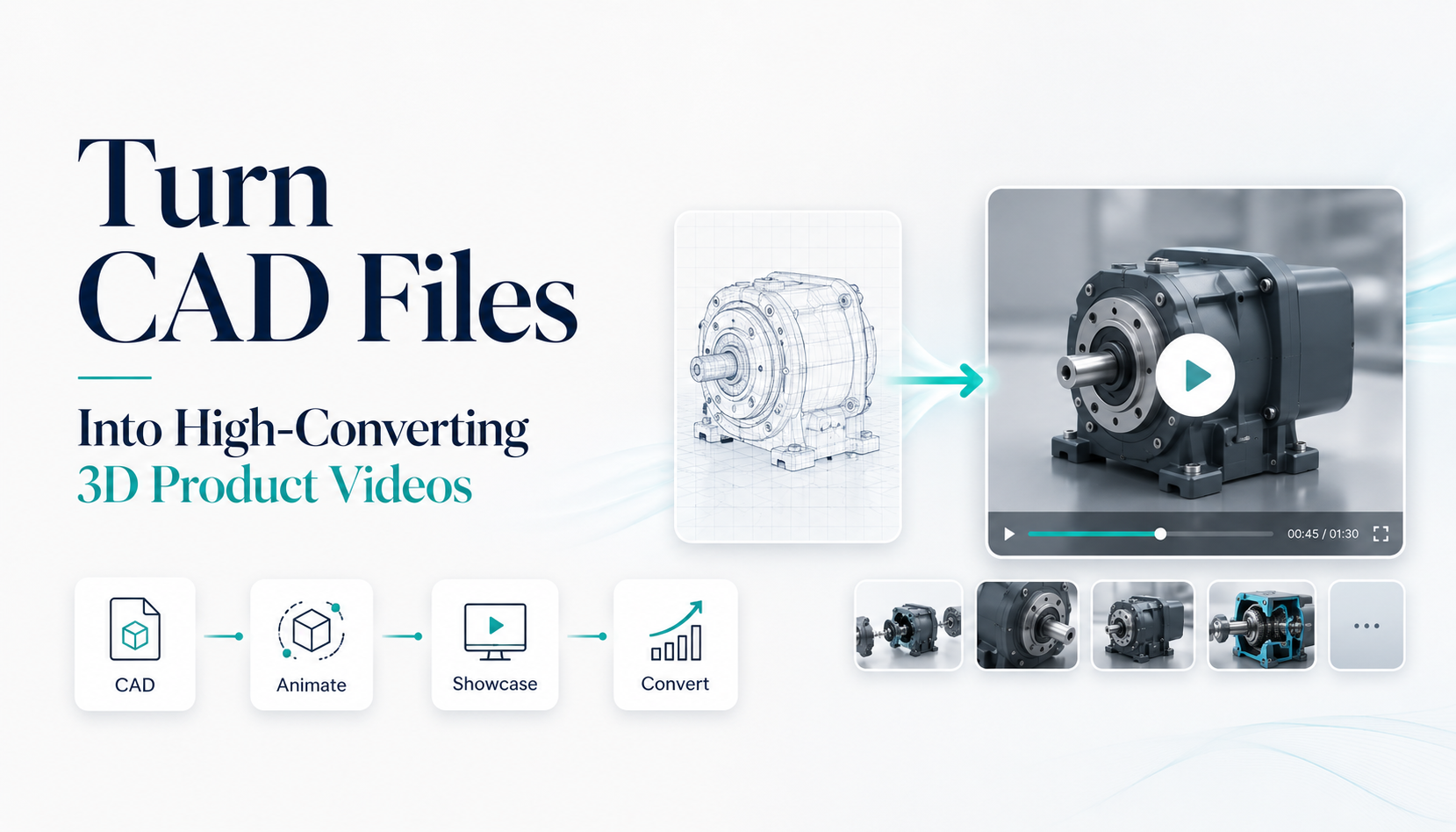 The Average Industrial Plant Video Shoot Costs Between $35,000 and $85,000 in Production, Logistics, and Operational Disruption, and Produces Footage That Cannot Show Internal Mechanisms, Cross-Sections, Tolerance Details, or Sub-Assembly Sequences That Engineering Buyers Actually Evaluate
That production investment gap is the structural driver behind the accelerating adoption of CAD to 3D animation B2B video marketing across industrial manufacturing sectors. Engineering firms, fluid handling equipment manufacturers, precision component suppliers, and industrial automation brands are converting their existing CAD libraries into photorealistic animated video assets that communicate mechanical functionality with a precision that camera footage is physically incapable of achieving. A 3D animation of a gear reduction assembly can simultaneously show the external housing, the internal gear mesh, the lubrication flow path, and the torque transmission pathway; a camera can show only the exterior.
Why Traditional Plant Shoots Are Being Replaced by Direct CAD Pipelines
High-converting industrial product video clips produced through CAD animation pipelines deliver three performance advantages over live-action footage that compound across the B2B sales cycle. The first is mechanical transparency: animation renders internal components, sub-assembly sequences, and operational mechanisms that physical products conceal behind housings, casings, and enclosures. A procurement engineer evaluating a hydraulic valve manifold does not need footage of the manifold sitting on a shelf; they need visualization of the internal flow path geometry, the spool travel sequence, and the port cross-section dimensions that determine whether the component meets their circuit design requirements.
The second is specification accuracy: 3D renders derived directly from engineering CAD files reflect the exact dimensional geometry, surface finish characteristics, and assembly relationships encoded in the design file. Dimensional claims made in the video are verifiable against the CAD geometry; the animation is the specification, not an approximation of it. The third is production velocity: a 3D CAD render pipeline for digital ads operating on existing engineering file assets produces finished video assets in 48 to 72 hours from asset delivery. A live-action plant shoot requires pre-production logistics, plant floor scheduling, equipment preparation, crew deployment, and post-production processing that collectively consume three to six weeks before a usable asset exists.
According to Wyzowl's 2025 B2B Video Marketing Report, B2B buyers in technical product categories report that 3D product animation increases purchase confidence by 67% compared to equivalent static imagery, and reduces the number of technical clarification requests submitted to sales teams by 41% directly compressing sales cycle duration in high-consideration industrial deals where technical validation is the primary decision bottleneck.
The Production Pipeline That Converts CAD Files to Sales Assets in 72 Hours
The 3D CAD render pipeline for digital ads begins with the engineering CAD files that industrial manufacturers already maintain for product development: SOLIDWORKS, AutoCAD, CATIA, PTC Creo, or Siemens NX native files are all compatible with professional 3D animation software including Autodesk Maya, Cinema 4D, KeyShot, and Blender. The pipeline converts native CAD geometry into animation-optimized mesh formats, applies photorealistic material shaders calibrated to the actual surface finishes and material properties of the manufactured component, and renders the result under studio lighting conditions that maximize visual clarity of the geometric features most relevant to the buyer's evaluation criteria.
The animation sequence design phase is where marketing and engineering alignment yields the greatest impact on conversion. Effective industrial product animations prioritize the mechanical sequences that resolve the most common buyer technical objections: the assembly and disassembly sequence that demonstrates serviceability; the operational cycle that demonstrates duty cycle compliance; the cross-section reveal that demonstrates internal construction quality; the dimensional callout overlay that demonstrates specification compliance without requiring the viewer to reference a separate datasheet.
The mechanics of video asset performance in industrial B2B digital advertising contexts, including optimal duration, caption strategy, and platform-specific format requirements, are examined in this advanced framework for video marketing mechanics in B2B and industrial categories; the strategic decision between short-form specification-focused clips and long-form technical demonstration content for different stages of the industrial buying cycle is mapped in this guide to short-form versus long-form video performance for B2B audiences.
The Agency Consensus
"Industrial marketing teams still scheduling plant video shoots to produce footage of their products sitting stationary on a factory floor are spending production budgets to show buyers less information than a photograph would provide. The buyer needs to see the product work. Animation is the only format that can show what the product does, not just what it looks like doing nothing."
Deploying CAD Animation Assets Across the Industrial Sales Funnel
LinkedIn's 2025 B2B Content Engagement Report documents that technical product animation videos in industrial categories achieve 3.4 times higher engagement rates than equivalent static product imagery across LinkedIn feed placements, with average video completion rates of 58% for sub-60-second specification-focused clips. The same CAD-derived 3D assets that produce LinkedIn awareness content are repurposed as embedded website product page explainers, Google Display and YouTube pre-roll advertising units, trade show digital display assets, and sales team presentation materials, a single production investment generating a multi-channel asset library from one engineering file source.