

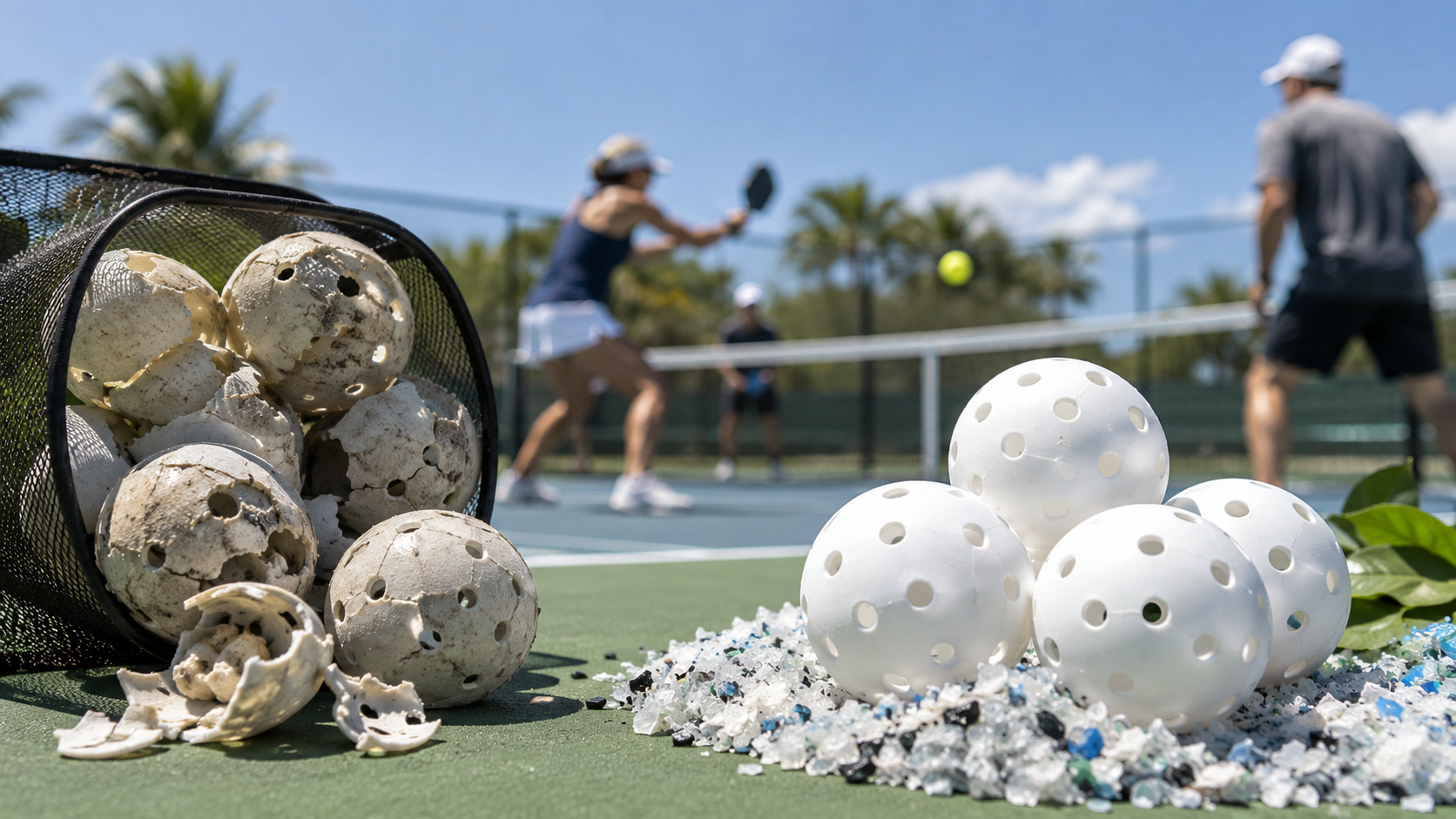
Every sport carries an environmental cost, but pickleball’s is unusual and slightly counterintuitive: the single largest source of plastic waste in the game is also its cheapest, most disposable, and most overlooked piece of equipment.
Not the paddle, not the packaging, not the apparel. The ball. Grasping why that is true, and what recycled balls genuinely change, is the key to understanding how a booming sport can grow without leaving an ever-larger pile of plastic behind it.
Where the waste actually comes from
The instinct is to look at the expensive, visible gear when thinking about a sport’s footprint. In pickleball that instinct points you in the wrong direction. A paddle lasts a season or several. Court shoes last many months. Nets and bags last years. The ball, by contrast, is consumed and discarded on a timescale of days to weeks, because it cracks suddenly and permanently once it fails.
That short life, multiplied by the sheer number of balls a busy court gets through, is what makes the ball the dominant waste stream. A single active facility can retire dozens of balls a month, and the great majority go straight to landfill. They do this not because players are careless but because the balls are physically incompatible with recycling infrastructure.
Understanding what pickleballs are made of explains the paradox: the plastic itself is recyclable, but the object, small, hollow, perforated, and unmarked with a resin code, gets rejected or lost by the sorting systems that would otherwise process it.
So the waste is not a fringe issue or a packaging problem. It is structural; it sits in the most-used item in the game, and it scales in direct proportion to the sport’s explosive growth.
What recycled balls actually change
Recycled pickleballs attack the problem from two directions at once, which is what makes them more than a feel-good gesture.
First, on the input side, they are manufactured from plastic that has already been diverted from the waste stream, frequently recycled or ocean-bound plastic. That means producing them consumes less virgin plastic and gives existing waste a second, useful life rather than pulling new material out of the ground. The environmental benefit here is upstream, before the ball is ever hit.
Second, and just as important, the better recycled balls are designed to be recyclable again at the end of their own life. This closes the loop: instead of a one-way trip from factory to court to landfill, the ball has a genuine route back into the material cycle. A ball that is both made from recycled content and built to be recycled is doing sustainability work at both ends.
Recycled is not the same as biodegradable, and the difference matters
This is where a lot of well-meaning buyers get misled. "Eco-friendly" balls fall into two very different camps, and conflating them undermines the whole effort. Recycled balls, as described above, use durable recycled polymers and are engineered to perform like conventional balls. Biodegradable or plant-based balls, made from materials like wheat straw or rice husk, promise to break down, but that promise frequently fails in the real world because the balls never reach the specific industrial composting conditions they actually require. A biodegradable ball in a landfill may sit there for years, breaking down no faster than any other plastic.
The distinction between recyclable and recycled options and biodegradable ones is therefore not pedantry; it is the difference between a claim that reliably reduces waste today and one that mostly reduces guilt. For players who want their choice to matter, recycled and recyclable is the camp with the proven, present-day impact.
Why this is the realistic path, not a compromise
The strongest argument for recycled balls is that they ask nothing of the player. The best of them are made to meet the same performance and, where applicable, the same official approval standards as conventional balls. That means switching involves no sacrifice on the court, no worse bounce, no shorter life, no penalty for choosing the greener option. It is the same game with less waste behind it.
That "no compromise" quality is exactly what allows recycled balls to scale beyond the eco-conscious minority. Most people will not trade performance for sustainability, but they will happily take sustainability when it is free. Recycled balls make it free.
Where the leverage is greatest
For individual players, choosing recycled balls is a small, easy good. For clubs, leagues and facilities, it is a genuinely high-impact decision, because they buy in bulk and generate the most waste in the first place. A club that switches its standing ball order to recycled options multiplies the effect across every session, every court, every month, without changing a thing about how the game is played.
That is the quiet power of addressing waste at the ball rather than anywhere else. The ball is the thing the sport gets through fastest, so it is also the point where a better choice compounds fastest. Reducing pickleball’s plastic footprint does not require players to sacrifice or organisers to overhaul anything. It requires choosing the recycled ball at the moment of purchase, on the single item everyone already buys again and again.