
Mothering and mothering and mothering was all I ever wanted and it turns out that I didn’t know what it meant to be someone’s daughter when the opportunity presented itself. I had absorbed messages from Dad (and society, in general), that crying was weak and I should learn to do things for myself and that Independence was the goal. I believed that pain was all in your head if you made it so and I should never let ‘em see me sweat.
I wanted to play with the boys and mow the lawn and fix the car and the plumbing. I wanted to swear and run and wear jeans and have my boyfriend say, “You’re not like the other girls!” and have it be the best compliment he could give me.
But when my brother, Cameron, was taken away and Dad got remarried and moved two states away and Mom stopped mothering, I had to do other things. Mom things. At the tender age of eight years old. I had to make dinner and soothe wounded feelings and smooth things over and keep it all together. I was Mom and Dad – even to my own children decades later. Fixing the loose doorknob and replacing the furnace filter and wiping away tears and hugging and rocking. Mowing the grass and doing the laundry and reading bedtime stories. By that time, at least I had resources. While I was mostly single-parenting while Sean traveled and worked 70 hours a week or more, I technically had a partner. I had a home, financial security, two college degrees. By most accounts, I had “it all.” But in most cases, I was “it all.” Running a household, taking responsibility for the emotional and physical safety of two children as well as making sure they had educational opportunities and friends and had fun. Working part time and then holding emotional space for my father while he was dying and my sister when she fell apart again and again. I was a lot of people’s go-to gal. The place where the buck stopped.
But you can’t mother yourself, at least not completely. And every mother knows, on some level, that mothering doesn’t equal fixing and you can’t mother someone who doesn’t want to be mothered. By the time I had my own children, I had convinced myself that I didn’t need mothering anymore and, anyway, I was so resentful of my mom for not doing it that when she offered in a million little ways, I rejected her over and over again, believing that being strong meant I could do it myself, that I didn’t need her.
In this culture, the one I grew up in and, arguably, the one I was raising my daughters in, men are supposed to fix things and they’re not supposed to feel things. I liked the rational part of that, the prescriptive part. Because there was always an answer out there, whether I knew it or not. It was discoverable. I just had to keep working and I’d find it. I knew how to work. Work Ethic was something Dad taught me about. Lazy equals unworthy. Working hard means you’re important and lovable. And the kind of work that is valued in this culture is the work men typically do – the compensated work, the transactional, piecemeal, machine-like work that fixes things and produces things (even if it’s just a report that shows what you did – that connects the dots). The kind of work that women do – the uncompensated work – the volunteer work and the caring work is relational, it’s complex, it’s ongoing, and it is not valued. It’s mostly invisible. So while I was doing all of those things, which ones do you think I wanted emphasized? Which ones would you highlight?
Part of being ‘not like other girls’ meant rejecting the gifts other girls expected, like jewelry and flowers. I always told Sean it was silly and sentimental to get me flowers because they were expensive and they were just going to die. And when flowers die in your kitchen – generally sooner than you expect or want – they are messy. The water smells of sour decay, the petals and pollen litter the counter. I preferred practical gifts – things that were useful, that lasted. I do love flowers, don’t misunderstand. I love the way they smell and seeing them grow in a riot of color. But I didn’t think it was good to want someone to give me flowers.
It wasn’t because I was drawn to being a tomboy more than I was drawn to other things. I loved coloring and reading and making mud pies just as much as I loved shooting baskets and playing chase and riding bikes. I somehow knew, even in early elementary school, that boy things were more important than girl things. Girl things were quieter and geared toward helping or pleasing. Boy things were more independent, more impulsive, more physical – more satisfying. As I got older, I instinctively knew that being just girly enough but setting myself apart by being good at math and science and sports and eschewing things like flowers meant that the boys would see some of themselves in me and like me better. It gave me an edge over the other girls.
But when I was forced into the more traditional role of helping others, supporting others, I learned about the rewards of that, too. I started helping other people in order to save myself. I knew when my parents divorced and my mom started to give up, that if I didn’t step in and take over, we might all be torn apart. If anyone on the outside recognized just how bad it was in our house, my brother and sister and I might be separated, and so while I was caring for my little sister out of a genuine, deep love for her, I was also saving myself from losing even more than I already had. Over time, I began to pride myself on my efforts and I began to see myself as strong and competent.
But more than that, I was part of a family. Something bigger than me. A fucked-up family, to be sure, but we had each other, and that was the goal. That whole notion of Independence didn’t seem to hold up when what I wanted most in my heart was to be part of something, to take care and be taken care of, but that doesn’t mean I didn’t struggle with it for decades. I suspect that that is the cognitive dissonance a lot of us struggle with - growing up steeped in this culture that tells us that Independence and Self Sufficiency is the ultimate goal, when what we yearn for more than anything is connection and community. On the outside, I wanted people to see me as someone who didn't need others, who could solve problems and take care of shit no matter what it was. I built an entire identity around it, around being vital and necessary and I got praise for it - "you are so grown up!" "you're an 'old soul'" "your parents must be so proud of you!" But true loving community requires giving and receiving. So if I was determined to be the one giving and I equated my self-worth with that, receiving - even wanting to be mothered - was an existential threat.
I was perfectly happy to pitch in and help other people wherever I could, but I didn’t want to ask for help. I was so invested in making myself indispensable to others so they wouldn’t abandon me, and the notion that I might be seen as "needy" felt like grounds for banishment. If I never needed anything, I wasn't extracting resources from the group. Frankly, I also got a huge ego hit from helping other people. Being able to solve someone else’s problem and soothe their fears made me feel competent and self-assured. And I kept hearing Dad’s voice echoing in my head – “figure it out” “you have to learn to be independent, Kari.” It seemed absurd that I couldn’t manage to solve my own problems the way I solved other people’s. Besides, focusing on other people’s problems was a great way to avoid thinking about my own.
But when I crashed into depression after having kids, I couldn’t avoid asking for help if I was going to stay alive. I had a few people I trusted enough to ask for logistical help – babysitting, bringing a meal when I was sick – and occasionally I could be brutally honest about my deepest, scariest feelings with Sean or my friend Sarah. I patted myself on the back for learning to ask for help. Mission accomplished. I could scratch things off my to-do list or be more comfortable saying no. I could let Sean know that I needed him to do bath night or cook on the weekend and feel good about that. I could admit that I was struggling to manage all of the details of our busy lives and get a sitter or leave the kids in the after-school program for an hour if I needed it.
I wonder how different my life might have been if my therapist had centered feminism in her approach when I started working with her in my early 30s. She was supportive and kind and blunt when she needed to be, but I wonder if it would have been better if she had talked to me through the lens of feminism, toxic masculinity, and patriarchy. Rather than taking the traditional approach of helping me fix what was wrong with me, if she had helped me understand why I felt like a square peg in a round hole, would it have taken me so long to start seeing things differently?
When I sought her out, I was suicidal, mothering two toddlers, and in the throes of desperately trying to help Sean navigate a mysterious, undiagnosed illness that had already nearly killed him more than once. I was exhausted, overwhelmed, terrified, and actively trying to come up with ways to disappear. Joan listened patiently and helped me rebuild my sense of worth. She taught me to focus on my positive attributes, the qualities that had gotten me that far, and said that it would bolster my ability to be a better mother and partner and person. She encouraged me to carve out time for myself (long before the term “self-care” was popular), to begin focusing on myself and my needs, and to purposefully put energy into my own dreams and desires. I still remember the day she asked me what I wanted and I couldn't answer her. It's not that I was afraid to, it is that I had no idea. I had no way of thinking about what I wanted. I rambled off something about healthy kids, a happy husband, world peace, and she asked what I wanted for me. That was what I wanted for me. It took a few sessions for her to help me understand that it was possible to want something that wasn't about other people, and while this was helpful, we never discussed the elephant in the room - that what I wanted was to feel part of something where all of our well-being was deeply intertwined (mine included) - but what we were doing was working on me as if I am a discrete, individual part of a larger machine that needs to be fixed so the machine works better. It was my work to do to fix myself for the better of everyone. We didn't talk about the way the machine was designed and what it was designed for. We didn't talk about my frustration with the fact I'd been placed in this machine and expected to work for something I didn't entirely believe in.
But we didn’t talk about why, even though I considered myself an outspoken, unapologetic feminist, I still defaulted to doing 90% of the childcare and housework. Had we dared to touch on the resentments I held about Sean’s refusal to take his health seriously, the mismatch between his spoken values (“family above all else”) and the choices he made about his work that resulted in the opposite, would things have been different? Had we talked about toxic masculinity and the role it played in the choices Sean made about work, how it drove him to work 70 hours a week, keep accepting promotions that he knew would cause more stress and take more time away from his family, and the overwhelm he likely felt, would I have been able to hear her?
The things we did speak of were important and necessary, but had we gone one step further to try and understand the systems and cultural messages that kept me in my place and Sean in his, maybe I would have been able to challenge the belief that things would be okay if I just learned how to fix them. That’s what we talked about – my need to fix things for other people and how it was destroying me. But the solution we came to was that I needed to look inside myself, figure out what I needed, and do something about it. We shifted the focus from taking care of other people to fixing my own beliefs about my worth, but it was still fixing, fixing, fixing. And we didn’t manage to find any more time in my day or energy in my spirit to add this important set of tasks, so it felt to me as though anything I did for myself would necessarily take away from what I currently did for others.
The truth is, no amount of fixing was ever going to change the system that was eating me alive. I came to terms with childhood abuse, grief and loss, fears I had for Sean and the girls. I learned to really believe that I am worthy of love and respect. But we humans live in relationship, and if therapy didn’t consider the reality of the communities and the family I lived in, it was incomplete.
I don’t believe that Sean was being cruel or calculating in getting his needs met any more than I believe I was pathetic or weak. I think we had both been raised to think that feminism meant women “having it all,” or at least having choices without understanding that it is impossible to actually, truly have it all. We were both raised to believe that choices were fine for women so long as they didn’t infringe on men’s ability to make choices for themselves. And while that may sound perfectly rational – who doesn’t think it’s not cool to infringe on someone else’s ability to choose – it’s not a zero sum game. It wasn't my needs versus the kids' needs or Sean's needs. It was the fact that the machine of patriarchy and toxic masculinity was only concerned with its own needs while we were all bending over backwards to keep it fed, stealing from each other as we did it.
The kind of feminism I was engaged in, what I expected of myself - to find the additional resources to engage in some occasional self-care so that I could come back stronger as a parent and a partner - is exactly like my dad putting me in as goalie when I wanted to play soccer. Here, you want it all? Go for it. Let me know how that works out for you. That’s not a choice, that’s a piling on. That’s blatant disregard for the fact that women can only do “whatever they want to do” within the context of the systems men set up to benefit themselves. It means that yes, we may take on more and more, but we will not be rewarded for doubling our workload with anything but fatigue and disillusionment.
Had my dad listened to me, worked with me to learn the game and develop my skills, that would have been paradigm-shifting. It would have meant he was using his (precious, male) time and energy to work with a young woman to grow and foster her talent and interest in something that was not typically reserved for young women. And that is exactly why he didn’t do it. Investing male expertise and energy in someone who is not valued the same way as a man is often seen as wasteful, if not preposterous.
I was so proud of myself when I got more comfortable reaching out to Sean to let him know I was overwhelmed, and when he took on things like bath night with the girls or cooking dinner on the weekends. But I never stopped keeping score and feeling grateful. Because I knew, in my very bones, that those things were my responsibility and he was helping me because I wasn’t able to manage all of the things I should have been able to manage. As if those things weren’t part of what it means to be in a family. That’s all the farther my therapy got me back then. Yay, me! I had learned to ask for help.
In truth, all I had done was ask for the only kind of help I was willing to receive – logistical help. Details. Planning. Errands. And that’s not nothing, but that’s not enough. I was only asking for help in transactional ways, not relational ones. I wasn’t letting anyone in to see where I was really overwhelmed. I didn’t know how to ask someone to witness my discomfort, to really see me when I was suffering, and to receive the care they might offer with grace and without shame. You may be thinking, “What? I don’t do that, either” or you may not even be able to wrap your head around what I’m trying to say. If that is the case, let me ask you a question and tell you a story:
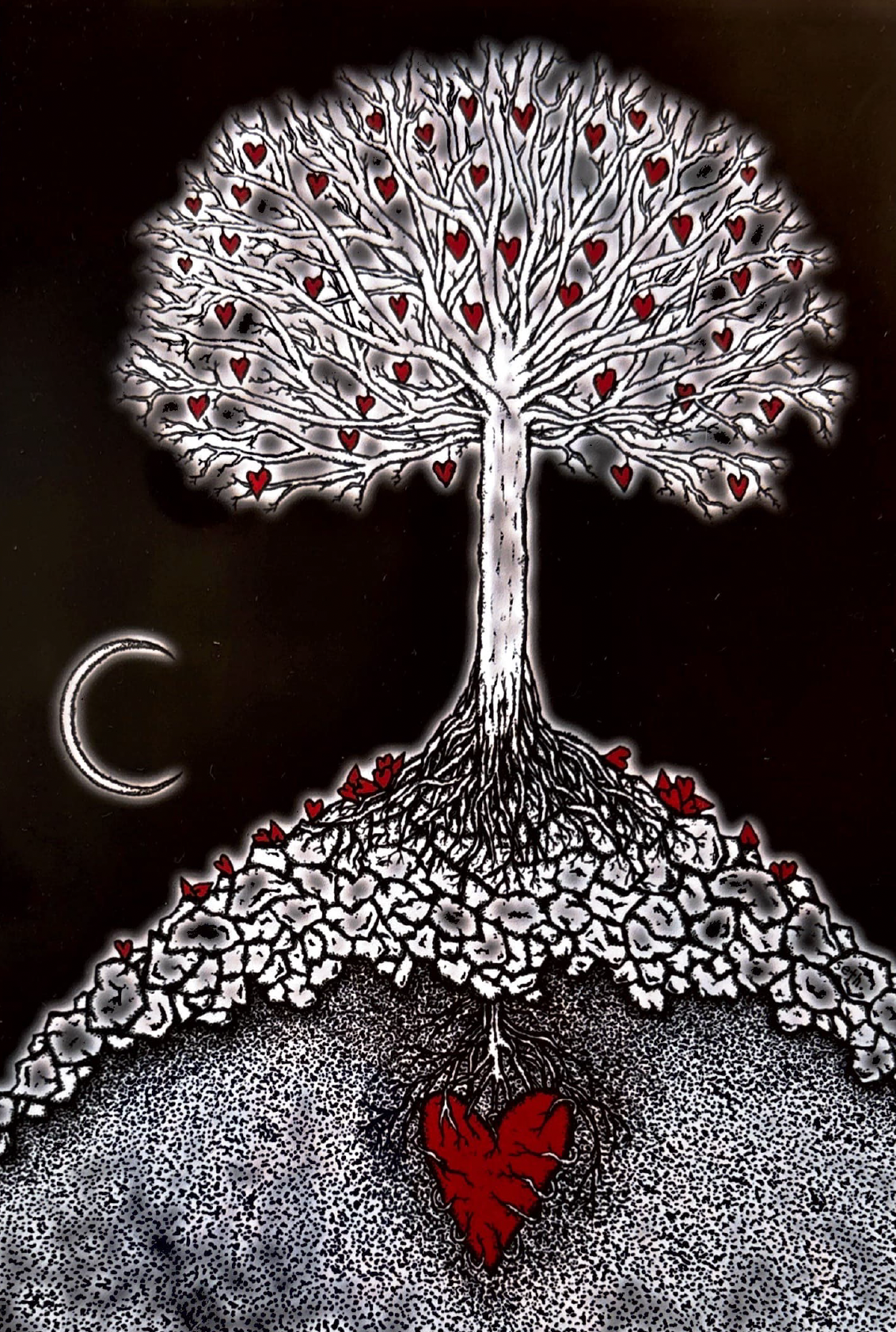
Do you believe you are held in community?
I don’t mean to ask “do you think you belong?” That is a slightly different question. Belonging is often predicated on what we do, how we appear, the way we act.
I mean, do you believe that you are held in love and care by the collective? Do you believe it, and by that I mean do you feel it in your bones, as a solid feeling in your gut? Do you believe you are held? That regardless of your attributes or accomplishments or identities, you are woven tightly into the fabric of community, the people who surround you, who you consider beloveds, you will not fall away?
In 2021, I celebrated my 50th birthday and I anticipated doing so alone; not by choice, but also not not by choice. We were, after all, in a pandemic that was still swirling around us (whether we had the bandwidth or willingness to acknowledge it as such or not). I had also just uprooted myself and moved to an entirely new town in an entirely new state post-divorce; my kids all lived in different cities, and I am not a fan of parties where I am the object of the celebration. (Whether that is simply a facet of my personality or my parents sparked that feeling by taking me to Farrell’s at the wrong developmental stage of my childhood is up for debate, but it does persist. I am not the kind of person who appreciates public acknowledgment of my birthday by singing waiters or birthday parties with more than five people or so. But I digress…)
I fully expected to spend the day alone and I was frankly unsure how I would feel, but then a series of things happened to change that. My youngest daughter and her boyfriend texted to say they were driving up to spend the day with me and my heart broke open a little bit. A new friend I had recently met texted to ask (randomly, she swears) when my birthday is and when I told her “two days from now,” she offered to take me out to dinner to celebrate. The crack widened a bit more. Then my aunt and uncle messaged to ask if they could take me out to lunch for my birthday and I cracked wide open.
On the day of my birthday, when I was as wide open as I’ve ever been, a really magical thing happened that still makes me cry when I think about it.
I am lucky enough to be part of a group of humans who know ourselves as The Nest. Most of us haven’t met in person, but we decided somewhere along the way to embark on an experiment in radical compassion and community care. As part of this, we have vowed to have each others’ backs and support each other no matter what, practice offering what we can – from time and a listening ear to practical support – and extending that care without strings to others in our communities and the world at large. Because we are all in different time zones, when I woke up on the morning of my 50th birthday, I saw a notification in our WhatsApp thread from Julie, wishing me a happy birthday. She knew I’d recently moved and was feeling odd about being alone on this milestone day. Another member of the group chimed in with an enthusiastic response, and then another, and within ninety minutes, there were close to 50 notifications – expressions of tender care, love, celebratory emojis.
I was overwhelmed and shaky at this outpouring of sincere, loving messages. The first thought that went through my mind was “why do they care about my birthday?” The second was “they’re only doing it because Julie started it and it would be weird not to add their wishes to the chat.” The third came in the form of a question and I truly believe it only showed up because I was already cracked open: “What if they do mean it? What if each one of them is taking a moment out of their own busy lives to sincerely think of me, hand on heart, and wish me well?”
That was the one that brought me to my knees. What if?
I texted my friend Nicci because I knew she would understand how scary it was to accept these birthday wishes. I told her that I imagined all of the love coming at me from these amazing, complex, brilliant human beings was crafting an enormous hammock. Each message wove a strand and they all came together to form a soft place for me to land. All I had to do was make the choice to climb in and be held by unconditional love, by people who were celebrating the fact that I exist in the world, but not having had that ever before in my life, it was hard to think about it as real.
Furthermore, there is no graceful way to get into a hammock. None. There is always that one moment when you wonder if someone is going to laugh at the awkward way you shove your butt over first and try not to get your foot tangled in the web of it. Or that other moment when you’re not quite sure if it will stay upright or flip and knock you out onto the dirt on your ass. We dubbed it the “Scary Love Hammock.” Nicci got it, and in that moment, she said one of the most loving things anyone has ever said to me: “I’ll hold it steady while you climb in.”
Later that week, when a bunch of folks from The Nest got on a Zoom call together and I told that story, we agreed that we would be each other’s spotters – that when one of us wanted to climb into that scary love hammock, one of us would stand by and hold it steady until they were safely inside, resting in love and care. We just had to ask.
If you can’t answer the question, “Do you believe you are held in community?” you are not alone. I am 54 years old and just beginning to have the barest sensation of trusting it. I mourn for the last five-plus decades when I didn’t know that that was what I needed more than anything else, and also, I am determined to not let any more time pass by before I start asking other people whether they feel held.
We are killing ourselves and each other because we don’t feel held. We are addicted to drugs and food, buying weapons and physically and verbally attacking each other in public because we don’t feel held. We hide behind laws and cultural standards because we don’t know what it is to hold each other – in our hardest moments and our ugliest moments and our most triumphant moments. We haven’t learned what it feels like to believe we are held even (and maybe especially) when we aren’t producing, contributing, acting or looking a certain way. The only way we will learn is to do it for each other, to take that leap of faith and hold each other in deep respect and care. When we feel like our well-being is something the collective cares about and for, we can rest in that space and come out ready to weave our strand of the hammock. It is terrifying, I know. And it is also the only thing that is left to do if we are going to make each other’s lives better.
It is capitalism and patriarchy and toxic masculinity that tells us that being held is nonsense. That we need to be Independent. That we should aspire to be smart enough to solve all of our own problems and strong enough to never let ‘em see you sweat because they might take you down or replace you if they think you’re weak. But I’m here to tell you that the other way – the scary love hammock way – is the bomb. Knowing that you can call or text someone and say, “help” and they will come is better than fresh flowers. Although, if they bring flowers, too, that’s pretty awesome.
Something I tell my beloveds these days is that “Help” is a complete sentence. You don’t have to know how to solve the issue or how I can help or even what the problem is. If you ask me for help, I will come. I will sit there with you and we will figure it out together or just hang out until you decide if it’s even something that needs to be figured out. Maybe you just want company when you’re having a shit day. Maybe you are confused and lost and you don’t want to be alone with those feelings. Or maybe you know exactly what you need but you don’t want to explain it until we’re face to face. Cool. You say help, I’m there. That’s what it means to be in it together. That’s the world I want to live in.
Human beings NEED to belong so pushing away from a group (even if it is not a healthy group to ‘belong’ to) is harder than we think. Having something else to belong to as we learn to belong to ourselves is key. That feeling of being lost and alone in the woods is terrifying, and having even one person by your side makes all the difference. Reimagining community as a place that welcomes us no matter what, that encourages us to lean on one another, that doesn't shame us for wanting to be cared for is transformational in all of the best ways. That crucible so many of us have grown up in that says that control and competition and exclusivity and materialism and exploitation and independence is what we should be striving for cracks under the weight of unconditional love and care and cooperation and generosity and connection. The moment I let myself clamber in to the Scary Love Hammock and lie down was perhaps the biggest moment of severance I've had yet. Once I saw it, I couldn't un-see it, and while it requires practice to continue to push against the old paradigm, it is magical and life-altering.