

It takes a certain kind of nastiness to turn a man’s fight for privacy into a punchline. Prince Harry walks into court to challenge the press for years of intrusion, and instead of reporting the substance, The Times wheels out its parliamentary sketch writer to sneer at him. This is “journalism” designed to humiliate.
The question is why. Why would a writer whose beat is Westminster suddenly be drafted in to lampoon the royal who is no longer even funded by the British taxpayer? The answer lies in the institutional reflexes of the British press.
The Times, like other establishment papers, has a vested interest in defending traditional power structures. A sketch writer can be used to reinforce that stance by ridiculing Harry, framing him as unserious or self-indulgent, and thereby undermining his challenge to the press.
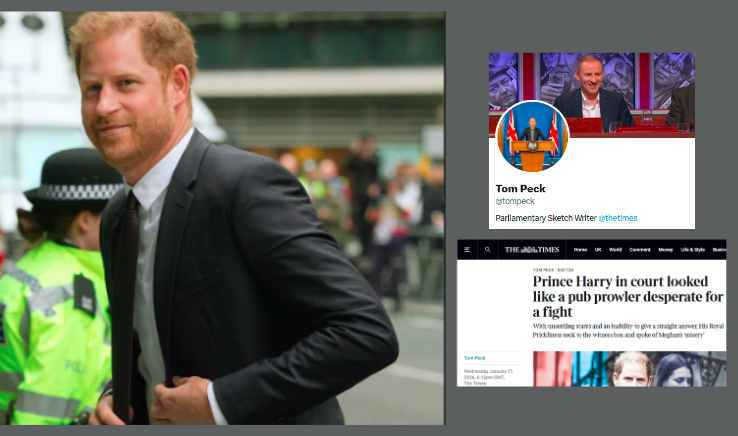 Harry’s case is dangerous to them. It threatens to expose the grubby mechanics of tabloid intrusion, the cosy deals, the casual lawbreaking dressed up as “public interest.” If he succeeds, it dents the credibility of the entire industry. So the press does what it always does when cornered: it mocks. It trivialises. It tries to turn the claimant into a caricature.
The Times benefits from undermining Harry’s credibility. It protects the press establishment and aligns with palace-friendly narratives.
This isn’t about Harry’s answers in court. It’s about sending a message: anyone who dares to challenge the press will be ridiculed, their seriousness stripped away, their motives painted as vanity. The sketch format is perfect for this. It allows cruelty to masquerade as wit, bile to pass as banter.
The nastiness is obvious. Instead of engaging with the evidence, the writer fixates on appearance, posture, imagined motives. It’s playground stuff. The cruelty is not accidental; it’s strategic. By reducing Harry to a punchline, the paper hopes readers will dismiss his case as farce rather than fact.
Beneath the sneers, though, there’s fear. The press knows Harry has struck a nerve. He refuses to play by the old rules of “never complain, never explain.” He insists on dragging their misconduct into the light. That terrifies them. So they lash out, not with evidence, but with ridicule and cruelty.
It’s worth remembering that parliamentary sketch writers are not neutral jesters. They are part of the machinery of establishment journalism. Their job is to entertain readers while reinforcing the hierarchy. When deployed against Harry, the intent is clear: to shore up the press’s own power by belittling the man who dares to question it.
So why would a parliamentary sketch writer pen a hit piece on Harry? Because satire, in the hands of the establishment, is a weapon. It’s not about truth or fairness. It’s about protecting the press from accountability, mocking anyone who threatens its grip, and reassuring readers that the old order still holds.
Harry’s fight is serious. The press’s response is petty. And the nastiness of that sketch tells us more about the fragility of Britain’s media establishment than it does about the Duke of Sussex.