

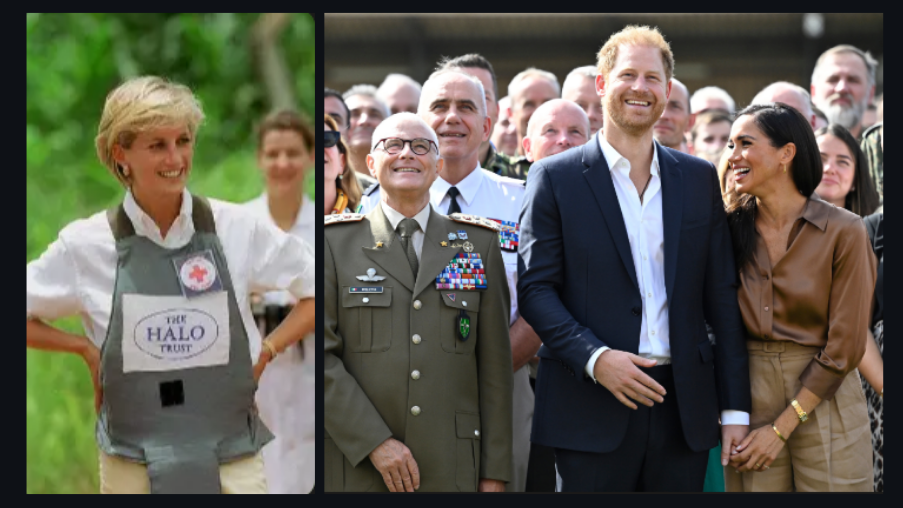
When Prince Harry addressed NATO's Military Committee in Brussels this week, one comment stood out.
Reflecting on his departure from military service, he spoke about losing "part of my purpose and identity" when he hung up his uniform. Yet he also described himself as fortunate because he had found "another way to serve." He went on to argue that the Invictus Games aren’t simply a sporting event but part of a wider effort to rebuild purpose, confidence, families, communities and resilience.
The speech sounded like the voice of a specialist advocate, rather than the words of a prince.
There was no ribbon-cutting or ceremonial appearance. It wasn’t a carefully choreographed engagement. Instead, there was a detailed discussion about wounded veterans, post-service transition, rehabilitation, and long-term support structures.
And it raises an uncomfortable question for defenders of the traditional royal model.
Harry, like his mother Diana before him, was determined to be effective even as part of the British royal family and to put their privilege to good use. But both seem to have become more effective after stepping beyond the constraints serving the royal family first and the nation second.
The British monarchy is built around representation.
Its members open hospitals, visit charities, attend commemorations, perform symbolic duties. But symbolism and advocacy aren’t the same thing.
The institutional role of a “working” royal requires political neutrality (or at least the pretence of it), message discipline, and careful management of risk. By design, it discourages strong positions, controversial campaigns and disruptive leadership.
Advocacy requires almost the opposite. It requires choosing sides and identifying systemic failures. Focusing intensely on specific causes. Sometimes making powerful people uncomfortable.
The moment both Diana and Harry moved away from the centre of the royal system, they began operating less as representatives and more as campaigners. Which helps explain why both appeared to gain momentum outside the institution.
The most significant phase of Princess Diana’s humanitarian legacy came after the collapse of her marriage and during the final years of her life. Freed from many institutional constraints, she increasingly focused on issues that other public figures often treated cautiously like leprosy and landmines.
These weren’t simply charitable visits, they became campaigns. Diana’s campaign against landmines transformed her from a royal figure into an international humanitarian actor whose influence extended beyond Britain's borders and beyond the traditional expectations of monarchy. She shifted from being a symbol associated with causes to becoming a force advancing them. That is a fundamentally different role.
The same pattern appears in Prince Harry's work.
Even before leaving royal service, the Invictus Games stood out because they reflected something deeply personal rather than institutionally assigned. His experience in the military gave him a direct connection to the challenges faced by injured veterans. This wasn’t a cause selected from a palace briefing document, it emerged from lived experience.
What has become increasingly apparent in recent years is that Invictus was never about medals. As Harry himself told NATO, sport is simply a tool. The real objective is rebuilding recovery, purpose and community. That message sounds less like traditional royal patronage and more like a specialist mission.
His NATO address revealed an ambition to develop Invictus into what he called a "global movement" capable of strengthening communities and helping nations learn from one another. Whether one agrees with every aspect of Harry's public life is almost beside the point. What’s clear is that his sphere of influence now centres around a clearly defined purpose rather than a constitutional role.
There’s a paradox at the heart of royal “service”.
The institution grants enormous visibility, but at the same time, the same institution limits how that visibility is used. A taxpayer-funded royal has prestige, access and publicity, but they also constantly operate within boundaries. They can’t become activists or pursue highly political objectives. They can’t build independent movements that might clash with institutional priorities.
Stepping outside those boundaries can reduce status - Diana had her “HRH” removed and Harry has agreed not to use his - while increasing effectiveness. But while they lost formal authority, they gained greater freedom to act, greater control over where energy, attention and influence were directed.
People tend to connect more strongly with purpose than position. Titles may generate attention, but mission sustains it.
What made Diana compelling wasn’t that she was a princess - if that were enough then Princess Michael of Kent or even Princess Anne would have been the most famous - and most photographed - women in the world. What captured attention was her visible commitment to causes and her willingness to challenge prevailing assumptions.
Similarly, Harry's most successful public work has never revolved around royalty itself. His strongest interventions emerged when speaking about veterans, recovery, mental health, service and community building. The credibility comes from commitment rather than inheritance.
Of course, both Princess Diana and Prince Harry initially benefited enormously from the platform monarchy provided. That’s undeniable. Yet the work for which they’re most admired was often accomplished when they moved beyond ceremonial representation and towards independent advocacy. Even as the Palace-Press machine launched attacks to undermine them and their work, service didn’t end when their royal roles ended. It simply took a different form.
And that’s one more connection between mother and son. Both were at their strongest when writing the mission themselves.
**
A collection of titles that take a distinctly different look at Harry, Meghan, the monarchy and the extraordinary media circus surrounding them.