
 There are rows, and then there are rows that expose something considerably bigger than the people having them.
The exchange between Mariella Frostrup and AJ Odudu on ITV's I'm A Celebrity... Get Me Out Of Here! began, ostensibly, with the allocation of cooking duties. But when Frostrup described Odudu as “aggressive”, and accused her of making a drama out of a crisis, the conversation moved beyond kitchen politics.
Odudu's response was telling:
“Please don't use those words towards me. Dramatic and aggressive are very harsh words.”
She was visibly upset. And there’s a reason, of course, that those particular words landed so heavily.
Because Black women have heard them before. Not necessarily from Mariella Frostrup, but from a culture that has spent centuries deciding that a Black woman who gives her opinion isn’t being assertive, a Black woman who objects isn’t aggrieved … and a Black woman who refuses to be agreeable, or who in any way stands up for herself, is somehow aggressive.
This isn’t a new phenomenon - the expectation that Black women should make themselves smaller, quieter and less challenging has a much longer history. At Ferris State University in Michigan, the Jim Crow Museum of Racist Imagery documents the caricatures through which Black Americans were dehumanised and controlled. Among its exhibits is the Sapphire caricature: the loud, domineering, angry Black woman, forever pointing a finger, apparently incapable of reason or restraint.
Sapphire was popularised in the 1950s television series Amos 'n' Andy, but the stereotype reaches further back, into the racist imagery and social hierarchies of slavery and segregation. It was more than an insulting cartoon. It helped establish a cultural expectation: Black women must be deferential, accommodating and quiet. When they weren't, their behaviour could be dismissed as evidence of their supposedly difficult nature.
The Jim Crow Museum makes an important point: Sapphire isn’t merely a stereotype but a mechanism of social control. It punishes Black women for refusing to be passive.
And here we are, decades later, still arguing over adjectives.
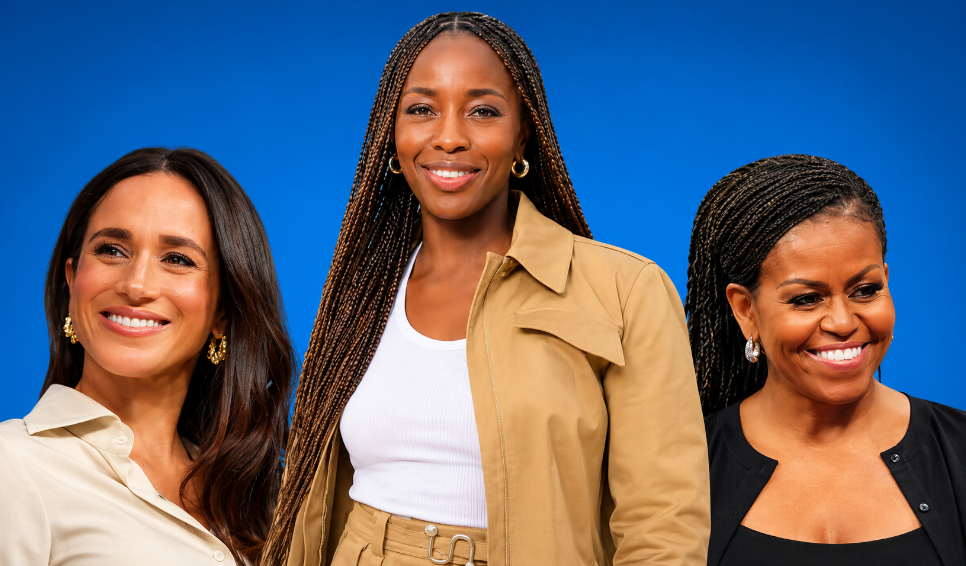
Michelle Obama knows a thing or two about this. During her years as First Lady, she was repeatedly subjected to a peculiar scrutiny of her appearance, manner and temperament. Her intelligence and confidence were recast as hostility; her directness became evidence, in the eyes of some commentators, of an allegedly angry disposition. Academic analysis of the media's treatment of Obama has documented the way old stereotypes of the domineering, threatening Black woman were revived in supposedly modern political commentary. The acceptable Black woman, it seemed, was one who could make history without ever making anyone uncomfortable.
Meghan, Duchess of Sussex, has spoken explicitly about the same stereotype. In a 2022 episode of her Archetypes podcast, discussing the subject with Issa Rae and Ziwe, she explored how the “angry Black woman” label shapes perceptions of Black women's behaviour. She recalled encountering online search suggestions asking why Black women are so loud, mean or angry.
The questions themselves are revealing. They don't ask whether a particular woman has a legitimate grievance. They invite us to believe that there’s something inherently wrong with the women themselves.
Meghan's experience in the Royal Family also provides a particularly British dimension to this discussion. Academic work examining her treatment in the British press has identified the language of disruption, irrationality and entitlement as part of a wider pattern in which a mixed-race woman who challenged royal conventions was presented as a troublesome outsider.
Michelle Obama in Washington, Meghan in Windsor, AJ Odudu in an Australian jungle. Different women, different circumstances, different audiences. But the recurring vocabulary is striking.
Context matters, of course. So does repetition. And so does the power of a word to change the subject.
In Odudu's case, the disagreement was about cooking. The really unjust thing was that she was being inordinately patient, speaking softly and calmly and never once raised her voice or even gestured excitedly. But once Frostrup labelled her aggressive, attention shifted from what Odudu was saying to how she was supposedly behaving. She was then left explaining why the description was hurtful, rather than simply being allowed to make her point.
Nigel Farage, Mariella will no doubt be delighted to learn, stuck up for her. Not everything is racist, yada yada. And perhaps we don’t have to conclude that Frostrup consciously intended to draw on a racist caricature. A person can use a word without knowing all the cultural baggage it carries. But ignorance of that baggage doesn't make it disappear.
Except …
Speaking to English football legend Wayne Rooney and actor and television presenter Claire Sweeney, Frostrup later claimed that Odudu was “angry” at being called aggressive. But she wasn’t. She was upset, visibly so.
To translate a Black woman's visible sadness into anger is to perform, almost in real time, the very stereotyping under discussion. Odudu’s objection to being called aggressive was then interpreted as further evidence of aggression. A neat, if deeply troubling, little circle: the label is applied, the woman objects, and the objection is taken as proof that the label was right all along.
Both Rooney and Sweeney, by the way, told Frostrup that they didn’t think Odudu was being aggressive. When a white footballer and a white musical theatre star think a Black woman is being unfairly labelled, it’s harder to say that Odudu was playing “the race card”.
Another revealing detail of the exchange is that Odudu had to ask Frostrup to stop using that word. The burden of managing the language, the atmosphere and the discomfort fell, once again, to the woman who had been hurt by it.
The Jim Crow Museum preserves the images of Sapphire so that we can recognise the prejudice embedded in them, rather than unconsciously reproduce it. The challenge is to recognise the modern equivalents, too. They may no longer come with a cartoon finger wagging from a television screen. Sometimes they arrive in a perfectly ordinary sentence, over who gets to cook dinner.
And sometimes, the most revealing thing about a row isn’t who raised their voice. It’s who gets called angry.