
I’ll admit it: I preferred Kate Middleton when she was missing. At least then she was interesting. Well, not her exactly. But the mystery of her absence gave us something to chew on, a flicker of drama in an otherwise dull royal soap opera. Remember the thrill of not knowing whether that was really her in the car with Carol and the sunglasses? Or skipping along with shopping bags at a farm shop?
But now she’s back, more boring than before, the Pre-cancerous Cells script having seemingly wiped out the Racist Kate storyline.
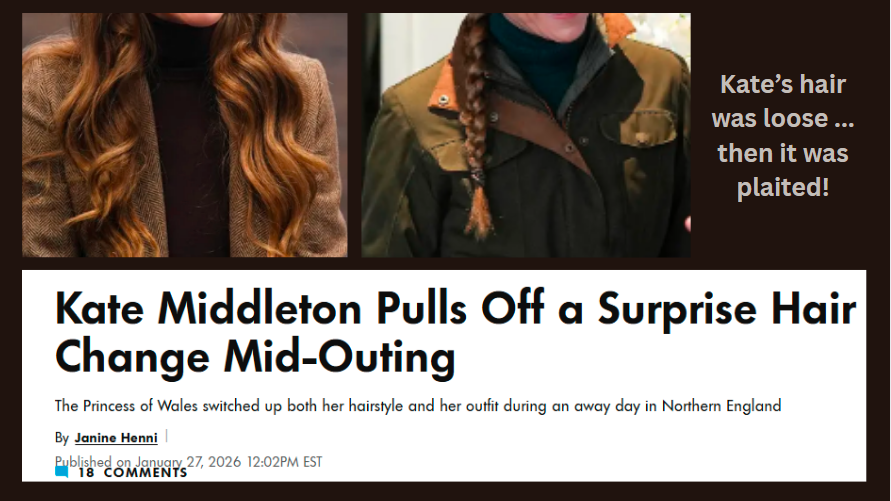
The latest “news” (and it pains me to write this) is that she changed her clothes and plaited her hair, maybe all by herself. Yes, really. Apparently, friends, the Princess of Wales (not the real one, I mean William's wife) arrived at one engagement in a blazer and loose curls, then (and you’ll want to sit down for this), switched into a green jacket, boots, and a braid for the next stop. This was reported as if she had split the atom or invented penicillin.
 Obviously, I have no objection to women changing their clothes. Or wearing plaits. Wear what you want, Cath.
It’s just that every time I read one of these articles, I feel myself getting thicker. She’s a grown woman. She’s supposed to be able to change her clothes and plait her hair all by herself. Yet the monarchy has infantilised her to the point where basic adult tasks are presented as headline-worthy achievements. Worse, it infantilises us too. We’re expected to clap along, to marvel at the miracle of a forty-four-year-old woman putting on trousers without assistance.
And I also have no objection to fashion. “This is a nice jacket, consider buying it” doesn’t upset me, any more than imparting knowledge like “wearing long hair in a plait can keep it out of your face” to our little ones does. And I’m pleased for Kate if she’s expanded her skill-set; a few years ago she revealed that her attempt to braid her daughter’s hair “didn’t really work very well.”
I’ll feel genuinely horrible if we later learn that there’s a very good reason why Kate struggles with ordinary tasks, and that, actually, getting dressed is a very big achievement for her. But I don’t think that’s what’s going on here. I think she ought to be perfectly capable of doing normal things, but the palace and the press still want us to give her a medal for it.
This is what having a monarchy does to a country. It shrinks our expectations of leadership, of relevance, of news itself. Instead of demanding accountability or vision, we are spoon-fed stories about hair elastics and jacket swaps. The institution thrives on this infantilisation. Kate is cast as the nation’s eternal schoolgirl:
Gold star goes to Kate for her neat braids and tidy outfits. As a special treat, Kate is to be allowed 15 minutes extra TV time before bed!
And the public is trained to accept this as meaningful. A feedback loop of banality.
The tragedy, for all of us, is that it works. These pieces are churned out because they get clicks, because enough of us have been conditioned to treat royal mundanity as national significance. The monarchy doesn’t need to do anything extraordinary; it just needs to keep us applauding the ordinary. That’s how power sustains itself. By lowering the bar until plaiting your own hair looks like a triumph.
“JP”, you might say. “Why don’t you simply NOT read these articles?”
Well, friends, sad to say, but I have to read these articles for my commentary. It’s my job to wade through them, to see what they say about modern life, culture, class, society.
If you know me, you won’t be surprised to hear that I think they say more about us than they do about her. They reflect a society where deference to royalty lowers expectations of leadership, where the act of applauding the mundane becomes part of sustaining power … where these articles reveal how the institution shrinks our sense of what matters, and, most depressingly, how easily we’re conditioned to accept it.
If I could end on a plea: don’t click these articles. Read them through archived links, or screenshots, mock and laugh at them by all means … but don’t encourage them with traffic and ad revenue. Every click tells the outlets that infantilising Kate - and infantilising us - is profitable. If we starve them of attention, maybe they’ll stop producing this guff.
And then commentators like me won’t have to read them or write about them. And we can all get back to demanding news that matters from proper journalists.