

Part I
The Lineage of Black Style Icons
If Meghan’s gala gown was a cultural statement, it was also a fashion history lesson. Charles Harbison revealed that, at Meghan’s request, the look was inspired by Zelda Wynn Valdez, a designer whose name, I’m just learning, deserves to be spoken alongside Dior and Balenciaga.
She came from a middle‑class family in Chambersburg, Pennsylvania, the eldest of seven children, and grew up in Charlotte, North Carolina. Her first training was actually in classical piano at the Catholic Conservatory of Music. She found her way into design through her uncle’s tailoring shop in White Plains, New York, and later worked as a stock girl at a high‑end boutique. There, she became the shop’s first Black sales clerk and tailor, a breakthrough in itself, given the racial barriers of the time.
By 1948, she had opened Chez Zelda on Broadway. This was historic: she was the first Black designer to own a shop on Broadway. Her boutique became a magnet for stars. Dorothy Dandridge wore her gowns with the kind of poise that made Hollywood nervous, Josephine Baker brought her designs to Parisian cabarets, and Ella Fitzgerald shimmered in her creations on stage. Valdez’s gowns were architectural yet sensual, cut to celebrate curves rather than disguise them. She was also commissioned to design the original Playboy Bunny costume in the early 1960s, a cheeky corseted silhouette that became a global symbol of glamour.
Her reputation for impeccable craftsmanship and daring cuts attracted white socialites and celebrities too, proving that her aesthetic transcended racial boundaries even in an era of segregation. She moved in circles that blended entertainment, fashion, and high society, dressing women who wanted to be seen as glamorous, powerful, and unforgettable. Later, she became the head costume designer for the Dance Theatre of Harlem, bringing her influence into the world of ballet and modern dance, while giving back to the Black community. She had also become president of the New York chapter of NAFAD, the National Association of Fashion and Accessory Designers, an organisation of Black designers.
Black glamour has always existed, even when society tried to shut the door. And Black Hollywood glamour has always been a story of invention against the odds.
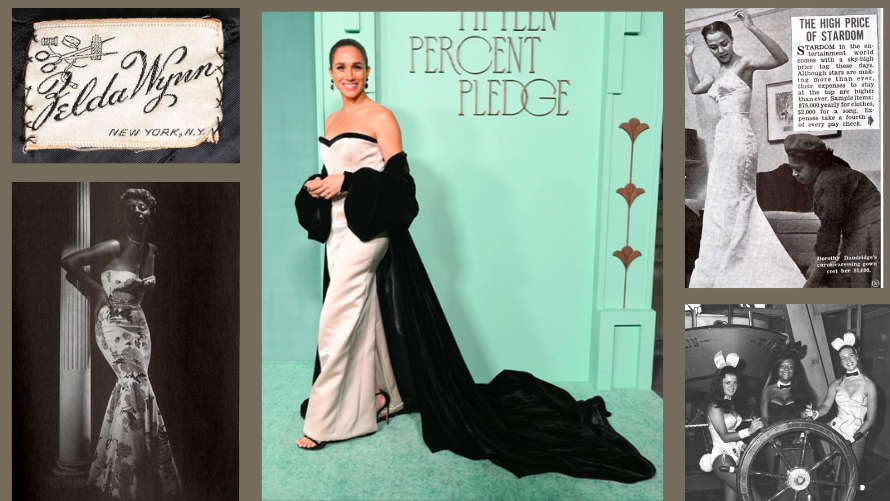 Josephine Baker, though she found her fame in Paris, was a style revolutionary: her sequinned costumes and slicked‑back hair influenced European couture houses. Dorothy Dandridge, often styled in Valdez’s gowns, brought a new kind of elegance to the screen in Carmen Jones (1954), even as Hollywood refused to give her the career she deserved. Lena Horne, with her velvet gowns and perfectly coiffed hair, became a fashion icon despite being cut from films when they were shown in the segregated South. These women were arbiters of glamour, shaping the aesthetics of an era while being denied full access to its rewards.
And then there’s Eartha Kitt, another icon who knew how to wield glamour like a weapon. Kitt often wore Zelda Wynn Valdez’s designs. Sleek gowns that matched her feline presence and razor‑sharp wit. She was the epitome of sultry sophistication, a woman who could purr a line and stop a room cold. Valdez’s gowns gave her that extra edge, turning every performance into a masterclass in allure. So, clearly, it was no accident that when Meghan posted about her gala appearance on Instagram, she paired it with Eartha Kitt’s “C’est si bon.” That choice was pure intention: a nod to a Black woman who embodied glamour decades before Hollywood was ready to embrace her fully.
Meghan’s appearance at the Fifteen Percent Pledge gala stitches her into this lineage. By requesting a gown inspired by Valdez, she was reclaiming the glamour that Black women had always embodied but were rarely allowed to showcase on Hollywood’s biggest stages. It’s a reminder that glamour itself is political. To walk into a room styled like a Hollywood bombshell while honouring Tina Knowles, the woman who raised Beyoncé, herself a master of reclaiming Hollywood iconography, is to say: this space belongs to us too.
There’s a lovely anecdotal symmetry here. Beyoncé once channelled Marilyn Monroe in an ad campaign, flipping the blonde bombshell aesthetic into something distinctly hers. Meghan, at Tina Knowles’s gala, picked up that thread … but she did it with a gown rooted in Black design history. And that’s the thing about Meghan: she’s known for being deliberate, intentional in her fashion choices. Every choice is layered, a nod, a gesture, a statement. Fashion’s really not my patch, friends, but what a treat it’s been to dig into Zelda Wynn Valdez because Meghan pointed us there. It’s intentional, it’s clever, and it’s a reminder that glamour can be more than sparkle; it can be cultural power.
Hollywood once dangled inclusion, then slammed the door shut. But the story doesn’t end there. Black women kept designing, performing, dazzling, and influencing, even when the industry refused to acknowledge them. Meghan’s gala look is part of that continuum. A moment where the glamour of old Hollywood is not just referenced but rewritten.