

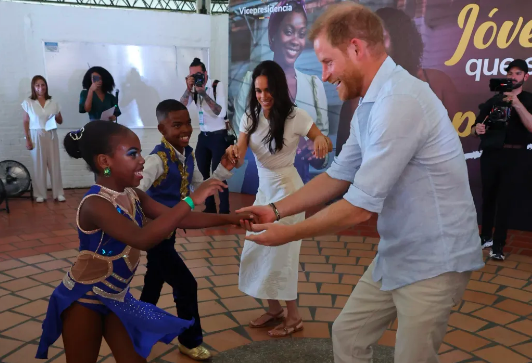
Seeing Harry and Meghan’s garden dance brought to mind the joyful dancing they brought to their overseas visits. When Prince Harry and Meghan hit the floor in Cartagena last year, they weren’t just indulging in a steamy salsa. They were participating in a centuries‑old Afro‑Caribbean tradition, joining locals in San Basilio de Palenque, a village famous for its heritage and resistance.
The symbolism was clear: instead of standing apart, they moved with the crowd, letting rhythm do the diplomatic heavy lifting.
 It wasn’t the first time. Back in 2019, on their South Africa tour, Meghan and Harry danced in Nyanga township. Footage shows Meghan clapping along, Harry fixing her ponytail mid‑groove, and both laughing with locals. Again, the message was simple: we’re here to share, not to lecture.
Dance as diplomacy isn’t new. During the Cold War, the US and USSR sent ballet and modern dance troupes abroad to project soft power. Dance tours were used to build cultural bridges and showcase national values. Dance collapses language barriers, communicates trust, and, crucially, levels the playing field. You can’t out‑rank someone mid‑salsa; you can only move together.
So what makes the Sussexes’ spins noteworthy?
First, they’re consistent. Whether it’s salsa in Colombia or drum beats in Nyanga, they choose dance over stiff protocol. Second, they’re strategic. Dance is harder to spin negatively: it’s joy embodied, and even hysterical Daily Mail columnists would struggle to frame a twirl as sinister. Third, it’s relational. Their marriage itself is choreographed in these moments. It’s intimacy turned outward, offered as a diplomatic gesture.
Of course, trolls called it performative. But that’s kind of the point: diplomacy is performance. The question is whether the performance resonates. In Colombia, salsa was a nod to Afro‑Caribbean heritage; in South Africa, it was a gesture of solidarity with children in a township. Both moments landed because they were culturally situated, not imposed.
Sometimes the most effective gesture isn’t a speech or a summit, but a spin. Dance is democratic, embodied, and memorable. It says: we’re willing to look silly, to share joy, to move together. And in a world where protocol often builds walls, a twirl can knock them down.