
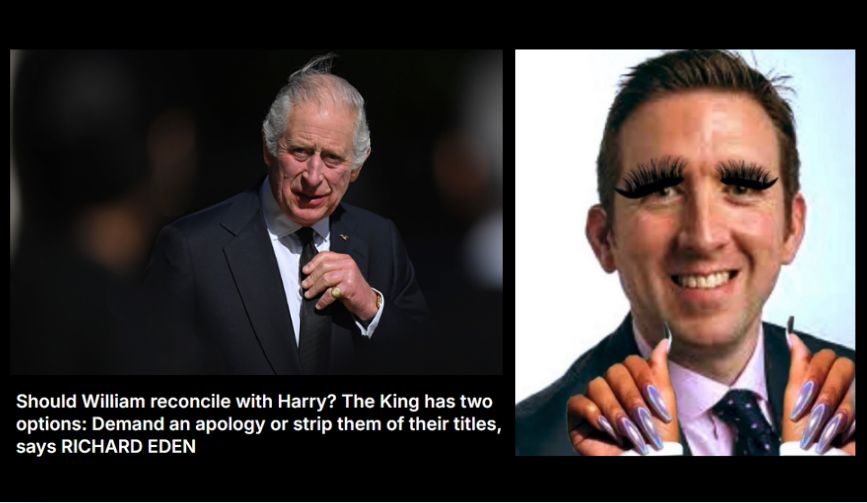
The Daily Mail has a revealing little piece (no need to watch the video) where it quite openly instructs King Charles on what he must do about the Duke and Duchess of Sussex. Pa has only two options, according to the Fail - “demand an apology or strip them of their titles”.
The curious thing about Richard (better known as “Maureen”, due to a Twitter burner account SNAFU) Eden’s little ultimatum isn’t the melodrama (the tabloids have been cosplaying as royal disciplinarians for years), but the confidence. “Maureen” writes as though they’re issuing instructions to a junior employee who’s late with his timesheets. It’s the tone of someone who genuinely believes the King answers to them. This didn’t happen overnight. The British press didn’t suddenly wake up one morning and decide it outranked the monarch; it was trained into that belief by decades of royal dependence, silence, and strategic cowardice.
For most of the twentieth century, the monarchy treated the press like a benevolent uncle: occasionally annoying, occasionally intrusive, but ultimately a source of protection. The Palace fed them tidbits, photo ops, and carefully curated narratives, and in return the press maintained the illusion of royal stability. It was a mutually reinforcing fantasy. The monarchy needed the press to maintain myth, and the press needed the monarchy to maintain relevance. Over time, that arrangement quietly inverted. The press realised it could make or break reputations, shape public sentiment, and even steer royal behaviour simply by deciding which stories to amplify. Once you discover someone depends on you for their public image, you start to believe you outrank them. And the monarchy never complained, never explained, and never noticed the leash tightening.
The Palace’s beloved motto, silence as “dignity”, turned out to be silence as surrender. By refusing to challenge false stories, racist narratives, or outright fabrications, the monarchy effectively handed Fleet Street editorial control over its identity. If you never correct the record, the record belongs to whoever writes it first. The press learned that it could invent motivations, dictate emotional states, and assign moral failings to royals without fear of contradiction.
Eventually, it stopped pretending to report on the monarchy and started behaving like its supervisor. “Maureen”’s “two options” is just the latest version of one of the press’s favourite tricks: the false binary. Reduce a complex situation to two punitive choices, both of which conveniently reinforce the press’s authority.
Then Harry and Meghan arrived and ruined everything. They did the unthinkable: they spoke directly to the public. They corrected the record. They refused to accept the press’s disciplinary framework. They declined to play the roles assigned to them by hacks who think a byline is a coronation. They exposed the machinery and revealed that the press wasn’t a neutral observer but a controlling force that expected obedience. And nothing enrages a controlling force more than losing control. The Sussexes didn’t disrupt the monarchy so much as they disrupted the press’s self‑image. They proved that royal narratives could be bypassed, challenged, and dismantled. They showed that the press’s authority was performative, not inherent.
Now the monarchy is weaker, the public is more sceptical, and the old hierarchy is wobbling. A slimmed‑down royal family, an ageing King, an Heir who prefers invisibility … the tabloids smell vulnerability, and vulnerability invites power grabs. “Maureen”’s ultimatum isn’t about apologies or titles at all. It’s about reasserting dominance. It’s a reminder to the monarchy of who sets the terms of engagement. It’s a reminder to the public of who gets to define royal legitimacy. And it’s a reminder to Harry and Meghan that the press still believes it is the arbiter of all royal behaviour, including theirs, even if the evidence suggests otherwise.
The press thinks it outranks the King because the monarchy taught it to. Decades of deference, silence, and reliance created a media class that sees itself as custodians of the national narrative. The monarchy spent years rewarding obedience, tolerating manipulation, and outsourcing its public identity to people who enjoy the feeling of power far more than the responsibility of truth. “Maureen”’s memo is simply the logical endpoint of that relationship: a columnist telling the monarch what his options are, as though the Crown were a department they manage.
Exclusive to members:
If Harry is Making a Diana Film, It Would Be A Correction to a Distorted Story