
 In Scandinavian folklore there exist many beings that inhabit the wilderness, significantly shaping its cultural identity. In this piece we will explore the origin of one such being and the role this being plays in mythology and folklore and the enduring impact that it has undoubtedly left on Scandinavian culture.
Trolls are not just found in books in Scandinavia and Iceland but in the majestic and untamed terrain, they are beings of nature, existing in the vast tundra’s, enormous mountains, flat lands, forests, and lakes, and have inspired Artists, writers, and composers alike. In the Middle Ages and with the birth of Christianity trolls become the stuff of scary stories and fairy tales to scare children, but to our Norse ancestors these beings were very real.
Trolls in old Norse Literature:
The old sagas and poems contain numerous references to trolls but there doesn’t appear to be a clear definition of a troll, instead the sagas and poems use the word troll for a variety of different situations, for example, you have Óðinn going north to Jötunheimr to visit trolls, while Þórr goes east to fight trolls. In fact, the word troll appears to overlap descriptions of jötunn (giant), þurs (hostile monsters), risi (heroic beings) and huldrefolk (Norwegian) huldufólk (Icelandic) meaning ‘hidden people’.
In Snorri Sturluson’s Edda, Skáldskaparmál we have an exchange between Bragi, the first named poet, and a troll woman. This encounter is recorded by Snorri in c. 1220-30, much later than the poem is thought to be. As Bragi makes his way through the forest late in the evening a troll woman challenges him.
“Trolls call me moon of the dwelling-Rungnir, giant’s wealth-sucker, storm-sun’s bale, seeress’s friendly companion, guardian of corpse-fjord, swallower of heaven wheel; what is a troll other than that.”
“Poets call me Vidur’s [Óðinn’s] thought-smith, getter of Gaut’s (Odin’s) gift, lack-nought hero, server of Ygg’s (Óðinn’s) ale, song-making Modi, skilled smith of rhyme; what is a poet other than that.”
- Skáldskaparmál [1]
This type of encounter between human and troll repeats itself many times and is often seen as not just a threat to humans but also as a threat to the cosmos. Here the troll woman speaks of the “swallower of heavens wheel” It is often thought she is referring to the swallowing of the moon at Ragnarök. Interestingly Lindow in his book “Trolls” suggests that after this encounter trolls are nearly always associated with threats to the cosmos, death, chaos and darker magic which he states mirrors the gendered system of the time associating women with the darker magical elements. [2]
I hear you shout, but not all trolls can be female, well probably not but it is interesting that in Snorri’s Edda there is a list known as a þulur which contains many names of troll women, some recognizable some not, but there are no names for male trolls only male jötnar and no þulur for female jötnar.
In Völuspá (Seeress’s Prophecy), trolls are also involved in the ultimate fate of the cosmos.
“In the east sat an old woman in Iron Wood and nurtured the offspring of Fenrir; a certain one of them in the form of a troll will be the snatcher of the moon”. [7] (translated by Carolynne Larrington;1996)
It isn’t difficult to see how truly frightening trolls appeared to be to the ancient Norse people when you combine the form of the troll in Völuspá, Fenrir’s breaking of his bonds at Ragnarök and the swallowing of the moon you can see how our ancestors feared these shapeshifting beings.
In Heimskringla (Ynglinga Saga), Snorri quotes an earlier poem called Ynglingatal attributed to Þjóðólfr of Hvinir where the poet uses the word troll. In stanza 3 we see the words “troll related” or “trollkund”.
“But to visit the brother of Vili
the creature of magic arranged for Vanlandi
when the troll-related night-Hildr (witch)
was to tread underfoot
the enemy of the band of men
and that necklace-destroyer [king]
whom the nightmare strangled
burned on the bed of Skúta”
Snorri cites this verse in connection with the story of a Swedish king Vanlandi who visited a Finn (Snær the Old) and married his daughter, Drífa. The following spring, the king returned to Uppsala and failed to keep a promise he had made to return to Drífa within three years. After ten years, Drífa arranged for a woman with magical powers (seiðkona) to charm the king back to Finland or kill him.
Shortly after the king found himself eager to return to Finland, but his advisers dissuaded him from the trip. The story goes on to say that the king was attacked by a ‘nightmare’, but this was not a bad dream, rather a supernatural female being, who disturbed men and animals in their sleep. It is said that when the king’s men protected his head, she attacked his legs, and when they protected his legs, she attacked his head and killed him.
Snorri’s ‘troll-related witch’ appears to be a powerful sorceress, capable of shapeshifting, and becoming invisible, traits very much associated with trolls.
In Kormáks saga we see another weaving of trolls into one of his verses. Kormákr stated that a fair woman gave his ring to the trolls and appears to imply that the ring was thrown away. In another verse, he says that trolls have done something to a woman, perhaps trampled or enchanted her. There is yet another troll mentioned in a verse attributed to Kormákr’s adversary Holmgöngu-Bersi in which Bersi says: ‘May the trolls take me if I never again redden my sword with blood.’
It’s in Kormáks saga that we really start to see trolls becoming collective beings who are mysterious and inexplicable, much like the landvættir (land spirits), and dísir (collective female spirits).
Trolls in Magic:
Trolls are heavily associated with fjölkynngi and Trǫlldómr. fjölkynngi appears to be an all-encompassing name for various forms of magic and sorcery and is mentioned in early sources but Trǫlldómr is not mentioned until much later. However, the poetic edda does reference certain beings and sorcery which are related both to the concept of Seiðr and Trǫlldómr.
The term Trǫlldómr is translated to ‘troll craft’ or ‘magic of trolls’ and encompasses various magical practices that are associated with trolls including healing, causing illness and affliction, protection, curses to bring misfortune and bad luck, enchantment spells, spells to transform, sitting out, communicating with the spirits, and the use of herbs and charms, these will sound familiar to any practicing Völva.
A good example of this is in the 15th century Ketils saga hœngs we encounter a curious story where Ketil is awakened by a cracking sound in the woods, so he follows the sound, what he finds is a trǫllkona (troll woman) who he discovers is his mother. Ketil asks his mother where she is going, she replies I am going to trollating or an assembly of trolls. Later that night Ketil witnesses the riding out of different shapes unfolding in the night sky above him as well as dark creatures peeping out of the forest. This form of Trǫlldómr is the act of changing shape and going out in the form of an animal during given phases of the moon which Frisvold cites could be an alternative explanation for the line ‘a moon-snatcher in troll’s shape.’[6] There are here many similarities found with the ritual of sitting out or utiseta which is performed by many Völva’s
Trolls in Folklore:
For many Scandinavians trolls are not figments of their imaginations, when King Magnus Haakonsson modernized the laws of Norway in 1276 he made it illegal to sit outside to wake ‘mound-dwellers,’ using the word troll to identify them for the first time in law.
Many folk beliefs about trolls exist today such as lightning frightening away trolls and jötnar, this appears in numerous Scandinavian folktales, and according to Lindow may reflect the god Thor's role in fighting such beings, this "accuracy and efficiency of Thor’s lightning strikes"[3] may explain the lack of trolls and jötnar in modern Scandinavia.
Scandinavian folklore says that the absence of trolls in certain regions is the "consequence of the constant din of the church-bells". This ringing caused the trolls to leave for other lands, although not without some resistance. Numerous folklore stories relate to how trolls destroyed churches by hurling boulders and stones at them and that large local stones are described as a troll's toss.[4] Later into the 20th century, the origins of Scandinavian and Icelandic landmarks, such as particular rock formations, are ascribed to trolls who have turned to stone upon exposure to sunlight.[5]
Trolls are beings from a dark past much like the jötunn, they are beings that exist outside of society. They come from the primordial forests and mountains, occasionally invading the spaces that humans occupy. But they have left an indelible mark on both Scandinavian and Icelandic culture and Landscape.
Trolls permeate both old and modern literature, we all remember stories of trolls when we were children, my own mother read me works by the brothers Grimm and I distinctly remember “the three Billy goats gruff”, a Norwegian folktale passed down orally until transcribed by Peter Christen Asbjørnsen and Jørgen Moe and included in their collection of Norwegian folktales called Norske Folkeeventyr first published in 1841.
J.R.R. Tolkien, Theodor Kittelsen’s and John Bauer’s work all feature trolls. I remember Tolkien’s trolls, who in the hobbit were dim witted and sun hating, became much darker in the lord of the rings, becoming aligned with Sauron and mirroring the terrible events of the second world war.
Trolls also feature in music “Hall of the mountain king by Edvard Grieg must be one of the most famous pieces of classical music and features in Henrik Ibsen’s “Peer Gynt.” A story involving a troll king called Bøyg and which humorously yet profoundly explores the virtues, vices, and follies common to all humanity.
I shall leave you here with a final thought, the Swedish word bergtagna means “spirited away” or “taken by the mountain spirits.” I have often wondered if the idea of the troll taking people to the mountains was our ancestor’s way of describing mental illness or some kind of physical deformity that may have caused people to be cut off from their communities? I would be interested in your thoughts.
Written by Freyja Mae Lomas
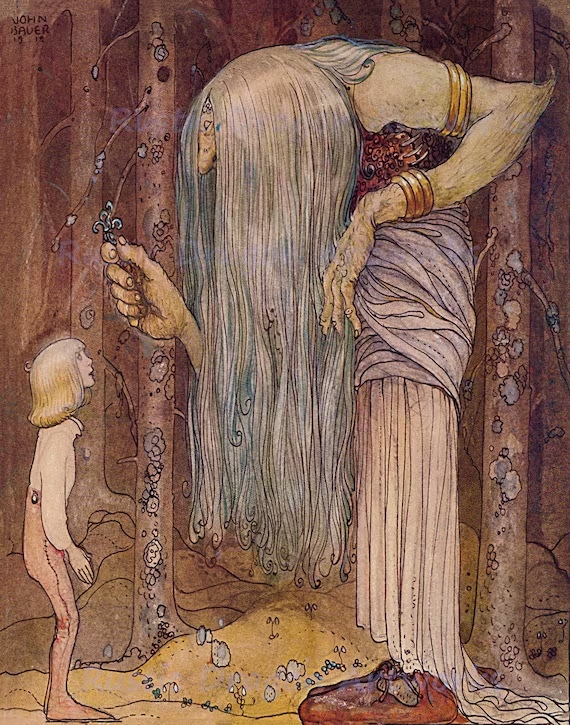
Artwork by John Bauer
References and further reading:
[1] Sturluson, Snorri. Skáldskaparmál, Anthony Faulkes translation (1995)
[2] LINDOW, John. (2014). Trolls. Reaktion Books, London
[3] LINDOW, John (1978). Swedish Folktales and Legends. University of California Press. ISBN 0-520-03520-8
[4] THORPE, Benjamin (1851). Northern Mythology, Compromising the Principal Traditions and Superstitions of Scandinavia, North Germany, and the Netherlands: Compiled from Original and Other Sources. In three Volumes. Scandinavian Popular Traditions and Superstitions, Volume 2. Lumley.
[5] Kvideland, Reimund. Sehmsdorf, Henning K. (editors) (2010). Scandinavian Folk Belief and Legend. University of Minnesota Press.
[6] FRISVOLD, Nicholaj De Mattos (2021). Trollrun: A discourse on Trolldom and Runes in the Northern Tradition. Hadean Press, West Yorkshire.
[7] LARRINGTON, Carolyne. (2014). The Poetic Edda. Oxford University Press
Further Reading
HARTMANN, Elisabeth (1936). Die Trollvorstellungen in den Sagenund Märchen der skandinavischen Völker. Stuttgart and Berlin
SCHULZ, Katja Schulz’s. (2004). Riesen: vonWissenshutern und Wildnisbewohnern in Edda und Saga. Heidelberg.
KITTELSEN, Theodor (2022). Trans by Tiina Nunnally. Troll Magic: Hidden Folk from the mountains and forests of Norway. Originally published as Troldskab. University of Minnesota Press.
IBSEN, Henrik. (2016). Peer Gynt. Penguin