
Apart from Norse folklore and mythology I also have a fascination with Archaeology, ancient languages and ancient Architecture which has led to a bit of a fascination with Norways Stave churches.
During the Middle Ages, immense stone cathedrals were constructed in many parts of Europe. But while the Europeans built there stone cathedrals, the Norwegian’s used what they new best - wood - this resulted in Norways beautiful Stave Churches.
Stave churches are characterized by the “staves,” or thick wooden posts, that hold them up. Using the same woodworking prowess that made the Vikings such adept shipbuilders, traditional stave churches were often built using nothing more that expertly crafted joints and joins, with no nails or glue. The only stones used were in the base of the structures.
As they did with the ships that carried them as far as Africa and North America, the Nordic builders coated their stave churches with tar to seal and protect the wood from freezing winters, and long days of summer sun. They coated them as they did their ships with a special glaze, made from pine resin, this took days to prepare in a massive peat-and-wood mounds
To step into one of Scandinavia’s surviving stave churches is to enter the past. Shadows shift and tell stories in the elaborate carvings of intertwined beasts that are hallmarks of the churches’ unique architecture. Sounds reverberate off the timber as if traveling across centuries. The air feels dense with the tang of wood, peat smoke, and pine tar.
The churches have wooden doors and finials that are beautifully carved, with a fascinating combination of Christian motifs and pagan Viking themes with animals and dragons.
Most stave churches were built between approximately 1130 and 1350. Once there were more than 1,000 stave churches in Norway, but nowadays only 28 remain. They range from small, simple churches to towering structures with multiple naves and elaborate decoration. Some of the most impressive include: Urnes, Borgund, Heddal and Hopperstad.
Due to the Black Death and the reformation, many stave churches disappeared. In 1650 there were around 270 stave churches, today only 28 of them remain.
The Urnes Stave Church is the most famous of Norway's stave churches, and it was added to the UNESCO World Heritage list in 1979. It is also the oldest of the stave churches dating back to 1130 it is highly preserved, and it is the most decorated.
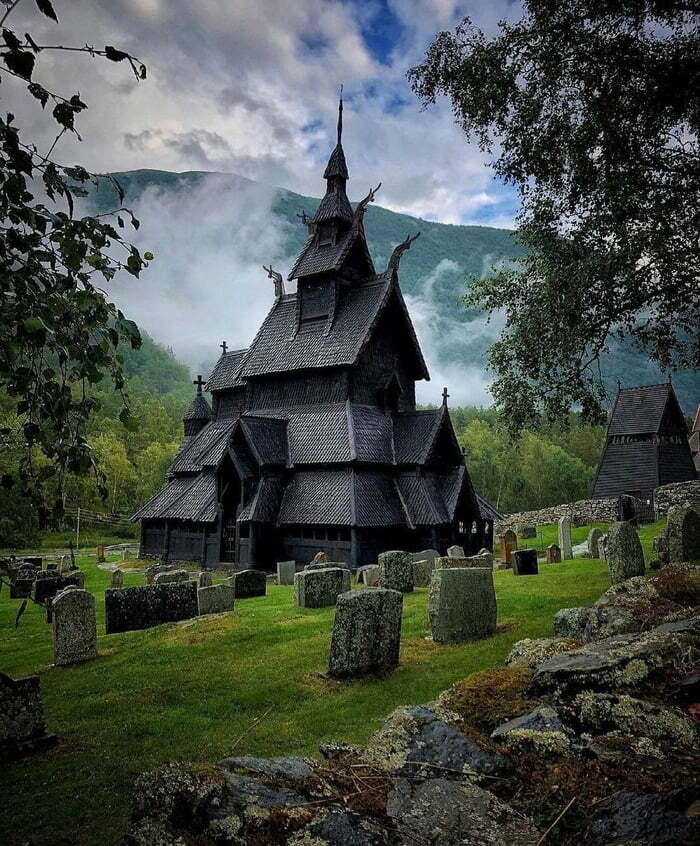
The Borgund stave church (pictured) dates from around 1180. Borgund is the most visited and most photographed church, It is also the stave church that has been the best preserved, and several runic inscriptions have been found on the walls of the church.
This runic inscription states that it was carved by a man named Þórir into a piece of wood while visiting the church during the mass of Saint Olaf during the Middle Ages.
The inscription testifies to lingering beliefs in the Norns, the female beings who rule the fates of gods and men in Norse mythology. Here Þórir blames the Norns for his troubles, just as the characters do in the Reginsmál and Sigurðarkviða hin skamma of the Poetic Edda.
The runes have been translated as -
Þórir reist rúnar þessar þann Ólausmessaptan, [e]r han fór hér um. Bæði gerðu nornir vel ok illa, mikla mœði … skǫpuðu þær mér
“Þórir carved these runes on the eve of Olaus-mass, when he travelled past here. The norns did both good and evil, great toil … they created for me”
These runic carvings fascinate me and also reassure me that the belief in the old gods did not disappear after the Christian conversion, and that as late as the end of the 12th or beginning of the 13th century, long after worship of the ancient gods was supposed to have ceased, Þórir was writing about the Norns in a Christian church. Moreover, he has an accurate view of the Norns and their involvement of his fate, proving the old ways may have been suppressed but they were never forgotten 🖤
Written by Mae Lomas