
Last year TapNPaddles gave me a Friday evening time slot to host a weekly pickleball event. They gave me freedom to do whatever kind of format. I could do a ladder, point play, open play -- basically any kind of structure I wanted. It was up to me.
For part of the year, I was doing a mixed doubles ladder. The benefit of this was that you didn't have to know anyone. You signed up solo and got to meet some people. It was perfect if you didn't already have a set play group. I tried different formats like up and down the river (winners move up and split, losers move down and split) and basic ladder (where winners move up and split, losers stay and split -- except at the top aka Royal Court where the winners would stay and the losers would drop all the way down to the bottom and start over).
We had a really great turnout for the first few events and then sign ups slowly dwindled. When I surveyed players why they weren't signing up, the biggest complaint was the quality of the play. Players wanted the games to be competitive so they wanted to play with and against better players. Since I didn't limit registrations (the event was open to everyone), the girls weren't signing up because they guys who were playing were not great. And, when I asked the better male players to sign up, they wouldn't sign up because they said the female players who were signing up were terrible. The general consensus was that players weren't signing up because, as they moved up the ladder or up/down the river, they would inevitably have to play with someone lesser skilled because you split up each time.
Taking this feedback into account, I thought to myself, "How do I fix this problem?" So then, I came up with the idea of people signing up as teams. Partners would be set so basically you wouldn't have to play with anyone you didn't care to play with. If you didn't enjoy playing with your partner then that would not be my fault or the format's fault, it would basically be because it was your choice to play with that person. LOL. And if you disliked playing with certain players, then you just don't partner with them.
This actually also had a positive side effect of eliminating those players that people just don't enjoy playing with or against because, in general, those players couldn't find partners. And, you had to have a partner to sign up so then they never could sign up. This totally solved my "quality" issue and people were signing up to play again.
However, there was still the issue of format. Players got to play with their chosen partner but I had to figure out a way to make the game fun and fair.
Up and Down the River: By far, this is my favorite format for ensuring that play is the most competitive. Since winners move up and losers move down, after a few rounds, the teams basically filter themselves. The better teams would be in the top two courts and the weaker teams ended up in the bottom two courts. To keep things simple, we declared the winner of the final game of the night on the top court to be the King and Queen. The disadvantages of this format is that you totally could win only a couple of games (I'm exaggerating a bit here for emphasis) and win. You just have to win at the right time. Most of the time, the winningest team did win but that doesn't always happen and there's no guarantee. For instance, you could win every single game at the top court but then lose the last game so the winning team technically had a worse record but still won. The other complaint I heard with this format is that sometimes you get to play only a couple of different teams. If a weak team doesn't ever make it out of the bottom court, then they would never get to play against certain team and they feel like they're missing out. In a way, toward the end, the games are super competitive because the teams playing against each other are similarly skilled but, if you're looking for variety, there really isn't much because you're likely bouncing back and forth between two courts for the most part. And, if you have played the same team for the third time that night and it's a team that you cannot seem to overcome, then it can be a frustrating evening.
Ladder: To solve the variety issue and give players the opportunity to play against different teams, we decided to switch to a ladder format. Winners move up and losers stay. So winning teams basically climb the ladder until they reach the top court and Royal Court. Once at Royal Court, the winner gets to stay and the loser drops back down to the bottom and starts their climb all over again. In this format, the most competitive games are on Royal Court because only the best teams eventually make it to the top. As with the up and down format, the winner of the final game is declared King and Queen; but this poses the same issue. You could win all night and lose the last game. We solved this issue by implementing a tracking system. You got one point for winning games on each court and two points for winning games on the Royal Court. The team with the most points wins. We also made it fair by drawing court positions, so you could choose to start at the Royal Court and just camp out. Obviously, starting on Royal Court gave those teams an advantage because they could earn two points right off the bat but starting on that court was the luck of the draw. We resolved the issues of fairness and scoring and everyone seemed to be happy with how the winners were determined but the other complaint that I got about this format is some teams get stuck on the same court all night and never get to move. The better players feel awful for these teams and, if you happen to be on a team that wins zero games, it can be really demoralizing. We were improving but it still wasn't perfect.
Swish Round Robin: Zach Young, one of the players who frequented Friday night play, suggested we use Swish to randomize the matches. This solved the variety issue because you got to play against different teams and you would never play the same team twice. This also solved the fairness issue for me because Swish tracked everything -- wins and losses, points earned, point differential, etc. -- so we always had a clear winner at the end of the session. Additionally, it didn't matter which court you started because we're not doing a ladder or river format. You should played and tried to score as many points as you can (since points are a way to break ties). This was really the final ingredient to our winning Friday Night Fiesta formula. Since we switched to this format, registrations have been consistent and players seemed to have a great time each week.
Besides organizing play, I also bring small gifts to give to the winners as prizes. We have crowns that we use for photos. We celebrate the winning team each week and to maximize bragging rights, I keep track of the winners by collecting the photos. Some players win a lot and sometimes even with different partners, which is a great accomplishment!
Here's a video montage of pictures I've taken of various winners last year:
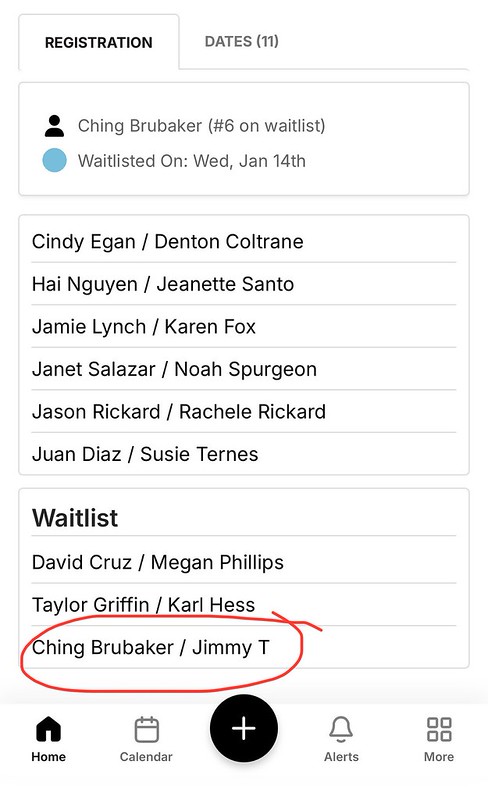
Fast forward to 2026. We finally have a set structure so we will just continue what we started but the crazy thing is, Friday Night Fiesta has gotten so popular that it often fills up as soon as registration opens. For example, right now, the event is sold out for the next three weeks. Insane, right?
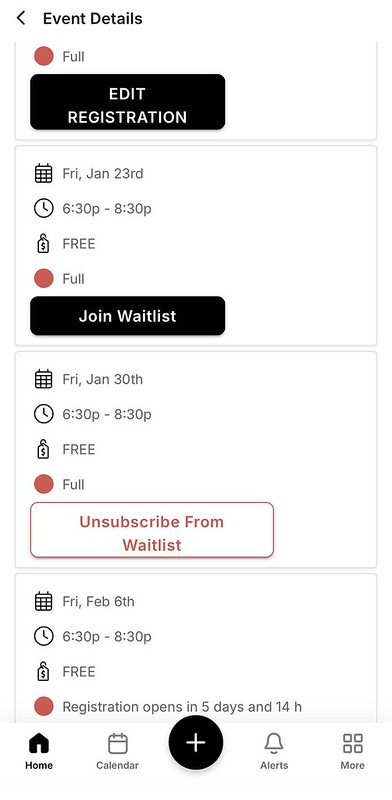 It's so popular that people sign up and fill all the spots even BEFORE I can sign myself up. I am literally waitlisted for MY OWN event. Is that wild or what? It's not great for me but it's a good problem to have. And, it makes me happy that people are signing up and seem to be enjoying the events. Here's to another awesome year of Friday Night Fiestas!