
Muscle, fascia, and walking: three lines that decline after 40 — and all three can be pulled back. The real question isn't whether it's too late. It's what you should train at the age you are now.
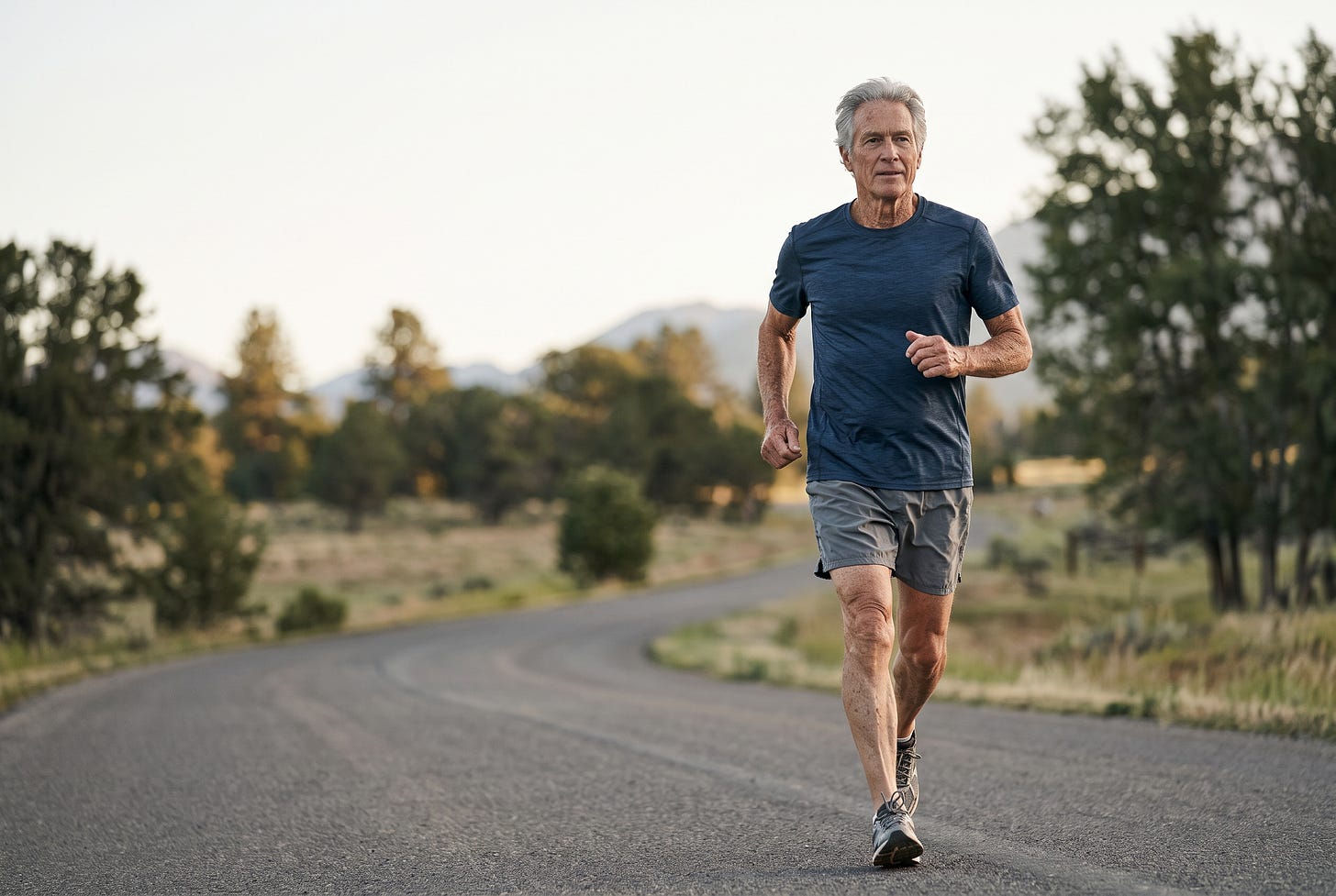
You’ve almost certainly never heard the name Juan López García.
He was not an athlete, not a coach, not a celebrity by any measure. He was a car mechanic in Toledo, Spain — 5 foot 2, a lifetime spent working in a garage. He retired at 66 and, for the first time in his life, went out for a run. On day one, he couldn’t finish a single kilometer.
Sixteen years later, at 82, he broke a 50-kilometer ultramarathon world record in Málaga, Spain.
4 hours, 47 minutes, 39 seconds. He cut the old record by a full 49 minutes.
But what actually stopped the scientific community wasn’t the time. It was what happened next.
Researchers monitored him physiologically for twelve straight months, then published the results in the Swiss journal Frontiers in Physiology.
His VO2 max was 52.8.
Here’s what that number means: it’s the highest ever recorded in a person over 80 — higher, in fact, than about 80% of ordinary 30-year-old men.
And his muscle mass? 76.8%. That’s a level you’d expect to see in a 30-year-old. No osteoporosis. No chronic disease of any kind.
One of the researchers, Iván Baltasar Fernández of the University of Castilla-La Mancha, described him in four words: “extremely rare.”
Your instinct is to file this away as a freak case. Good genes. Good luck.
At first, the researchers thought so too. But then something happened that made the question look completely different.
This isn’t one man’s story
If Juan López were alone, this would just be a curiosity.
But when you look up from him, a stranger pattern appears:
In the United States, Ernestine Shepherd didn’t start structured strength training until she was 56 — the whole thing began with a promise to go to the gym with her sister. Her sister later died, and she kept going. At 74, Guinness named her the world’s oldest female bodybuilder. “I feel better in my seventies than I did in my forties,” she says.
Also in the United States, Joan MacDonald stepped on a scale at 71 — 200 pounds, chronically high blood pressure, knees so painful she struggled with stairs. Her daughter, a fitness coach, brought her into a gym. Three years later she had lost 60 pounds, dropped her blood pressure medication, and built an Instagram following of hundreds of thousands who call her their “motivation.” “I thought that was the end of my body,” she said. “It turned out to be the beginning.”
And in the United States again, Jim Owen was 67 when he realized his body couldn’t handle a simple rowing session. He had spent his adult life as an ordinary, inactive businessman. At 70, he won a world championship on the indoor rowing machine. Now in his eighties, he still competes. His conclusion is plain: “We don’t get too old to move. We get old because we don’t move.”
In Canada, Ed Whitlock only began running marathons seriously in his forties. That’s late enough on its own — but the next few decades were the real surprise: 2:54 at 73, 3:15 at 80, and 3:56 at 85, each one an age-group world record.
In China, a man named Lu Mingpu only started structured training after retiring at 60. In September 2026, at 92, he jumped 2.05 meters to win the long jump world title at the World Masters Athletics Championships — entering six events and coming home with two golds, a silver, and a bronze. Asked whether he’d keep competing, he didn’t hesitate: “I’m going to keep going until I’m 100.”
In the UK, Charles Eugster walked back into a gym at 85 — he had been a rower in his youth, but for the decades in between he had, like most people, set his body aside. At 87 he hired a former Mr. Universe as his coach and built a six-pack within a year. After 95, he broke world records in the 200 and 400 meters.
In Japan, Michiko Morita didn’t start competing in track and field until she was 69 — before that she had only ever done table tennis and swimming, and running was completely foreign to her. At 90, she ran the 100 meters in 23.80 seconds, setting a world record. Her physical testing put her body’s function at roughly that of a 50-year-old.
Also in Japan, Hiroshi Inada only learned to swim after retiring at 60. At 70 he realized he had everything he needed for a triathlon and signed up. At 78 he lined up for the first time at the Ironman World Championship in Hawaii. He is now the world’s oldest active triathlete, Guinness-certified, with multiple age-group world titles.
Also in Japan, Yoko Nakano started running at 70 for a simple reason — after retiring, she wanted a hobby that “didn’t cost money.” She began with walking and progressed step by step. She went on to set three world records and two Japanese records in the 75-79 age group.
In South Korea, Hee-moon Jung decided to lose weight at 61, after climbing from 154 to 198 pounds, and impulsively signed up for a marathon. Twenty-five years later, he has run roughly 500 marathons. He ran the New York City Marathon at exactly 80, in 2018. “It is no exaggeration to say that was the peak of my life,” he said.
Different countries. Different genders. Different starting lines.
But they all share one thing: none of them were lifelong competitive athletes. Every one of them truly began in midlife or later.
One person doing it is luck. Two people doing it is coincidence.
When this many people do it, the question changes —
Is there a rule here that we simply haven’t been told?
Scientists put 85-year-olds and 65-year-olds side by side
In 2023, a research team at Maastricht University in the Netherlands did something few had dared to do before.
They recruited 29 healthy older adults and split them into two groups: one aged 65 to 75, the other 85 and older.
The key was the screening criteria — none of them had any structured strength-training experience. All were independent, ordinary people without serious illness.
Then they trained. Three times a week, full-body resistance training on machines, with intensity climbing to 80% of each person’s maximum. For 12 weeks.
Before the study began, the researchers had a prediction: the 85-plus group would also improve, but surely not as much as the 65-year-olds — they were twenty years older, after all.
Twelve weeks later, the results came in.
Both groups improved clearly. But what genuinely surprised them was the size of the gains:
85-plus group: muscle mass +11%, strength +46%
65-75 group: muscle mass +10%, strength +38%
The older group improved more.
On the “rise from a chair and walk” test, the 85-plus group gained 13%, while the 65-75 group gained 8%.
Why? The researchers’ explanation was remarkably plain: the 85-plus group had already declined for an extra decade, so they started lower and had more room to recover.
The lead researcher, Professor Luc van Loon of Maastricht University, said something crucial:
“Muscle tissue keeps turning over as long as we’re alive.”
In other words, muscle isn’t a battery that drains with each use. It’s a construction site that is always being torn down and rebuilt — and as long as you’re alive, the site is still active.
Tommy Lundberg, an exercise researcher at Sweden’s Karolinska Institutet who was not involved in the study, offered this assessment: “This shows that healthy older adults can of course respond to strength training — their muscle still has plasticity.”
A whole country’s data beats any single case
You can list individual cases all day, but the real persuasiveness lives in population data.
The city of Seoul runs an institution called the “Seoul Physical Fitness Center,” which tests citizens for muscle strength, cardio endurance, and flexibility. Over three months, they tested 10,000 residents and sorted the results into six levels.
When the results were released, many people couldn’t believe their eyes:
Among 70-79 year-olds, 52% reached levels 1-3 (the top three tiers) — the highest share of any age group. The 60-69 group followed at 48%.
And the share of 60-79 year-olds in levels 1-3 not only beat middle-aged 40-59 year-olds, but exceeded young people aged 20-39.
The result sparked a round of discussion in Korea. One outlet summed it up in a phrase — “steel fitness, 60-70.”
The same report added a comparison worth pausing on:
When young people stop exercising for a month, they lose about 2% of their muscle. When older adults stop for ten days, the loss can approach 10%.
In other words, the older you get, the less you can afford to stop.
Japan shows something similar. Annual measurements of sit-ups, single-leg standing time, and grip strength in people over 65 show that they outperform the 40-59 group — and that the 70-79 group’s numbers keep setting new records year after year.
The numbers all point to one thing: much of what we assume about “old people” is simply out of date.
So what does all this actually buy you?
By now you might be thinking: fine, I get that you can build strength late in life — but is it worth it?
The answer to that is far more concrete than “you’ll feel a bit better.”
First, the hardest data is on lifespan.
A Harvard research team tracked more than 110,000 people for 30 years, comparing nine different forms of exercise for their effect on longevity. The “longevity champion” turned out to be the most unglamorous one — walking, which cut all-cause mortality risk by 17%. And adding variety on top of it lowered risk by another 19%.
Another figure is even more direct: 30 minutes of vigorous activity a day is associated with nearly a 40% drop in mortality risk.
Second, the most personal data is about not losing your independence.
This is probably the most overlooked — and most important — point. Muscle peaks around age 40, then declines year by year, entering an accelerated phase after 50. In older adults who don’t exercise, muscle loss runs 1-2% per year.
“Sarcopenia” sounds like a minor term, but it doesn’t just mean “weak legs” — it means slower movement, a higher risk of falls, and eventually the inability to care for yourself.
And in the Maastricht study, the finding that excited researchers most wasn’t the muscle data. It was that “rise from a chair and walk” test: a 13% gain in the 85-plus group.
Translated into a life, that number means four words: you can still live on your own.
Bones work the same way. Exercise increases bone density and prevents osteoporosis; once muscle strength returns, the skeleton has support, and the risk of falls and fractures falls with it.
Third, chronic disease risk follows.
Some studies find that good leg strength and upper-body flexibility significantly reduce the incidence of high blood pressure in older adults. On the metabolic side, long-term exercise improves insulin sensitivity, lowers glycated hemoglobin, and visibly narrows the post-meal blood sugar swings.
And finally — something rarely written into study abstracts, but that the people themselves bring up.
In an interview, Hiroshi Inada described how he feels during training. He shouts while cycling: “This feels amazing!”
He had another line, even more grounded: “Right now is the happiest time of my life.”
Another older Korean, Man-young Jung, 85, rides the subway alone three times a week to the gym — an hour of strength training, an hour of running. “Living long and healthy comes down to one thing,” he said in an interview. “Being able to live on your own.” He carries a handwritten note that reads: “Pain that is given is painful. Pain you choose is joy.”
These feelings are hard to turn into a chart. But for someone older, having one thing you control, with immediate feedback, may itself be a kind of support.
If it’s never too late, what should you do at each age?
Reading this far, the question naturally moves down a level: if it’s never too late to start, shouldn’t the training look different at different ages?
Before the table, one thing that’s easy to miss: age doesn’t just change how much you train. It changes what you train.
Everything so far has been about muscle — its lifelong plasticity is the “strength” line. But there’s a second line inside your body. It also starts declining after 40. It’s also reversible. And almost nobody connects it to anti-aging.
It’s fascia.
Fascia is the connective-tissue web that wraps and links your muscles, bones, blood vessels, and nerves — like an invisible bodysuit. Its key feature is a lubricating layer of hyaluronic acid that lets the sheets slide against each other. The catch: during the seven or eight hours you sleep without moving, the hyaluronic acid thickens like honey left in the cold and glues the layers together — that’s morning stiffness.
A study at the University of Kent used ultrasound to measure fascia thickness in 38 people with low back pain. The finding is hard to ignore:
“For every extra 10 minutes of sitting, thoracolumbar fascia thickness dropped by 5.5 millimeters. For every 10 minutes of moderate activity, it gained 4.2 millimeters.”
In other words, sitting is physically erasing your fascia, and movement is growing it back. And a meta-analysis covering 14 studies and 1,001 participants found that people with chronic low back pain have thicker, stiffer thoracolumbar fascia than people without pain.
The good news: fascia is one of the few tissues in the adult body that keeps a high degree of plasticity. Give it mechanical load and it remodels along that line — a property called mechanotransduction. So how you move each day directly decides whether this web softens or hardens.
Put the three lines together — muscle (strength), fascia (flexibility), walking (longevity) — and you see that at each age, the weight quietly shifts among them. The American College of Sports Medicine (ACSM) guidelines for older adults, combined with these findings, sketch a table like this:
Ages 50-60: lay the foundation — work all three lines. The focus is base strength — resistance training 2-3 times a week, with movements like squats, deadlifts, and presses that recruit large muscle groups; aerobic exercise 3-5 times a week at moderate intensity. The body bounces back fastest in this window, making it the highest-return period of all — training now is like depositing principal for the next twenty years. Start the habit of moving in multiple directions, too — don’t only run, or only lift.
Ages 60-70: add “balance,” and switch on multi-directional fascia work. Keep resistance training at 2-3 times a week, but start at lower intensity (about 40-60% of your maximum), progressing by roughly 2.5% at a time. Add balance work weekly — single-leg standing, heel-to-toe walking; studies show older adults who include it have about a 34% lower fall risk than sedentary peers. Then add the fascia piece: resistance training loads the tissue in one direction, but fascia needs many — slow, multi-directional movements like cat-cow, standing leg swings, and torso twists, a few times a week, to wake the web from every angle.
Ages 70-80: lower the frequency; let walking be the anchor. Resistance training twice a week is enough, with at least a day between sessions; move toward seated variations — seated leg extensions, chair squats — to reduce joint impact. Make walking the main aerobic work, 20-30 minutes a day — Harvard’s 110,000-person study already showed that for cutting all-cause mortality, this free motion beat the gym, swimming, the treadmill, and CrossFit. But there’s a specific ceiling: past roughly 8,000 steps, the added protection for knee osteoarthritis disappears, marginal gains fall, and joint wear climbs. So at this stage, aim for movement every day — not a step count.
Ages 80 and up: fall prevention first, maintenance second. Train with support and preferably with someone present. Beyond daily balance work, two movements deserve endless repetition: the sit-to-stand transition (rising from a chair and sitting back down) — exactly what improved most in the Maastricht study; and the glute bridge (on your back, lift your hips just a centimeter, build up slowly) — which trains glute strength and the muscle-to-brain coordination that is the single most important circuit for preventing falls. The goal isn’t to get stronger. It’s to protect your ability to “stand up on your own and walk on your own.”
The most counterintuitive thing on that table is this: the older you get, the less the priority is “how hard you train” and the more it’s “don’t stop, don’t fall, and don’t stiffen up.”
The Seoul data already made this point — young people lose 2% after a month of inactivity, while older adults can lose close to 10% in ten days. For older adults, consistency matters far more than intensity. Even ten minutes of seated training plus a few minutes of multi-directional movement a day, so long as it never stops, will accumulate.
So the real answer is this: don’t wait until you’re old to start — start today, in the way that fits the age you are now. What you train today doesn’t determine how you’ll feel tomorrow. It determines whether, twenty years from now, you can still stand up on your own — and walk.
In the end
Go back to that opening line: “It’s never too late to start exercising.”
Science’s answer is far more precise than that platitude — and more honest too.
The more precise version goes like this:
Muscle tissue turns over for your entire life. So no matter when you start, strength will grow — that part is certain.
But time is a variable. Your room to recover shrinks the later you begin.
Juan López started at 66 and broke a record at 82. Ed Whitlock started in his forties and was still setting world records at 85. But someone starting at 70 may find that the brain’s line no longer answers.
So the real question isn’t “Am I still in time if I start now?”
It’s this —
The part of your body that’s still rebuilding itself: do you plan to let it keep rebuilding, or leave it idle?
It won’t wait for you to be ready. Every day, it either keeps building — or, unnoticed, quietly shuts down.
If you’ve ever thought, “I’m too old for this” — this piece is here to suggest it may be less late than you think, though perhaps not as relaxed as you’d hope.
What iBetterWithin tries to do is take the health claims we accept as “obvious” and check them against the research, one by one, so you can hear what your body is actually saying.
If that’s worth a little of your time, come listen with us.
Listening, together, to what happens inside.
References
Marzuca-Nassr GN, van Loon LJC, et al. Muscle adaptations to resistance training in adults over 85. Maastricht University, 2023. — 29 healthy, untrained older adults, 12 weeks of training: the 85-plus group gained +11% muscle mass and +46% strength, exceeding the 65-75 group.
Harvard research team, BMJ Medicine, 2026. — Over 110,000 people tracked for 30 years, comparing nine exercises: walking lowered all-cause mortality risk by 17%, with exercise variety adding another 19% reduction.
Lee IM, Shiroma EJ, et al. Association of Step Volume and Intensity With All-Cause Mortality in Older Women. JAMA Internal Medicine, 2019;179(8):1105-1112. — 16,741 older women, 4.3-year follow-up: benefits begin around 4,400 steps and plateau at 7,500.
University of Kent. Physical activity and sitting time as determinants of thoracolumbar fascia in low back pain. n=38. — For every extra 10 minutes of sitting, thoracolumbar fascia thickness dropped 5.5 mm; for every 10 minutes of moderate activity, it gained 4.2 mm.
American College of Sports Medicine (ACSM) guidelines for exercise in older adults. — For adults over 65: resistance training twice a week on non-consecutive days, starting at 40-60% of maximum, integrated with balance training.
Honest Notes
1. The muscle and fascia data come largely from small, short-term studies. The Maastricht study involved 29 people over 12 weeks; the University of Kent fascia study had only 38 participants. They can show direction, but they cannot predict long-term outcomes.
2. Whether people over 85 can substantially add muscle is still debated. Some studies observe no fiber hypertrophy and attribute strength gains mainly to neural adaptation. The more consistent conclusion is that “strength can grow.”
3. Most cases here come from media reports or individual case studies, not controlled trials. They can show what is “possible,” but not what will “certainly happen to you.” For the brain, exercise is more like “holding the line” than “retaking lost ground.”
4. This is health journalism, not medical advice. If you have underlying cardiovascular, bone, or metabolic conditions, consult a doctor before starting any training program.