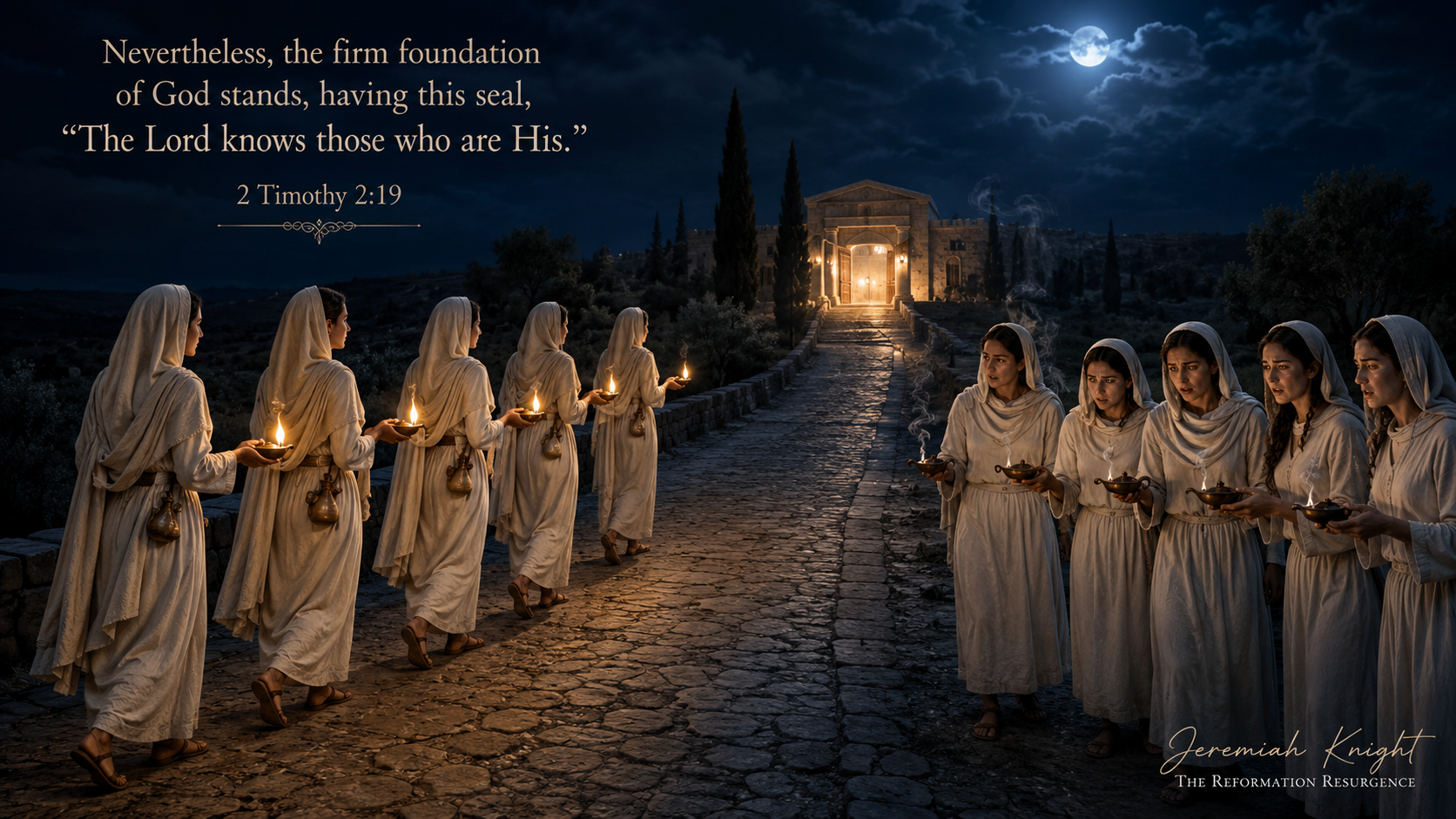

There is a parable of the Lord Jesus that should trouble every comfortable churchgoer far more than it does, because it is not a parable about the difference between the church and the world. It is a parable about a difference inside the church itself, a difference invisible to every human eye until the moment it is too late to fix. "Then the kingdom of heaven will be comparable to ten virgins, who took their lamps and went out to meet the bridegroom. Five of them were foolish, and five were prudent" Matthew 25:1 and 2. Ten virgins. Notice carefully what they had in common before we look at what divided them, because what they had in common is what makes this parable so unsettling.
All ten were virgins. None of them were harlots. In the language of Scripture, spiritual harlotry is friendship with the world, "you adulteresses, do you not know that friendship with the world is hostility toward God?" James 4:4, and none of these ten were guilty of it. Outwardly, they were pure. All ten carried lamps, and all ten lamps were burning, the visible testimony that others could see, "let your light shine before men in such a way that they may see your good works" Matthew 5:16. All ten were waiting for the same bridegroom, part of the same company, dressed for the same wedding. And all ten fell asleep when he delayed, the wise and the foolish alike, so even the sleeping did not distinguish them. If you had stood watching that night, you could not have told the five from the five. Same profession. Same lamps. Same light. Same expectation. Same drowsiness. The division ran deeper than anything observable, "for the Lord sees not as man sees, for man looks at the outward appearance, but the Lord looks at the heart" 1 Samuel 16:7.
The difference was oil. "For when the foolish took their lamps, they took no oil with them, but the prudent took oil in flasks along with their lamps" Matthew 25:3 and 4. The lamp was public. The flask was private. The light could be seen by everyone in the darkness, but no one in that darkness could see into the flask to know whether anything was inside it. And there is the whole parable in a single picture. The lamp is the outward life, the testimony, the church attendance, the service, the visible works. The flask is the hidden life before God that no human being can inspect. The parable does not pause to explain the oil, but Scripture gives us what it pictures. The oil stands for the inward reality of genuine spiritual life, the life that only the Holy Spirit produces in the regenerate heart, in contrast to outward profession without inward possession. Paul draws exactly this line, "for he is not a Jew who is one outwardly... but he is a Jew who is one inwardly; and circumcision is that which is of the heart, by the Spirit, not by the letter; and his praise is not from men, but from God" Romans 2:28 and 29. Two people can carry identical lamps and only God knows which flask is empty, "the Lord knows those who are His" 2 Timothy 2:19. Every one of us carries a flask. The only question that matters is whether there is anything in it.
Now watch what exposed the difference, because this is the hinge of the parable. "Now while the bridegroom was delaying, they all got drowsy and began to sleep" Matthew 25:5. The delay. Not persecution, not scandal, not argument. Simple, uneventful, grinding time. The foolish virgins were equipped for a short wait and a quick celebration, and if the bridegroom had come early, their emptiness might never have been exposed at all. But he delayed, and the delay did what delays always do, it outlasted everything that was not real. This is the searching truth our generation of instant decisions and raised hands needs to hear. Time tests profession. The seed on the rocky ground sprang up immediately, and the same sun that made the rooted plant grow scorched the rootless one, "and since they had no root, they withered away" Mark 4:5 and 6. The Lord Jesus interpreted it Himself, they believe for a while, and in time of temptation fall away, Luke 8:13. This is also why Scripture warns against assessing spirituality too quickly, in new converts or in ourselves, for beginnings prove very little. Judas began among the twelve. Demas began beside Paul, and time revealed him, "Demas, having loved this present world, has deserted me" 2 Timothy 4:10. Endurance is the signature of reality, "but the one who endures to the end, he will be saved" Matthew 24:13. And crisis compresses time's testing into a single hour, "if you are slack in the day of distress, your strength is limited" Proverbs 24:10. The day of distress does not create our weakness. It reveals the strength or emptiness that was in the flask all along.
Then midnight came. "But at midnight there was a shout, Behold, the bridegroom! Come out to meet him" Matthew 25:6. And in the lamplight of that moment, the hidden difference finally became visible. "The foolish said to the prudent, Give us some of your oil, for our lamps are going out" Matthew 25:8. Going out. The outward light, fed by no inward supply, could flare for a while and no longer. And here the parable delivers a truth that demolishes an assumption millions quietly hold, the assumption that grace can be borrowed. "But the prudent answered, No, there will not be enough for us and you too; go instead to the dealers and buy some for yourselves" Matthew 25:9. This was not selfishness. It was impossibility. No believer can share his regeneration. No godly mother can lend her new birth to her child, no husband his faith to his wife, no friend his walk with God to his companion. "No man can by any means redeem his brother or give to God a ransom for him, for the redemption of his soul is costly" Psalm 49:7 and 8. Each soul must have its own oil, its own dealing with God, its own life from the Holy Spirit, for "the righteous will live by his faith" Habakkuk 2:4, his own, not another's. There are people sitting in churches today whose entire spiritual confidence is borrowed, the faith of their parents, the atmosphere of their congregation, the prayers of a spouse, and midnight will find every borrowed lamp empty.
"And while they were going away to make the purchase, the bridegroom came, and those who were ready went in with him to the wedding feast; and the door was shut" Matthew 25:10. The door was shut. Four words that should sober every soul that keeps postponing reality. There is a moment after which readiness can no longer be obtained, when the day of salvation, "behold, now is the acceptable time" 2 Corinthians 6:2, gives way to the day of settlement, and the God who shut Noah into the ark, Genesis 7:16, shut everyone else out. And then the most chilling exchange in the parable. "Later the other virgins also came, saying, Lord, lord, open up for us. But he answered, Truly I say to you, I do not know you" Matthew 25:11 and 12. Hear it exactly. He does not say, you are late. He does not say, your works were insufficient. He says, I do not know you. It is the identical sentence the Lord speaks in Matthew 7:22 and 23 to those who prophesied and cast out demons and did miracles in His name, "I never knew you; depart from Me." The final tragedy of the foolish virgin is not a missed feast but a missing relationship. She was near the bridegroom's company all along and never known by the bridegroom Himself. Eternal life is not proximity to Christ's people. It is being known by Christ, "but if anyone loves God, he is known by Him" 1 Corinthians 8:3.
So, the Lord draws the application Himself, and it is a command, not a suggestion. "Be on the alert then, for you do not know the day nor the hour" Matthew 25:13. But be careful to hear what watchfulness means in this parable, because it cannot mean staying awake, since the wise virgins slept too and were not condemned for it. The watchfulness commanded is readiness, and readiness is having oil, possessing now, today, the inward reality that midnight will demand. So the question comes to each of us, and it must go past the lamp to the flask. Not, is my testimony visible, but is my hidden life real? What am I in the dark, before God alone, in my thoughts, my motives, my secret prayers, my private holiness where no human eye reaches? "Blessed are the pure in heart, for they shall see God" Matthew 5:8. Is there a life of God in my soul that would still be there if every spectator vanished, a communion with Christ that exists when no one is watching, "but you, when you pray, go into your inner room, close your door and pray to your Father who is in secret" Matthew 6:6? For "you must be holy because I am holy" 1 Peter 1:16, and the holiness God requires begins precisely where men cannot see.
And if an honest look into the flask finds it empty, if all the light in your life turns out to be lamp and no oil, then hear the one difference between you and the foolish virgins. For them, midnight had come and the door was shut. For you, it is still today, and the shout has not yet sounded. The oil that cannot be borrowed can still be sought from the Giver Himself, for the Lord still stands behind His own invitation, "buy wine and milk without money and without cost" Isaiah 55:1, and He has promised in the new covenant, "I will give you a new heart and put a new spirit within you; and I will remove the heart of stone from your flesh and give you a heart of flesh. I will put My Spirit within you" Ezekiel 36:26 and 27. Do not go to the dealers of religion for it. Go to Christ, confess the empty flask, and ask for life itself, for "he who has the Son has the life; he who does not have the Son of God does not have the life" 1 John 5:12. The bridegroom is coming. The delay is mercy, "the Lord is not slow about His promise... but is patient toward you, not wishing for any to perish" 2 Peter 3:9, but the delay will end mid sentence, at midnight, when no one expects it. Ten lamps are burning in the church today, and midnight will divide them forever. Make certain, while the door still stands open, that when He comes, He comes for someone He knows.
He who has ears to hear, let him hear.