

SpaceX just caught a spacecraft with two mechanical arms. But the extraordinary thing isn’t what happened. It’s what this says about the human relationship with the impossible.
Imagine throwing a building into the sky.
Not a small building. Not a satellite. A gigantic machine made of steel, engines, and fuel, tall enough to dominate a city skyline.
You send it beyond the atmosphere. It travels around Earth. It experiences temperatures and forces that would destroy almost anything we have ever built.
Then, instead of allowing it to fall into the ocean, you bring it back to the place it started.
And you catch it.
Not with a parachute. Not with a runway. Not with a giant net.
You catch it with two enormous mechanical arms attached to a launch tower.
On November 14, 2026, this stopped being an imaginary scene.
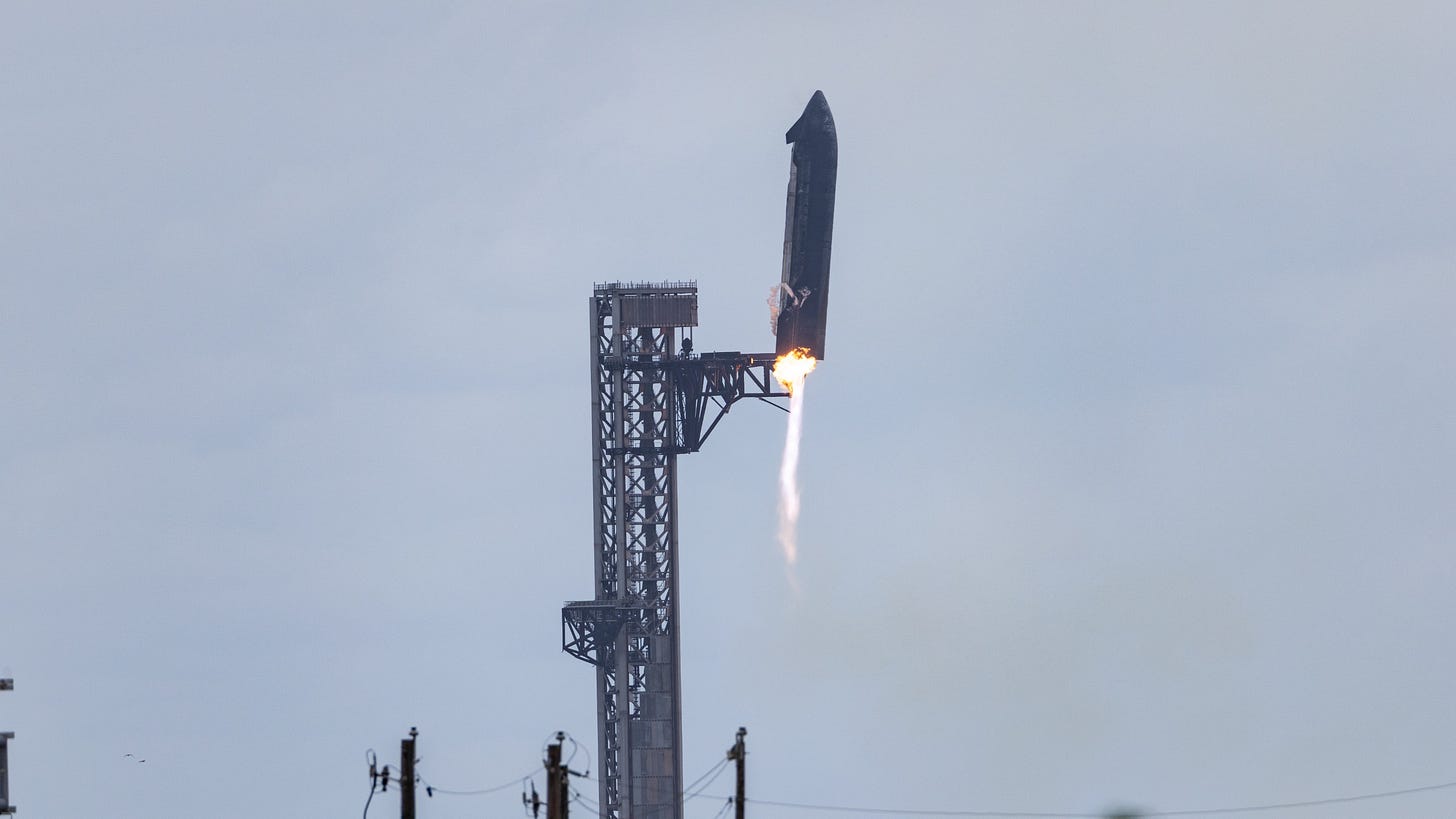
SpaceX’s Starship returned from orbit after approximately 22.5 hours and 14 revolutions around Earth. As it descended towards its launch site in Texas, its engines slowed its fall, and the tower’s enormous mechanical arms, nicknamed chopsticks, caught it.
The spacecraft was home.
For the first time, SpaceX had successfully caught Starship’s upper stage after an orbital mission.
There was a complication: the Super Heavy booster had failed to complete its planned return to the tower and instead made a controlled splashdown in the Gulf of Mexico.
It was not a perfect mission.
But something extraordinary had happened.
And perhaps the most interesting question is not how they caught a rocket.
It is why human beings keep attempting things that once seemed impossible.
WE HAVE NEVER BEEN SATISFIED WITH THE LIMITS OF THE WORLD
There was a time when the sky was a boundary.
Human beings could look at the Moon, study the stars and imagine worlds beyond their reach. But imagination was not transportation.
Then we learned to fly.
Then we learned to leave the atmosphere.
Then we learned to return.
And now we are attempting something that sounds almost absurd: building a spacecraft that can return to its launch tower and be caught by mechanical arms.
Notice the pattern.
We encounter a limitation. We study it. We challenge it. We develop a new ability. And almost immediately, that ability becomes the starting point for another ambition.
Flying was once extraordinary.
Now we complain when an aircraft is delayed.
Crossing oceans once required dangerous expeditions.
Now we check flight prices on our phones.
Reaching space was once the achievement of a generation.
Now we are discussing how to make rockets reusable.
Human beings have an unusual relationship with miracles.
We spend centuries trying to accomplish them, and then a few decades getting accustomed to them.
Perhaps progress is not simply the expansion of what we can do.
It is the continuous shrinking of what we consider impossible.
THE CHOPSTICKS ARE NOT CATCHING A ROCKET. THEY ARE CATCHING A POSSIBILITY.
The most interesting part of this achievement is not the spectacle of a spacecraft descending between two metal arms.
It is what those arms represent.
Traditional rockets are expensive partly because much of the hardware is discarded after launch. SpaceX wants Starship’s two stages to be recovered, refurbished, and flown again.
The long-term ambition is to make spaceflight more like an operation that can be repeated rather than an extraordinary event that requires building much of the vehicle again.
Think about the difference.
A disposable machine must justify its existence through one successful journey.
A reusable machine must justify its existence through the journeys that follow.
The first asks: Can we reach space?
The second asks: Can we make reaching space ordinary?
That is a much bigger question.
Because the future of space exploration may depend less on whether we can launch enormous rockets and more on whether we can make those launches affordable, reliable and frequent.
A successful catch is one step towards that future. It does not yet prove rapid reuse, and Starship still has significant engineering challenges ahead.
But the direction is unmistakable.
We are trying to transform an extraordinary achievement into an ordinary capability.
FAILURE IS NOT ALWAYS THE OPPOSITE OF PROGRESS
There is another detail worth noticing.
SpaceX wanted to catch both parts of Starship during Flight 15.
It did not.
The Super Heavy booster aborted its return to the tower after its guidance system determined that it was not in the correct position for a safe catch. It diverted towards a splashdown in the Gulf.
The upper stage, however, completed its journey and was caught successfully.
Some people will look at the mission and see a failure because the original plan was not completed.
Others will see a historic success because something never accomplished before was finally achieved.
Both observations contain part of the truth.
This is what makes technological progress so interesting. It rarely arrives as a perfectly executed story.
It arrives as a collection of partial victories, unexpected problems, failed experiments, and discoveries that change what engineers believe is possible.
The important distinction is whether failure produces information.
A failure that teaches us nothing may simply be a failure.
But a failure that reveals a weakness, exposes an assumption or makes the next attempt more informed can become part of progress.
The booster did not make it back to the tower.
The spacecraft did.
The mission was imperfect, but our understanding of what is possible changed.
Perhaps we should be more careful about judging progress by whether everything went according to plan.
Sometimes the most important thing that happens is the thing nobody had successfully done before.
THE STRANGE HUMAN DESIRE TO MAKE THE IMPOSSIBLE BORING
There is something almost tragic about our relationship with achievement.
Imagine the engineers who worked on this system.
They spent years designing, calculating, testing, and correcting. They dealt with problems that most of us would struggle even to understand.
And eventually, a spacecraft returned from orbit and was caught by a tower.
For a brief moment, the world watched something that looked like science fiction.
But what happens next?
The next mission will be expected to do it again.
Then again.
Eventually, people will stop being surprised.
That is the peculiar nature of human ambition.
We pursue extraordinary things, but we rarely remain satisfied with their extraordinariness.
We want to repeat them. Improve them. Make them cheaper. Make them faster. Remove the drama.
We do not merely want to accomplish the impossible.
We want to make it routine.
And once it becomes routine, we begin searching for another impossible thing.
Perhaps this is why humanity never truly arrives.
We keep moving the destination.
WHAT ELSE HAVE WE DECIDED IS IMPOSSIBLE?
There is a temptation to look at Starship and think this is simply a story about rockets.
It isn’t.
It is a story about the assumptions that quietly govern human life.
There are things we have been told cannot be done because nobody around us has done them.
There are limitations we accept because they have existed for so long that we have mistaken their existence for necessity.
There are problems we inherit, repeat and defend without ever asking whether they can be solved differently.
Of course, not every limitation can be overcome. Reality has laws that ambition cannot negotiate with. And believing something is possible does not make it so.
But there is a difference between respecting a genuine limitation and surrendering to an imagined one.
The engineers at Starbase did not make gravity disappear.
They learned how to work with it.
They did not eliminate the danger of returning from orbit.
They developed systems to manage that danger.
They did not make the spacecraft weightless.
They built something capable of carrying its own weight back home.
Perhaps that is the real lesson.
Progress does not always mean defeating reality.
Sometimes it means understanding reality so deeply that you discover possibilities hidden inside its constraints.
And perhaps the next time someone tells us that something cannot be done, we should ask a different question.
Is it genuinely impossible, or have we simply not learned how to do it yet?