

🎯 TODAY'S HIGHLIGHTS
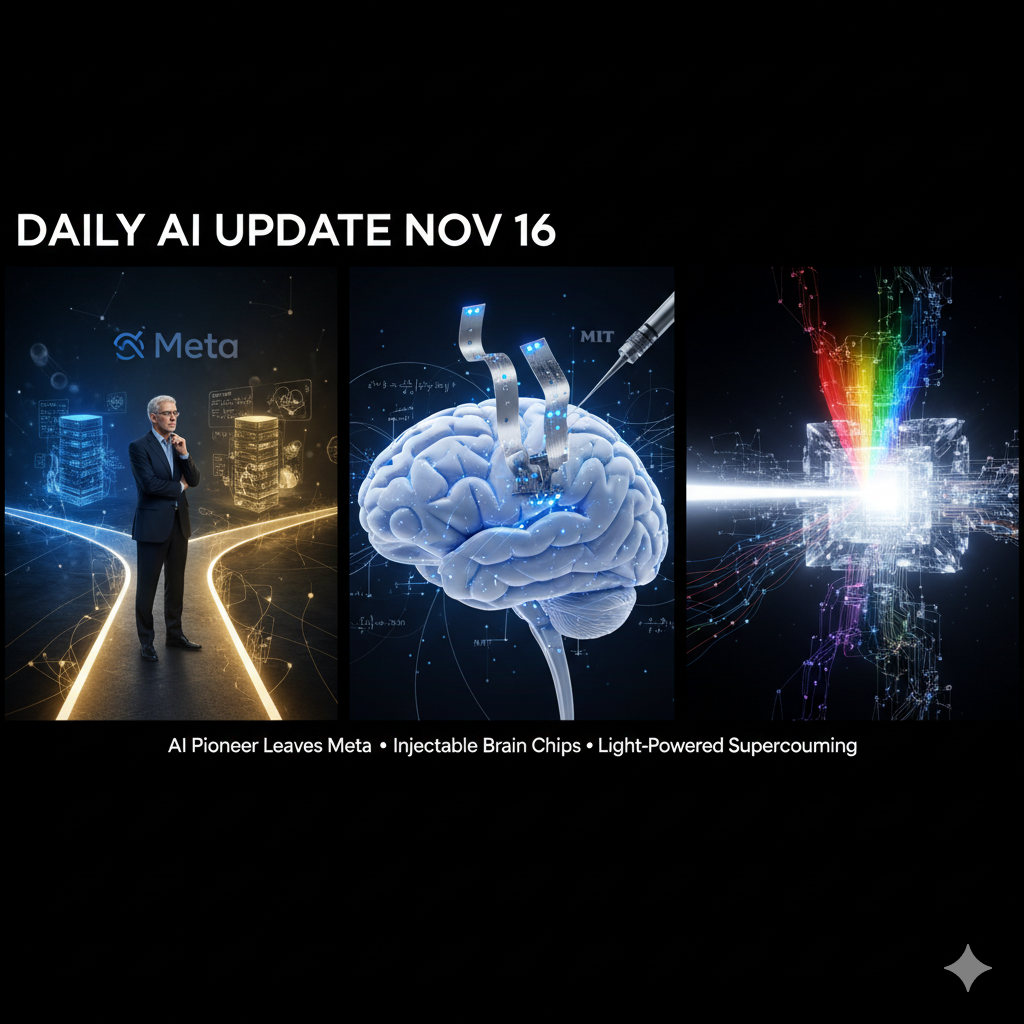
AI godfather Yann LeCun is parting ways with Meta over philosophical differences about the future of intelligence, MIT just unveiled injectable brain chips that sound like science fiction, and a breakthrough optical computing system is running AI with the power of a supercomputer using just a single beam of light. Plus, Google's planning a staggering $40 billion Texas data center investment, and we've uncovered tools that could revolutionize how AI agents work.
Why this matters: 5,643 AI articles published yesterday so you don't have to wade through them. Here are the 30 stories actually worth your time—the ones shaping boardroom conversations, breaking the internet, and changing how you'll work tomorrow.
⭐ EDITOR'S PICK
#1 AI pioneer Yann Le Cun is quitting Meta over the future of intelligence [france24.com]
One of AI's founding fathers is leaving Meta after years of leading their AI research. LeCun's departure signals a major philosophical divide about the direction of AI development, particularly around "world models" that could enable machines to understand reality like humans do. This isn't just a personnel change—it's a seismic shift in how one of the biggest AI players will evolve.
🔥 TRENDING NOW
#2 MIT Invents Injectable Brain Chips [futurism.com]
MIT researchers have developed brain chips so small and flexible they can be injected through a needle, eliminating the need for invasive surgery. The chips unfold inside the brain to monitor neural activity, potentially revolutionizing how we treat neurological conditions and interface with technology. We're talking Neuralink-level capabilities without drilling holes in your skull.
#3 A single beam of light runs AI with supercomputer power [sciencedaily.com]
Scientists have achieved what sounds impossible: running AI computations at supercomputer speeds using optical computing instead of traditional electronics. This breakthrough uses light instead of electricity to process information, potentially solving AI's massive energy consumption problem while dramatically increasing speed. This could be the computing revolution that finally makes AGI feasible.
#4 Google plans $40 billion Texas data center investment amid AI boom [indianexpress.com]
Google is betting big—$40 billion big—on AI infrastructure with a massive data center expansion in Texas. This investment dwarfs most AI acquisitions and signals Google's commitment to maintaining dominance in the AI race. When tech giants spend this much, they're not making bets, they're seeing the future clearly.
#5 How Google's DeepMind tool is 'more quickly' forecasting hurricane behavior [theguardian.com]
DeepMind's AI can now predict hurricane paths and intensity faster than traditional models, potentially saving lives through earlier, more accurate warnings. The system doesn't just match meteorologists—it's beating them at speed while maintaining accuracy. Climate prediction just got its ChatGPT moment.
💼 FOR PROFESSIONALS
#6 'Imagine a Cube Floating in the Air': The New AI Dream Allegedly Driving Yann LeCun Away from Meta [gizmodo.com]
LeCun's vision of "world models"—AI systems that can imagine and simulate reality like humans do—represents a fundamental departure from Meta's current approach. This isn't about better chatbots; it's about machines that truly understand physics, causality, and spatial relationships. The fact that Meta isn't prioritizing this vision tells you everything about industry tensions.
#7 Q-Filters: The Game-Changing KV Cache Compression That's Making AI 32x More Efficient [towardsai.net]
Researchers have cracked a major bottleneck in AI efficiency with Q-Filters, compressing the memory required for language models by 32x without sacrificing quality. This means faster responses, cheaper inference, and the ability to run powerful models on devices that couldn't handle them before. Efficiency breakthroughs like this are what make AI ubiquitous.
#8 MCP, Agents, Agentic AI & RAG — The Complete Blueprint for the Next Era of AI [towardsai.net]
This comprehensive analysis breaks down how Model Context Protocol (MCP), AI agents, and Retrieval-Augmented Generation are converging into the next evolution of AI systems. We're moving beyond static chatbots to dynamic agents that can reason, retrieve information, and take action autonomously. Understanding this architecture is crucial for anyone building with AI.
#9 Why MCP-Powered Agents Fail Miserably in Production and How Cloudflare's New Strategy Just Solved It [generativeai.pub]
While everyone's excited about AI agents, they're failing spectacularly in real-world deployments—and this article explains why. Cloudflare's engineering team has identified the core problems with Model Context Protocol implementations and developed solutions that actually work at scale. This is the difference between demo magic and production reality.
#10 India's AI shift moves from pilots to performance: EY-CII Report [thehindubusinessline.com]
India's enterprise AI adoption has hit an inflection point: 47% of companies are now deploying multiple AI use cases in production, not just running pilots. This shift from experimentation to execution signals genuine transformation in how businesses operate. When nearly half of enterprises are beyond the pilot stage, that's a market worth watching.
🛠️ TOOLS & PRACTICAL
#11 How Mem0 is Revolutionizing AI Memory: The Breakthrough That Makes ChatGPT Actually Remember You [towardsai.net]
Mem0 solves one of AI's most frustrating limitations: the inability to remember you across conversations. This system gives AI genuine long-term memory, learning your preferences, context, and history to provide increasingly personalized responses. Imagine ChatGPT that actually knows you—that's what we're talking about here.
#12 A Practical Guide to Prompt & Context Engineering [towardsai.net]
This hands-on guide cuts through the theory to show you exactly how to engineer prompts and context for reliable AI outputs. It's not about tricks or hacks—it's about understanding how context windows work and structuring information for optimal results. Essential reading for anyone doing serious work with LLMs.
#13 How to Build Tools for AI Agents [towardsai.net]
AI agents are only as good as the tools you give them, and this guide shows you how to build reliable, production-grade tools that agents can actually use. From API integrations to custom functions, you'll learn the architecture patterns that make agentic AI work in practice, not just in demos.
#14 Pollo 2.0 Is a Very Cheap Video Model That Delivers Quality on Par With Sora 2 and Veo 3.1 [generativeai.pub]
Pollo 2.0 is disrupting AI video generation by offering Sora-level quality at a fraction of the cost. This democratization of advanced video generation could unleash a wave of creativity and content production that was previously gated behind expensive API access. When premium capabilities become affordable, markets explode.
#15 Context Engineering Is All You Need [towardsai.net]
Forget prompt engineering—context engineering is where the real power lies. This article argues convincingly that how you structure and present context to AI models matters far more than the specific words you use in prompts. It's a paradigm shift in how we think about AI interaction.
⚡ BREAKING DEVELOPMENTS
#16 Is Waymo Ready for the Icy Streets of Detroit and Denver? It Had Better Be, Because It's Coming [gizmodo.com]
Waymo is expanding to Detroit and Denver, its first cold-weather markets with snow and ice—conditions that have historically challenged autonomous vehicles. This is either Waymo's confidence showing or a high-stakes bet that their systems can handle winter driving. Real-world autonomy requires operating in ALL conditions, not just sunny California.
#17 AI creates the first 100-billion-star Milky Way simulation [sciencedaily.com]
AI has enabled the most detailed simulation of the Milky Way ever created, modeling 100 billion stars and their interactions. This computational achievement would have been impossible without AI acceleration, and it's unlocking new insights into galactic formation and evolution. When AI helps us understand the universe better, that's profound.
#18 AI tool in national disease surveillance helped issue over 5,000 alerts to health authorities: data [thehindu.com]
An AI-powered disease surveillance system has issued over 5,000 outbreak alerts to health authorities since 2022, providing early warning for infectious disease threats. This is AI saving lives at scale, not through flashy demos but through systematic monitoring and pattern detection that humans couldn't match.
#19 How much of the AI data center boom will be powered by renewable energy? [techcrunch.com]
As AI data centers multiply, the question of their environmental impact becomes critical. This analysis examines how much of the explosive growth in AI computing will run on renewable versus fossil fuel energy. The AI revolution's sustainability depends on solving this equation correctly.
#20 Farming the future: Why AI could be the most powerful tool against climate uncertainty [thehindubusinessline.com]
AI is emerging as agriculture's best defense against increasingly unpredictable climate patterns, optimizing crop selection, irrigation, and harvest timing based on sophisticated weather and soil analysis. When food security meets climate chaos, AI-driven farming could be the difference between abundance and shortage.
🚀 INNOVATION & RESEARCH
#21 Attention really is all you need — The Encoder [towardsai.net]
This deep dive into transformer architecture explains why the "attention mechanism" remains the foundation of modern AI, from ChatGPT to image generators. Understanding attention is understanding how AI actually works under the hood. Even as architectures evolve, attention remains central.
#22 PAN: A World Model for General, Interactable, and Long-Horizon World Simulation [towardsai.net]
Researchers have developed PAN, a world model that can simulate interactive environments over long time horizons—think of it as AI that can imagine and predict complex scenarios far into the future. This capability is fundamental to building AI that can plan, strategize, and anticipate consequences like humans do.
#23 Beyond the Chat Window: LLMs as Strategic Decision Engines [towardsai.net]
This research explores using large language models not for conversation but for strategic decision-making in business contexts. We're talking about AI that weighs options, considers constraints, and recommends high-level strategies rather than just answering questions. The shift from chat assistant to strategic advisor is happening.
#24 LLM Interview Series: RLHF (Reinforcement Learning from Human Feedback) Demystified [dev.to]
RLHF is the secret sauce that makes ChatGPT helpful rather than chaotic, and this guide breaks down exactly how reinforcement learning from human feedback works. Understanding RLHF is understanding why modern AI systems behave the way they do and how alignment actually happens in practice.
#25 Can AgentFold Solve Search for Web Agents? [towardsai.net]
AgentFold tackles one of the biggest problems with web-browsing AI agents: they can't efficiently search and navigate complex websites. This research could unlock truly autonomous web agents that can accomplish tasks across multiple sites without getting lost or confused. Solving navigation is solving half the agent problem.
💡 WORTH WATCHING
#26 What I learned from Google's 5-Day AI Agents Intensive Course (Day 4): Quality & Evaluation [towardsai.net]
Google's internal training on AI agent development reveals their approach to quality assurance and evaluation—the unglamorous but critical work that separates toy demos from production systems. If Google's teaching framework emphasizes evaluation this heavily, you know it's the real bottleneck in agent deployment.
#27 Google Gemini now lets users guide AI video with multiple reference images per input [the-decoder.com]
Gemini's new multi-image video guidance represents a significant leap in controllability for AI video generation. Instead of describing what you want in text, you can now show the AI multiple reference images to guide style, composition, and content. This is how creative tools evolve from prompts to precision.
#28 A.I. Chatbots Are Changing How Patients Get Medical Advice [nytimes.com]
AI chatbots are now being used for preliminary medical advice, changing the patient-doctor relationship and raising important questions about accuracy, liability, and healthcare access. This shift is happening whether the medical establishment is ready or not, driven by patient demand for instant, accessible health information.
#29 From Shiny Object to Sober Reality: The Vector Database Story, Two Years Later [venturebeat.com]
The vector database market has matured from hype to reality, with clear winners emerging and use cases crystallizing. This retrospective on the vector DB boom provides important lessons about how infrastructure markets evolve during AI transitions. Not everything hyped survives, but what does becomes essential.
#30 Human-centric IAM is failing: Agentic AI requires a new identity control plane [venturebeat.com]
As AI agents proliferate, traditional identity and access management systems designed for humans are breaking down. This analysis argues we need entirely new approaches to identity, permissions, and security for a world where agents act autonomously on our behalf. It's a security challenge we're not prepared for yet.
📊 Today's crawl: 5,643 articles • 219 rated by Gemini • 1,507 feeds monitored
🎯 MY TAKEAWAY
Three major themes emerge from today's news, and they're all converging on a single inflection point: AI is transitioning from experimental technology to fundamental infrastructure.
First, the leadership drama at Meta with Yann LeCun's departure isn't just gossip—it's a philosophical battle about the future of intelligence. LeCun's vision of "world models" represents a fundamentally different approach to AI than the scaling-focused strategies dominating the industry. When one of AI's godfathers publicly breaks with a major player over technical direction, that's a signal that the field hasn't settled on the path forward. We're still in the "format wars" stage of AI development, where different approaches are competing to define the future. This uncertainty should make everyone cautious about betting too heavily on any single approach.
Second, the infrastructure investments are staggering and telling. Google's $40 billion Texas data center bet, the explosive growth in disease surveillance systems, the expansion of autonomous vehicles to harsh climates—these aren't experiments, they're massive capital commitments based on proven returns. When you see this much money flowing into AI infrastructure, it means the business case has been proven repeatedly in private. The public conversation is still debating "will AI transform industries?" while the smart money has already moved to "which infrastructure wins the transformation?" If you're still skeptical about AI's impact, you're not looking at where the serious money is going.
Third, and most crucially, the bottleneck has shifted from "can AI do this?" to "can we make AI do this reliably at scale?" Every single tools and practical article today—from MCP agent failures to context engineering to evaluation frameworks—is about productionization, not capability. The demos work. The challenge now is making them work consistently, safely, and economically in real-world conditions. This is where fortunes will be made and lost: not in building flashier demos, but in solving the unglamorous problems of reliability, efficiency, and deployment.
If you're building with AI, stop chasing capabilities and start obsessing over reliability. If you're investing, follow the infrastructure money, not the hype. And if you're planning strategy, understand that we're entering a phase where execution matters more than innovation. The technology works—now we need to make it work everywhere, for everyone, all the time.