
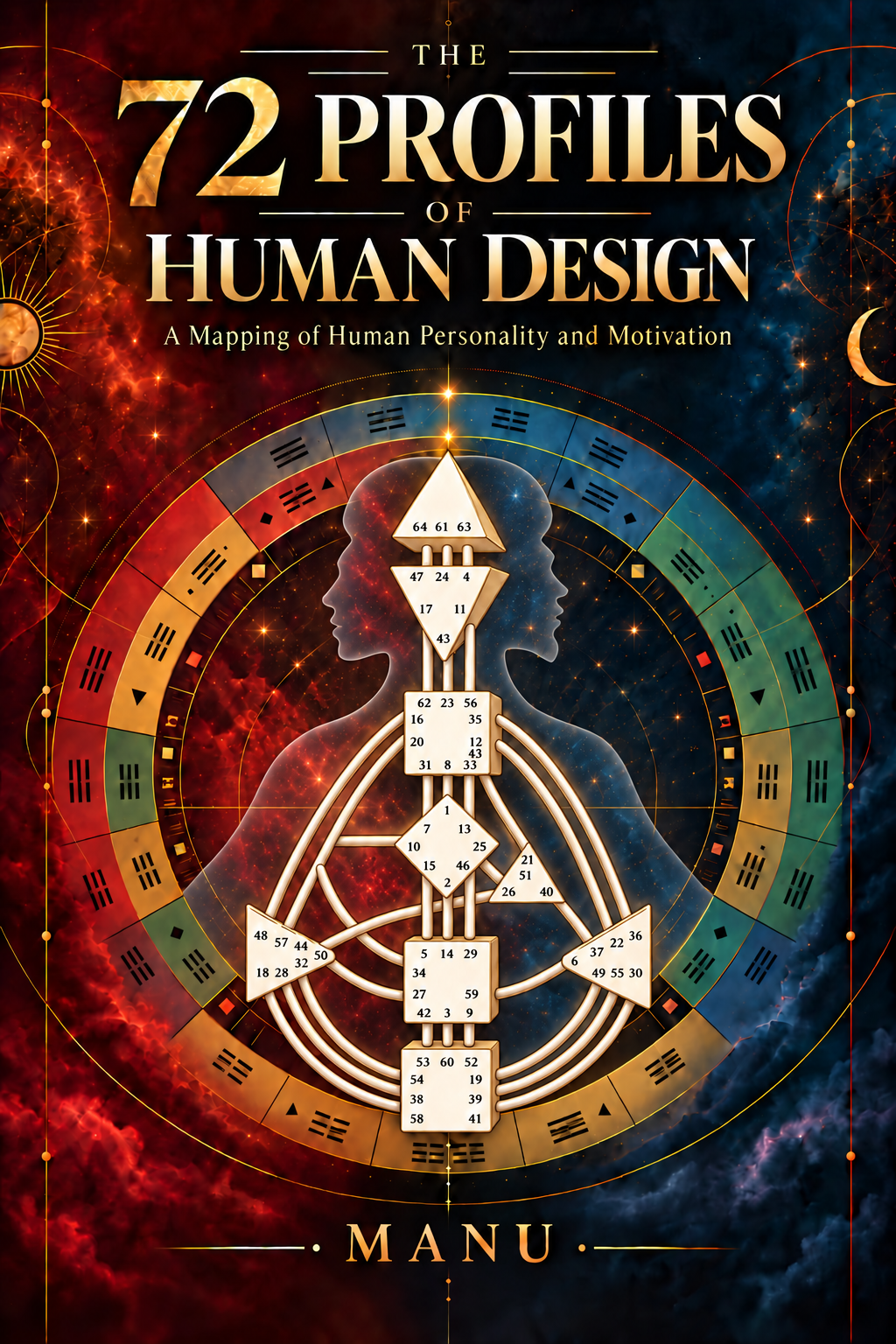
 My new book, The 72 Profiles of Human Design: A Mapping of Human Personality and Motivation, is now available as a 201-page PDF for $19.99.
This is a revised edition of the work I began in Beyond the Twelve Profiles. It continues a question that has held my attention throughout nearly two decades of studying and applying Human Design: how do shared patterns become particular in an actual person?
Two people may recognize themselves in the same Profile and still be very different to spend time with. One wants to investigate every detail before proceeding. Another has an instinct for what can be allowed to develop. Someone may be willing to help and discover, only after agreeing, that the demands of the arrangement are difficult to live with. A broad description can give us something useful to recognize while leaving these differences unexplored.
This book brings the familiar Profile together with two finer distinctions in the Human Design framework: Personality Color and Design Color. Personality Color concerns Motivation, the interest beneath a person's thinking. Design Color concerns Determination, the body's way of receiving nourishment and experience. The 72 entries consider these themes together, with attention to how they may become visible in ordinary life.
Why these differences matter
We often judge an encounter by the part of it we can see. Someone asks for more time, and we hear reluctance. Someone explains a problem in detail, and we miss the care they were trying to express. A capable person continues helping until their patience shortens, and the people around them are surprised because the effort had looked easy.
The book stays close to situations like these. It considers what a person may be trying to understand or contribute, as well as the conditions under which their participation is taking place. Their intention matters. So does the experience of the person receiving their words or actions.
An evening conversation provides a simple example. One person is finishing a task when their partner introduces a concern, then another, then something that happened last week. The first person may care about each concern and still struggle to receive all of them at once. Asking to finish the task could make room for a more attentive conversation, provided they actually return and listen. The detail that matters is what happens between those two people, including whether the promise is kept.
Reading for yourself
For personal study, I suggest beginning with your entry and reading it all the way through. It is easy to recognize an ability and pass over the strain that accompanies it, or to recognize a difficulty and overlook the useful contribution underneath.
The descriptions give you something to observe over time. You might notice when investigation becomes an endless collection of prerequisites. You might recognize the point at which allowing a possibility to develop turns into managing everyone involved. You may find that a wish to improve something is more useful when you can name the particular help you are prepared to offer.
These are examples of themes explored through what Human Design calls motivational transference. The question is what has begun directing your attention. Preparation, rest, ambition, and helping can each have a place in a person's life. Their presence alone does not explain the whole situation.
You can also notice the practical conditions of participation. The sequence of a task, a familiar method, the sound around a conversation, or the light in a room may be worth paying attention to. The book explores those ideas within Human Design and leaves room for observation rather than prescribing a regimen.
Reading with family and friends
When someone you know appears in a description, there can be a temptation to feel that you have finally explained them. I would rather the recognition make the next conversation more attentive.
You can read a passage together and ask whether it resembles their experience. Perhaps the useful question concerns how they prefer to learn something new. Perhaps it is about what they understood when you offered help, or how much time they thought a commitment involved. Their answer may confirm something you noticed, or it may show you something the description did not capture.
The chapters return often to ordinary agreements. A private person can care about a relationship and still need to be clear about shared time. Someone with a strong direction can acknowledge what they want while hearing that another person wants something different. A generous offer becomes easier to receive when its scope is understood.
I hope these descriptions help readers make more room for that kind of specificity. Being understood can include having your limits heard, your intentions considered, and the effects of your actions taken seriously.
A companion for professional study
If you read, teach, or practice Human Design, this book can serve as a reference alongside your existing work. The entries give everyday expression to the relationships among Profile, Motivation, and Determination. Comparing neighboring entries allows you to consider how a similar conscious orientation is described with a different physical theme.
That comparison can help you prepare a more useful question. You might ask what draws someone into a task, what happens once other people begin relying on them, or which circumstances make their contribution easier to sustain. Their response can then guide the conversation rather than having the description decide it in advance.
The illustrations are my interpretive synthesis, not documented individual case histories. The wider BodyGraph, finer distinctions within the system, and the person's circumstances remain relevant. Human Design is the framework of this book; the profiles are not presented as scientifically established classifications of personality or physiology.
Finding your place in the book
To locate your entry, you will need your familiar two-number Profile, your Personality Sun–Earth Color, and your Design Sun–Earth Color. The book's finder lists the 72 combinations and their entry numbers and pages. A chart showing only your Profile does not supply everything needed, and the Colors attached to the Nodes are not the two values used here.
The opening chapters explain the six Motivations, the six Determinations, and motivational transference. You can begin there, find your own entry, and return to other descriptions as your study develops. The closing reflections bring the attention back to living with our differences and to the fact that a person will always have more to reveal than a description can hold.
The 72 Profiles of Human Design is available for $19.99. You can read the sample before choosing the full PDF. If this is a question you have been exploring in your own life or your work with others, I invite you to spend some time with it.