
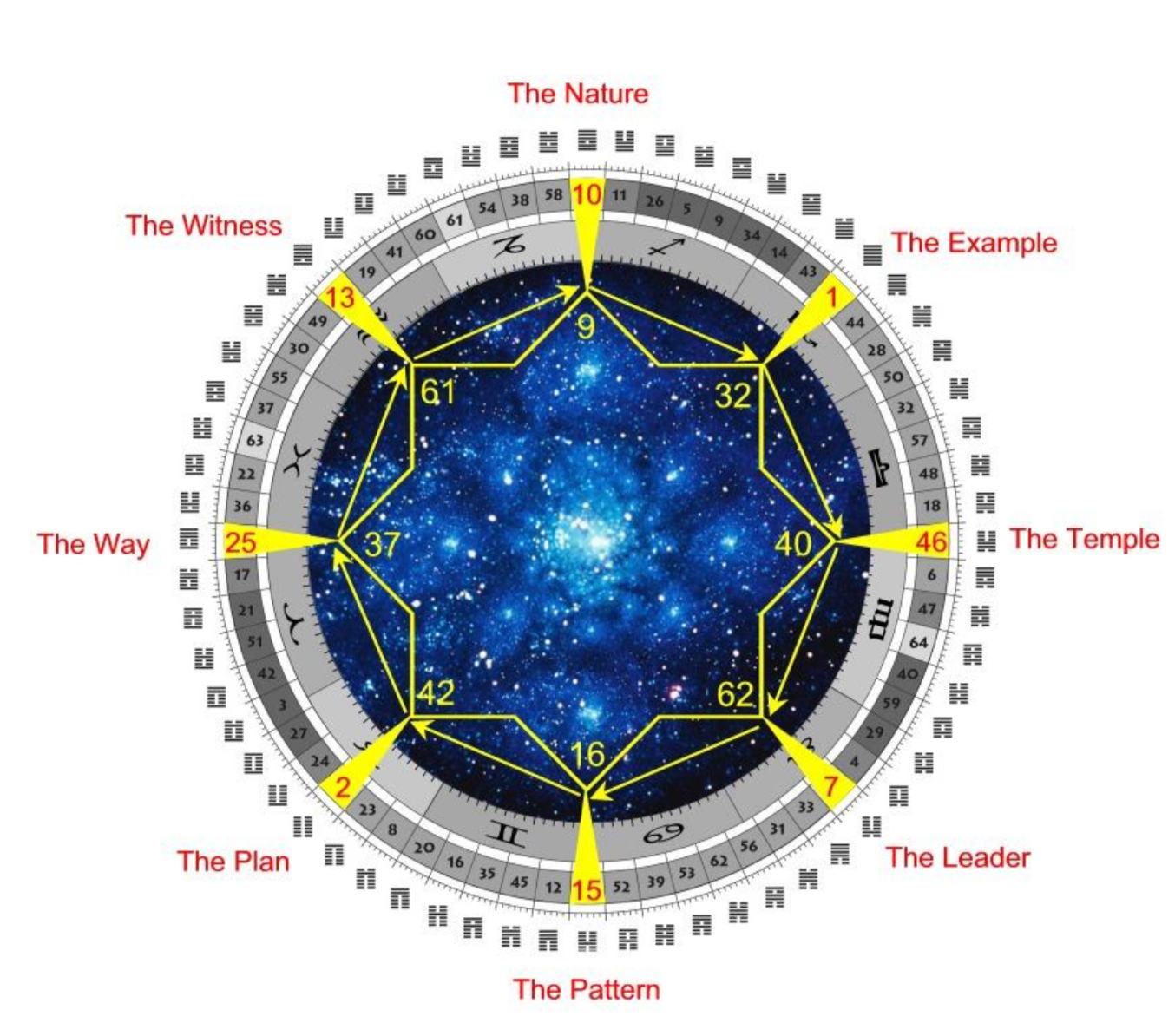
The global cycles in Human Design, specifically the Cross of Consciousness, Cross of Planning, and Cross of the Sleeping Phoenix, represent overarching themes that shape the universal laws, rules, customs, and collective behaviors of humanity over 400+ yr time spans. These cycles influence societal organization, governance, culture, and interpersonal dynamics by aligning collective consciousness with specific energetic themes. Below is a breakdown of how these cycles express themselves through the collective behavior of people and the systems they create.
1. Global Cycles and Their Universal Laws
Each global cycle establishes a set of universal “rules” or guiding principles that manifest in how people organize their lives, interact, and evolve. These rules are not always codified as laws but often express themselves in societal customs, cultural norms, and collective behaviors.
Cross of Consciousness (1203–1614 AD)
• Universal Laws and Themes: Spiritual inquiry, listening to the past, balancing extremes, and embodying serendipity.
Expression Through Collective Behavior:
• Religious Power: Collective adherence to spiritual doctrines (e.g., the Catholic Church, Islamic Caliphates) shaped universal laws around morality, governance, and social order.
• Exploration and Migration: People embraced serendipity and chaos, leading to territorial wars for expansion (e.g., Age of Exploration) and new cultural patterns.
• Rhythmic Living: Feudal systems and agricultural societies reflected alignment with natural cycles, reinforcing behaviors like communal labor and seasonal traditions.
• Artistic and Intellectual Flourishing: The Renaissance expressed creative self-expression (Lock 1) aligned with shared values (Key 50), creating art and literature that reflected the universal human experience.
Cross of Planning (1615–2027 AD)
• Universal Laws and Themes: Resource management, collective contracts, institutional frameworks, and logical articulation.
Expression Through Collective Behavior:
• Structured Governance: People organized themselves into systems of centralized authority (e.g., nation-states, constitutional monarchies) with codified laws and bureaucracies.
• Economic Collaboration: Global trade networks and capitalism emerged as collective agreements to manage resources and labor.
• Scientific Rationalism: Collective behavior shifted toward valuing logical inquiry, measurable outcomes, and structured education systems.
• Social Contracts: The rise of unions, welfare systems, and civil rights movements reflected the need for fair bargains between individuals and institutions.
• Uniformity in Customs: Calendars, time zones, and standardized currencies reinforced collective collaboration.
Cross of the Sleeping Phoenix (2027–2438 AD)
• Universal Laws and Themes: Individual sovereignty, emotional independence, decentralization, and intuitive action.
Projected Expression Through Collective Behavior:
• Decentralized Systems: People will likely shift toward peer-to-peer governance and resource management, rejecting rigid hierarchies in favor of collaborative networks.
• Emotional Fulfillment: The focus will move from collective goals to personal satisfaction, with people prioritizing well-being, creativity, and self-expression over productivity.
• Rewilding and Self-Sufficiency: A return to intuitive, nature-aligned living may emerge, with communities embracing holistic sustainability.
• Customs and Rituals: Spirituality and cultural traditions will likely become more personal, with people creating individualized rituals that reflect emotional and intuitive sovereignty.
2. Collective Behavior: Universal Themes in Action
The universal laws of each cycle influence how people organize their collective behavior into specific patterns, customs, and rules. Here are some key examples:
Governance and Leadership
• Consciousness Cycle: Leadership was driven by storytelling and spiritual authority (e.g., religious leaders, kings ruling by divine right). People accepted hierarchical structures grounded in moral or cosmological authority.
• Planning Cycle: Leadership became structured and logical, with constitutions and policies defining roles and responsibilities. Bureaucratic hierarchies reinforced collective governance.
• Sleeping Phoenix: Leadership will decentralize, with individuals taking responsibility for their own lives. Leaders may act as facilitators rather than rulers, guiding communities intuitively or through collaborative networks.
Spirituality and Belief Systems
• Consciousness Cycle: Collective spiritual practices unified societies through shared doctrines, rituals, and cosmic narratives.
• Planning Cycle: Spirituality became institutionalized, with organized religions playing key roles in governance and education. A growing emphasis on science introduced materialist belief systems.
• Sleeping Phoenix: Spirituality will likely individualize, with people rejecting dogmas and seeking personal, intuitive experiences of the divine or universal truths.
Economic Systems and Resource Management
• Consciousness Cycle: Resource sharing was often localized and aligned with natural rhythms (e.g., bartering, feudal obligations).
• Planning Cycle: Resources became centralized and institutionalized, leading to global trade, industrialization, and economic agreements.
• Sleeping Phoenix: Economic systems may decentralize into cooperative networks, tokenized economies, and localized production. Emotional fulfillment, rather than material wealth, could drive economic behavior.
Education and Knowledge
• Consciousness Cycle: Knowledge was transmitted orally or through religious institutions, often guarded by elites.
• Planning Cycle: Education became systematized and accessible to broader populations, with structured curricula reinforcing collective rationalism.
• Sleeping Phoenix: Learning will likely become self-directed and intuitive, focusing on experiential knowledge, emotional intelligence, and personalized skill-building.
Social Structures and Customs
• Consciousness Cycle: Customs were often tied to seasonal rhythms, religious calendars, and cosmic alignment.
• Planning Cycle: Uniformity in customs (e.g., Gregorian calendar, industrial workweeks) reflected collective agreements for efficiency.
• Sleeping Phoenix: Customs may fragment, with individuals creating personalized rituals or adopting practices from diverse cultures based on resonance rather than conformity.
3. Implications for the Transition to the Cross of the Sleeping Phoenix
The upcoming transition reflects a significant pivot in how universal laws and collective behaviors will evolve:
1. From External Authority to Inner Sovereignty
• People will prioritize personal freedom, rejecting systems that impose external control (e.g., centralized governments, organized religions).
2. From Collective Conformity to Individual Expression
• Social customs will shift toward individual creativity and unique expressions, supported by decentralized networks.
3. From Materialism to Emotional Fulfillment
• Economic and societal systems will prioritize well-being and emotional independence over material accumulation or production.
4. From Institutions to Intuition
• Rules and norms will be guided by intuitive and adaptive approaches, with flexible frameworks replacing rigid institutional structures.
The global cycles are reflected in the collective behavior of humanity through evolving laws, rules, and customs. By understanding the patterns of past cycles, societies and individuals can align with emerging themes, ensuring smoother transitions and greater harmony with the universal laws of the new era. This alignment fosters resilience and empowers people to navigate the future with clarity and purpose.