
FROM CHAKRAS TO CENTERS
$39
19 personnes ont acheté ceci
From Chakras to Centers
A 138-Page Illustrated Atlas of the Nine-Centered BodyGraph
What if the evolution from seven chakras to nine Human Design Centers represents more than a symbolic change?
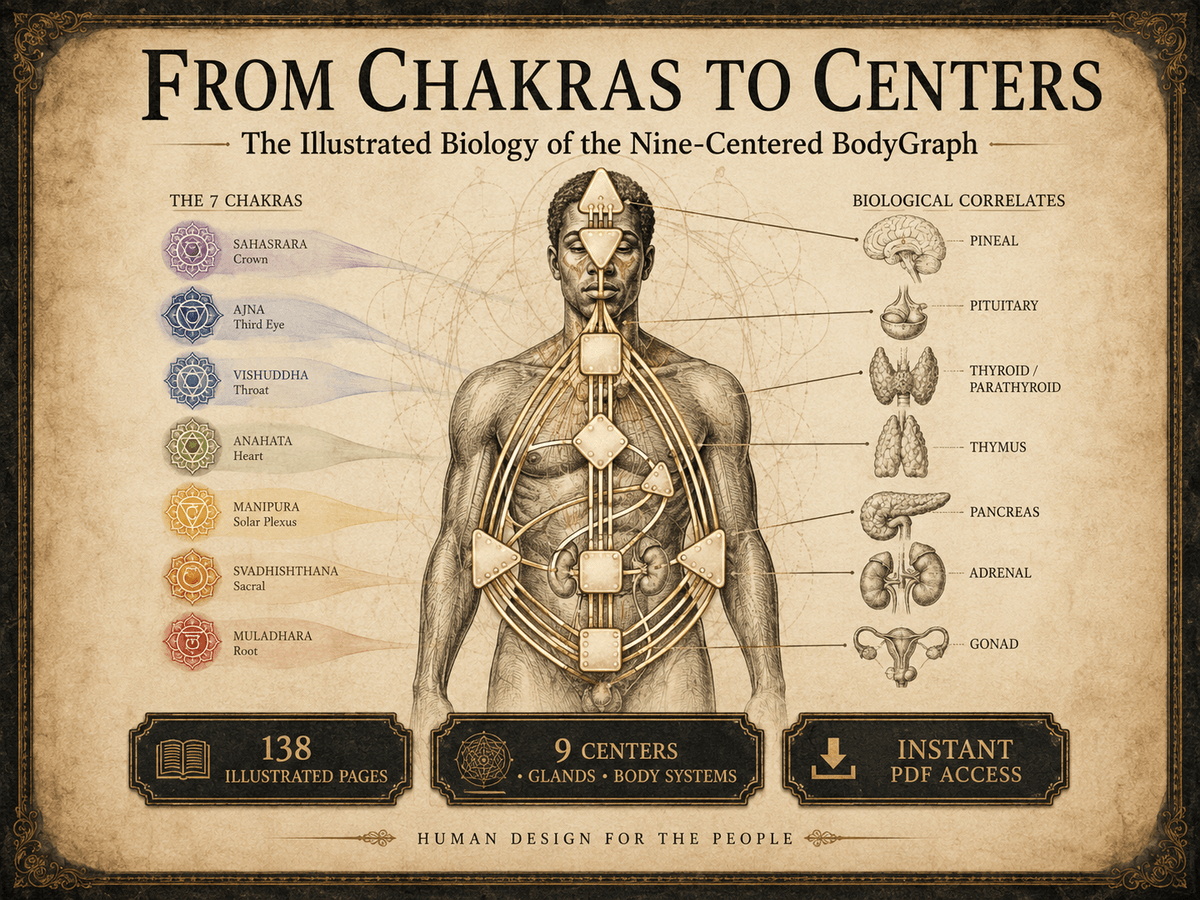
From Chakras to Centers is a 138-page illustrated atlas exploring the possible biological, anatomical, and regulatory foundations beneath the nine-centered Human Design BodyGraph.
The book places traditional chakra symbolism, Human Design Center mechanics, endocrine structures, organs, and physiological systems into one comparative visual framework.
Its purpose is inquiry:
What becomes visible when symbolic energy anatomy is studied alongside the physical intelligence of the human body?
What You’ll Receive
• A 138-page illustrated PDF
• A comparative study of chakras and the nine Human Design Centers
• Detailed visual exploration of each Center
• Anatomical, glandular, endocrine, and organ-system analogies
• Victorian medical-style illustrations
• Human Design geometry layered over anatomical form
• Material suitable for personal study, teaching, and research
• Immediate digital access
From Seven Chakras to Nine Centers
Traditional chakra systems describe seven primary energetic centers.
Human Design presents a nine-centered configuration with differentiated functions involving:
• Pressure
• Inspiration
• Conceptualization
• Communication
• Identity and direction
• Will and material value
• Emotion and relational chemistry
• Life force and reproduction
• Instinct, immunity, and survival
This book examines how the nine-centered model reorganizes and expands older symbolic frameworks.
Rather than treating the chakra and Center systems as identical, it studies their differences, overlaps, and possible relationships.
The Nine Centers as Functional Systems
Each Center is explored as part of a larger regulatory architecture.
The atlas examines possible relationships between the Centers and structures such as:
Head Center
Inspiration, mental pressure, and symbolic relationships to the pineal region
Ajna Center
Conceptual processing, certainty, and analogies involving the pituitary and neurological organization
Throat Center
Expression, manifestation, metabolism, and thyroid-parathyroid symbolism
G Center
Identity, direction, love, orientation, and liver-blood-system analogies
Ego or Heart Center
Willpower, value, resources, commitment, and relationships involving the heart, stomach, thymus, and gallbladder
Solar Plexus Center
Emotion, sensitivity, chemistry, bonding, digestion, and pancreatic-intestinal analogies
Sacral Center
Life force, work, sexuality, reproduction, and regenerative energy
Spleen Center
Instinct, immunity, fear, survival, cleansing, and lymphatic-system analogies
Root Center
Pressure, stress, adrenaline, movement, and adrenal-system analogies
These mappings are explored as Human Design interpretations and research hypotheses rather than settled medical conclusions.
Three Layers of Study
The book brings together three distinct layers.
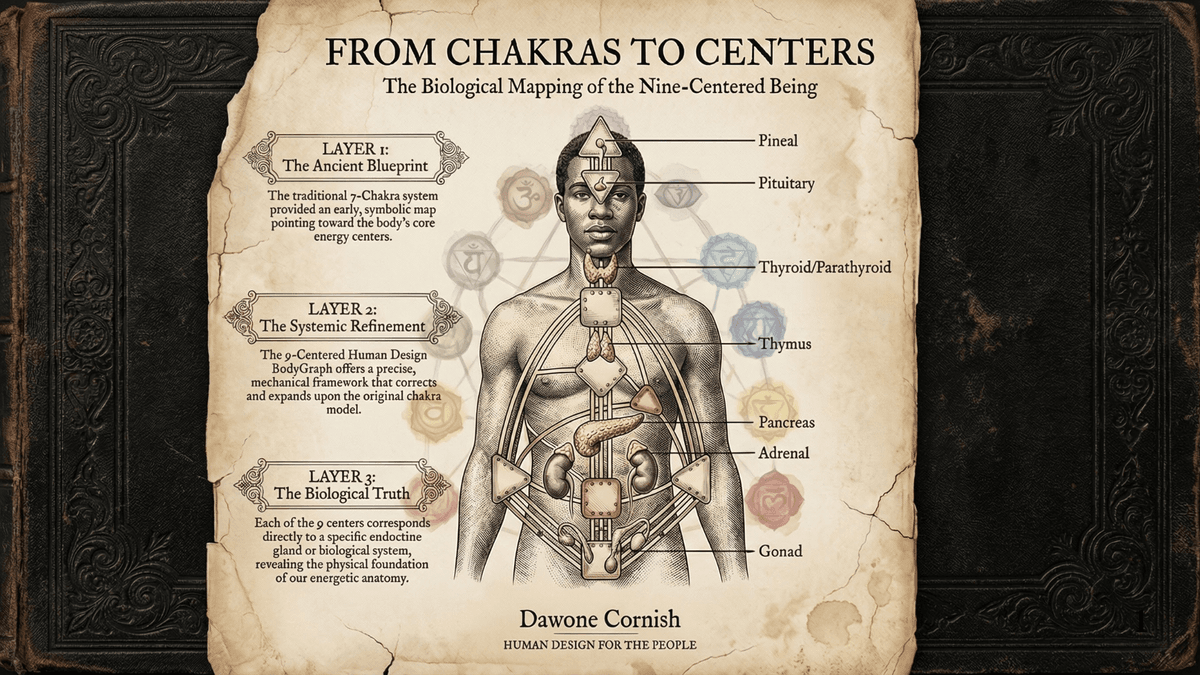
Layer One: The Ancient Blueprint
Traditional chakra symbolism provides an early map of internal energy, consciousness, and bodily organization.
Layer Two: The Nine-Centered Refinement
The Human Design BodyGraph introduces nine differentiated Centers with distinct mechanical functions.
Layer Three: The Biological Inquiry
Anatomical and endocrine analogies are used to explore how symbolic mechanics may correspond with physical systems.
Together, these layers create a visual bridge between historical symbolism, Human Design mechanics, and modern anatomical understanding.
What This Atlas Explores
• The transition from seven chakras to nine Centers
• The mechanical role of each Human Design Center
• Defined and undefined Center dynamics
• Pressure, awareness, energy, identity, and expression
• Glands, organs, endocrine structures, and body systems
• Historical symbolism and modern visual synthesis
• The difference between metaphor, analogy, and physiological evidence
• The body as an integrated regulatory system
Built for Visual Study
The illustrations are central to the learning experience.
They combine:
• Anatomical figures
• BodyGraph geometry
• Endocrine and organ diagrams
• Historical chakra imagery
• Mechanical overlays
• Comparative maps
• Victorian medical-atlas aesthetics
The book is designed to be consulted repeatedly rather than read once and set aside.
Each section encourages the reader to compare images, question assumptions, and observe the relationship between symbolic language and physical form.
Who This Book Is For
This atlas is ideal for:
• Human Design students
• Analysts and teachers
• Researchers of consciousness and symbolic systems
• Readers interested in anatomy and endocrinology
• Coaches and workshop facilitators
• Students comparing chakra traditions with Human Design
• Anyone building a serious illustrated Human Design library
Experienced students will gain a deeper anatomical lens.
Newer readers will gain a visual introduction to the nine Centers and their distinct functions.
Use This Book To
• Study all nine Centers in one visual framework
• Compare chakras and Human Design Centers
• Deepen your understanding of Center mechanics
• Build clearer teaching language
• Develop classes, presentations, or study groups
• Explore endocrine and anatomical analogies responsibly
• Strengthen pattern recognition
• Add a distinctive research atlas to your library
Why This Book Is Different
Many Human Design resources describe the psychological themes of the Centers.
From Chakras to Centers asks what physical and regulatory architecture may sit beneath those themes.
It approaches the BodyGraph as a model worthy of anatomical comparison and careful investigation.
The result is neither a medical manual nor a spiritual manifesto.
It is an illustrated inquiry into whether ancient symbolic systems and modern Human Design mechanics may be pointing toward recurring patterns within the living human form.
Instant Digital Access
Your purchase includes the complete 138-page illustrated atlas in PDF format for immediate download.
Download From Chakras to Centers and explore the nine-centered BodyGraph through anatomy, symbolism, endocrine analogies, and visual systems thinking.
$39
19 personnes ont acheté ceci
$39