
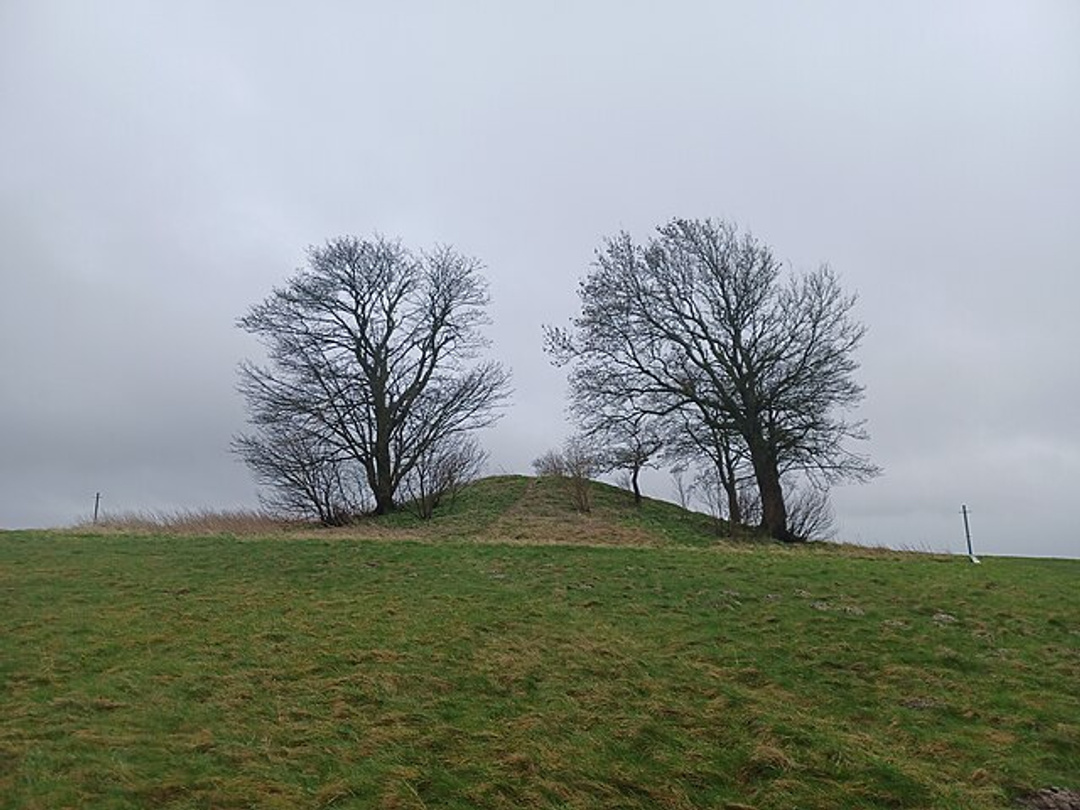
(Image: Middle Hill bowl barrow, Bishopstrow, Wiltshire, England. Late Neolithic to Bronze Age. Credit Simon Burchell, used under the Creative Commons Attribution-Share Alike 4.0 license)
For a long time, I wondered about the relationship between the feys and the dead. Sidhe/shee, a word used to refer to faeries in Scots and Irish folklore, is also applied to the mounds where they were thought to live, and in many stories these mounds open at certain times, often with their tops raised up on red pillars, to reveal a scene of feasting and merrymaking within. Mortals who enter are welcome to join the feast, but doomed never to leave if they touch any of the faerie's food and drink.
Then there is the banshee - clearly stated to be a ghost in most legends, but with a name that translates literally as "faerie woman."
There are more strange correspondences, but this article is more thorough and scholarly than anything I could produce: https://classicallyeducated.wordpress.com/2017/10/16/the-connection-between-fairies-and-the-dead/
Then, a few weeks ago, a link suddenly came up in one of my social media feeds that explained everything perfectly. The only problem is, the app wouldn't let me save the link and I've been unable to find it since. But here's the gist:
The writer alluded to a theory I've read before*, which holds that the dead go through a series of transitions over time, socially as well as physically. They retain their names and stories for as long as they are remembered by the living, but this individuality fades as the memories of them as individuals die out. At that point, they join a kind of collective known as "the ancestors." Depending on the local culture and beliefs, the ancestors watch over their descendants, protecting or punishing according to the circumstances.
The next transition occurs when their native culture dies out and is replaced by incoming peoples or outside influences. At that point, the ancestors' direct link to local mortals is broken, and they become spirits of the land. This article on recent DNA research is interesting, pointing to a population collapse at the end of the European Neolithic that did just that: https://www.sciencedaily.com/releases/2026/07/260707054108.htm
They still reside in their mounds, and can still interact with the living in good ways or bad, but their culture is as lost as their names. They become known as "the old folk" or by some other euphemism, and mortals take care not to anger them, as they can turn the land itself against the living, causing crop failures, diseases, or other problems. And don't forget, either, that in almost all folklore and almost all fantasy, feys and elves are described as an ancient people, who have been in the world far longer than humans but have often been in decline since humans arrived.
Finally - often, but not always, after Christianity takes over their homeland - the dead transition from being spirits (or small gods, like the Vanir of Norse myth) to being faeries. They go from being small gods to even smaller gods, or from spirits to sprites. Then, as Christianity grows stronger and belief in the Old Ways fades, they become smaller and weaker, tricky rather than deadly. They are vulnerable to the trappings of Christianity, such as the sign of the cross and the sound of church bells, and also to cold iron, which may be because no iron objects are ever found in their Stone Age and Bronze Age mounds.
Through all of this, though, they retain their links to the mounds, sustained by folk memory and by legends of faerie treasure that spring from medieval and later finds of bronze and other treasures in and around their graves. Stone arrowheads from the Neolithic and Bronze Age are seen as magical elf-shot, the cursed missiles that cause strokes (itself a contraction of elf-stroke or elf-struck) and other sudden aliments in mortals.
Even though I can't track down where I saw this theory (maybe someone reading this will know?), it explains the sometimes puzzling links between faeries and the dead, between faerie mounds and prehistoric burial mounds, so neatly and completely that I love it.
What do you think? Let me know in the comments. What do you think this theory could mean for elves in a fantasy setting, existing or yet to be designed? There's a lot to chew on here.
In a previous career, I was a grave robber - or as we prefer to be called, a funerary archaeologist - specializing in the Neolithic-Bronze Age transition (aka the Chalcolithic period) in North-East England. I've read quite a lot about burial mounds.