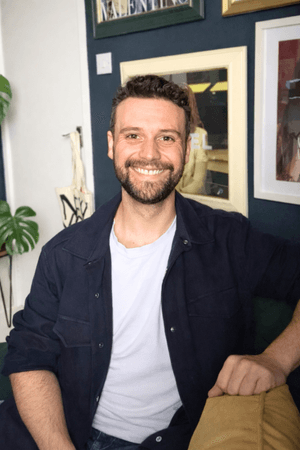

If you’re new here, welcome — and if you’ve been reading along already, thank you for staying.
It’s a new year, and this felt like the right place to begin. LOVER is part of my plan to properly launch my writing this year, and sharing it here felt like the most honest way to introduce myself and the work to new readers.
I’ve been working on this novel for six years. It’s been rewritten more times than I can easily count, and it’s now at a point where I’m proud to let it out of my hands. While it’s currently being queried with agents, considered by competitions, and read by beta readers, I wanted to share the opening chapter with you first — outside of those systems, and without intermediaries.
What follows is the beginning:
Ezra Thorne lives alone on the Yorkshire moors. He makes wedding dresses. For most of his adult life, his world has been deliberately small: few people, limited technology, routines that haven’t changed in years.
When the deaths of his elderly parents bring thirteen years of isolation to an end, Ezra allows himself one small breach in that order—a dating app, downloaded onto a second-hand iPhone.
Enter Aidan. He is attentive, attractive, and seems to want Ezra without complication.
Then Aidan disappears.
What follows is not a search in any conventional sense. It’s a narrowing. Ezra moves through messages, apps, and the underworld of modern dating culture, transforming him into something else entirely — something that might have been inside him all along.
LOVER is a psychological thriller. It’s interested in what people do when they are given just enough intimacy to believe it was real.
Thank you for reading.
1. THIS IS THE KILLER SPEAKING
He had the loveliest bones—attenuated, almost perishable, as if they had learned early how to survive by yielding. Beneath my touch he preened, responsive in a way that felt less like vanity than relief. I traced his face, the fine, nest-soft texture of his hair, the swan-curve of his spine, which recoiled and returned at once, as though undecided about flight.
His movements were quick, economical, betraying a nervous intelligence. With one hand he caught my wrist—not to restrain me, exactly—and with the other pressed my palm to his bare chest, as though compelling me to witness something essential, something he feared might vanish if left unacknowledged. His heart fluttered against my skin, hummingbird-fast, a trapped life striking again and again at invisible glass.
My hand closed around his and I teased him with the disparity of our strength. The contrast was exquisite: his sparrow bones enclosed by my python grip. When he stiffened I made a joke—careless, almost kind—and he loosened at once, laughter breaking from him like scattered seed. He folded into me then, sudden and complete, as if relieved of the burden of holding himself upright.
He shivered when I pressed him close, not with cold but appetite. A tremor gathered in him rather than dissipating, cumulative, as though he had come into possession of something he’d never believed was meant for him and was now uncertain how to survive it.
I could smell his fear.
That I might vanish.
That I might recoil.
That I might prove illusory—too much, too good.
Salt and sweetness together: the scent of prey recognizing the predator while resisting the truth of it. He was right to be afraid. To me it was the most beautiful scent in the world.
He did not know what to do with me—they never do. But this one was different.
This one wanted to play.
“You’re dangerous,” he says, his voice thinned and breathless with want. He traces the line of my jaw with one finger, lingering as if astonished by its severity. “I can see it in your eyes.”
I smile, and he shivers. They always do.
“What do you see?”
“Hunger,” he whispers, edging closer now, compelled. “Like you could swallow me whole.”
I could.
I will.
But not yet.
We circle each other on the bed, a choreography I have refined over years of practice. I allow him the illusion of courage. I let him press his palms to my chest, feel the coiled strength waiting there. I flex beneath his touch and watch his pupils darken, the body betraying what the mind still pretends to master.
“You’re so strong,” he breathes—and there it is, that intoxicating admixture of fear and fascination. They are always drawn to what might undo them. The delicate ones most of all, with their bird-quick hearts and hollowed bones. They want the trial. They want to measure themselves against something larger, something that could ruin them without effort.
I pin his wrists above his head—careful, inexorable—and he arches beneath me with a futile, almost comic grace, as though his body has mistaken restraint for invitation.
“Is this what you wanted?” I ask.
He nods, too quickly. His eyes shine with the terrible clarity of belief.
I let his wrists go. He leaves them where they are.
The body understands certain instructions without being taught.
I trace idle figures on his skin, provisional, erasable. “You’re perfect,” I tell him, and the word settles between us with its dangerous finality.
“I’ve never—” He stops, startled by himself, heat blooming in his face.
“Never?” I say, indulgent now.
He hesitates, then: “Never wanted someone like you.”
Someone like me. Not beautiful—convincing. I make wanting feel inevitable, as if it had always been waiting for the proper occasion. They mistake recognition for fate. They offer themselves with the solemnity of converts.
I accept.
And I do not return what I am given.
I lean down and kiss him slowly, deliberately, letting the moment lengthen until it displaces thought. He makes a small, involuntary sound—not pleasure, not distress—and I take it into myself, as one takes breath. This is the moment that sustains me: the instant comprehension arrives, followed almost immediately by consent.
The embrace tightens. My hands learn him by touch alone, registering the narrowness of his frame, the tentative scaffolding beneath skin too easily marked. I trace him with an appraiser’s care, attentive to the places where he yields without resistance.
He goes still then—not frozen, not struggling, but listening inwardly, as though his body were consulting some deeper instruction. His breath shortens. His pulse loses rhythm, becomes erratic, urgent, as if searching for a language it no longer possesses.
There is no longer any space between us. I enclose him completely, a presence without edges. He brushes against me and understands, at last, the miscalculation he has made—not fear exactly, but recognition. Something like regret, sharpened by wonder.
The change in him is minute but unmistakable. His confidence fractures soundlessly. What escapes him is not a cry but a failure of sound, an interruption. My hold adjusts without thought. Comfort is an instinct I’ve perfected.
“Shh,” I say, close to his ear. “I know.”
He believes me. They always do—briefly. I offer words that resemble tenderness closely enough to be convincing. His resistance softens, dissolves into compliance. The energy that had animated him withdraws, as if recalled elsewhere.
When it is over, he weighs almost nothing. What remains is exquisitely arranged, emptied of urgency. I hold him a moment longer, honouring the illusion that something has been preserved.
2. EZRA
The most dangerous predators know how to wait. My father used to say that.
The adder lies on the limestone, sun-warmed, incurious. Its scales are darkened copper, dulled by dust. The body folds into itself in efficient S-curves, dense and economical, like a torso twisted mid-sleep. Nothing ornamental about it. Muscle doing what muscle does.
A field vole blunders into view. Small, brown, undeserving of the confidence it carries. It stops to sniff, whiskers flickering, as though the air itself might offer guidance. The snake is close enough to touch. The vole doesn’t register it. Some animals arrive in the world already misinformed.
“You have to understand your prey,” my father said. “The dangerous ones rarely advertise themselves.”
I’ve been here twenty minutes. Long enough to learn the rhythm of the place. I crouch behind sandstone, ash stick balanced in my hand. The adder breathes. That’s the only movement—an almost imperceptible dilation, contraction. Even the patterning on its back seems to shift reluctantly, as if resisting the inconvenience of being alive.
I came here to kill it. That was the idea. Watch. Wait. Intervene. I move closer, calibrating each step against the snake’s stillness. Heather scrapes my legs. I don’t rush. I don’t hesitate.
This is how I think now. Everything reduced to sequence and timing. Observation followed by decision. Execution without ornament. Anything can be brought down if you are willing to learn how it persists.
The moors stretch out on all sides, indifferent. Curlews call from somewhere I can’t place. Grouse erupt from the bracken in brief, unnecessary violence.
The vole stops foraging. It rises onto its haunches, forepaws held awkwardly to its chest. Something has shifted—pressure, maybe. A disturbance too minor to be useful. Enough to interrupt, not enough to prevent.
The adder responds. Its head lifts a fraction. The tongue appears and disappears, quick, efficient. I raise the stick. The interval tightens.
The vole should run. Any creature with even a rudimentary sense of self-preservation would run. Instead it remains fixed, suspended between impulse and failure. It is very small. Excessively so. The kind of helplessness that invites correction. Or avoidance.
I feel a brief, unwelcome tug of something like pity. The sensation is unfamiliar. I note it and let it pass.
The adder gathers itself. The body shortens, compacts. The head draws back. The vole’s eyes widen—not with fear exactly, but recognition. The information has finally arrived.
Too late. It is almost always too late by the time understanding asserts itself. Small things learn last. Careless things learn not at all.
Part of me thinks it deserves what’s coming. Survival isn’t a favour. You don’t earn it by drifting through the world inattentive to threat.
The adder strikes. Too fast to follow cleanly. Motion without outline.
The vole emits a single squeak—pinnacle and end of it.
The ash stick meets stone. Wood splinters where I pinned the snake mid-extension, its head arrested inches from where the vole had been. Beneath the pressure the body convulses—only muscle, only refusal. Jaws snap at empty air, gleam with venom that beads and then spills onto limestone.
The vole bolts. A brief blur, then absence.
I bring the stick down again, harder. The spine gives under methodical force. Resistance collapses into weight, and the body goes slack. I don’t move immediately. I watch the stone accept what it has received.
I came to kill this snake. That objective remains intact. But I stopped another kill I didn’t expect to stop. Field voles are everywhere out here—every scrub and tussock hides their runs—and when they boom in numbers they nibble roots and seed heads raw, eroding the sparse forage sheep depend on. It’s why farmers on the moors shrug and curse them; why land managers tolerate their tunnels more than their nibbling mouths.
Intervening shouldn’t have occurred to me. And yet it did.
The knife is sharp. The cut is clean. The head comes away. Blood darkens the pale stone, an ink of consequence. The vole is already distance and irrelevance.
I sit back on my heels. Breathe. The moor resumes its habitual indifference. Nothing rushes in to mark what’s happened.
I saved something today. That strikes wrong. I shouldn’t know why. I shouldn’t feel it.
Patience explains predators. It doesn’t explain this.
I lift the snake’s body. It is heavier than it looked. Cooling already. There is a satisfaction in the fact of it—something that was active, decisive, dangerous, now reduced to an object I can carry. I don’t mistake that feeling for mercy. I recognize it for what it is: possession.
The mist thins as the sun lifts. Water rises off the grass in a fine, anonymous vapor. The air is cold and mineral, tastes faintly of limestone. I walk back across it, boots darkening with damp.
I think about men. Not sentimentally. As forms. Structures that repeat with minor variation. The ridge of vertebrae visible through thin shirts. The hinge where jaw meets neck—never smooth, always abrupt—with the shallow pocket where the pulse insists on itself. The hollow at the base of the throat that collects heat and scent.
These are facts. They don’t require interpretation.
Joseph’s forearms.
Dark hair growing in irregular whorls, dense in places, sparse in others, refusing symmetry. His hands when he explained medical things—steady, almost careless, assuming he would be believed. Years since we were together. None of it degraded. I remember the chalk-sweet taste of an orange popsicle on his mouth. I remember the way he said I love your voice as if the sentence had surprised him into existence.
The categories no longer hold. The neutral becomes charged. What I was examining begins to look back at me. Want spreads through the systems I built to contain it, staining everything. I attempt correction. It doesn’t work. The body retains information the mind insists is obsolete. Old appetite. New embarrassment.
Men simplify when you are alone long enough. They become fragments. I collect them like still images: a back from a film. Shoulders caught mid-turn in a photograph. A laugh that may or may not have belonged to anyone I knew. Always partial. Always distant. Safe because they cannot answer back. I preserve them the way one preserves specimens—emptied of function, arranged for inspection.
Always dead things I’ve made beautiful.
I know men’s bodies better than my own face. I can name every muscle, every attachment point. But I can’t name this. This pressure that increases in the absence of contact. This wanting that feeds on deprivation. I take apart what I can’t have; worship what I can’t touch. I know everything and nothing. I’m an expert and an idiot.
This is what distance does. Watching replaces touch. Understanding substitutes for warmth. Attention, prolonged and unanswered, becomes the loneliest form of intimacy. The mind that wanted mastery gives way to something less articulate. Something that simply wants.
I see the house when I crest the hill. Victorian. Square-shouldered. Soundly built, in the way people mean when they say they don’t make them like this anymore. Mist clings to the stone, reluctant to lift. The nearest neighbour is a smudge on the horizon. Trees bent by prevailing wind lean toward the windows, as if listening.
Inside, I begin the usual sequence. I set the adder on the scarred kitchen table—the same surface where my mother kept her careful lists, where my father stripped and oiled his rifles.
I work quickly. Venom glands first—some dangers persist past usefulness. The meat separates cleanly, pink and dense. Nothing is discarded. The smallest cuts go to the stone wall behind the house, high enough for the scent to travel. Ravens will arrive soon enough. The larger portions I leave on the flat rock near the copse, where the kestrel hunts. She has young.
I keep the bones.
This isn’t mercy. It isn’t reverence. It’s procedure.
Upstairs, the spare bedroom holds the work that keeps the house functioning. An industrial sewing machine anchored to a reinforced table. Dress forms along the wall—headless, limbless, compliant. Bolts of fabric stacked by weight and temper. An unfinished gown hangs where I left it, ivory silk falling in long, obedient lines. The seams are basted, not fixed. I prefer to live with a garment before committing. Bank statements show regular deposits from Lydia Hartwell Bridal Couture. Lydia speaks to the brides. I never do. I receive numbers. Measurements. Deadlines. What arrives is raw expectation. What leaves this house fits.
Downstairs, the past sits quietly. Photographs. Books stopped mid-sentence. Records filed with care. Nothing newer than 2009.
This place accommodates me without question. It absorbs routine. One mug left to cool on the counter. One plate drying by the sink. Sometimes my hand reaches for two more before I remember and put them back. The table bears pale rings where mugs once stood every morning. Three coats hang by the door. Only mine shows wear. My father’s reading glasses still rest beside his chair. My mother’s prescription bottles line the sill, empty, aligned. Her wedding ring sits in a shallow dish beside his. I don’t wear them. I don’t move them.
The rotary phone has filmed over with dust, disturbed only by scheduled calls that require nothing beyond coherence. I cook from recipes that once assumed more bodies. I talk aloud while working—not for company, just to keep sequence intact. The radio replies with interference.
Something is off.
Light enters at an angle I don’t recognize, striking the glass hard enough to suggest motion where there is none. The air holds. Not weather—attention. I go to the window. The moor darkens as cloud shifts. Heather bruises toward afternoon. A curlew calls from distance, pitched to carry and not be answered.
I see the movement before I understand it.
A figure on the track. Too far to identify. Too deliberate to dismiss. Human. Coming uphill, following the line that leads nowhere else. My hand closes around the cloth. Dried blood prickles beneath my nails.
Nothing has prepared me for this disruption. Not isolation. Not discipline. Not the belief that distance was sufficient. The house does not respond. The moor does not intervene. Whatever equilibrium I mistook for permanence offers no guidance now.
The thought settles. It does not resolve into fear or anticipation. It simply occupies space, altering the room around it:
Someone is coming.
Thank you for reading to the end.
I’m grateful for your time and attention — both are in short supply, and neither is automatic. Reading closely, without prompts or incentives, is a choice, and I don’t take it lightly.
If something here stayed with you — whether it worked for you or didn’t — I’d be glad to hear about it. I’m interested in how readers move through the work, what they respond to, and where their attention lingers or slips.
If you feel inclined to buy me a coffee or pass this on to someone else, please do. If not, that’s fine too. However you engage — quietly, critically, or by returning later — thank you for being here.
— G