

©lidapavlova at https://www.cosmos.so/e/795766181
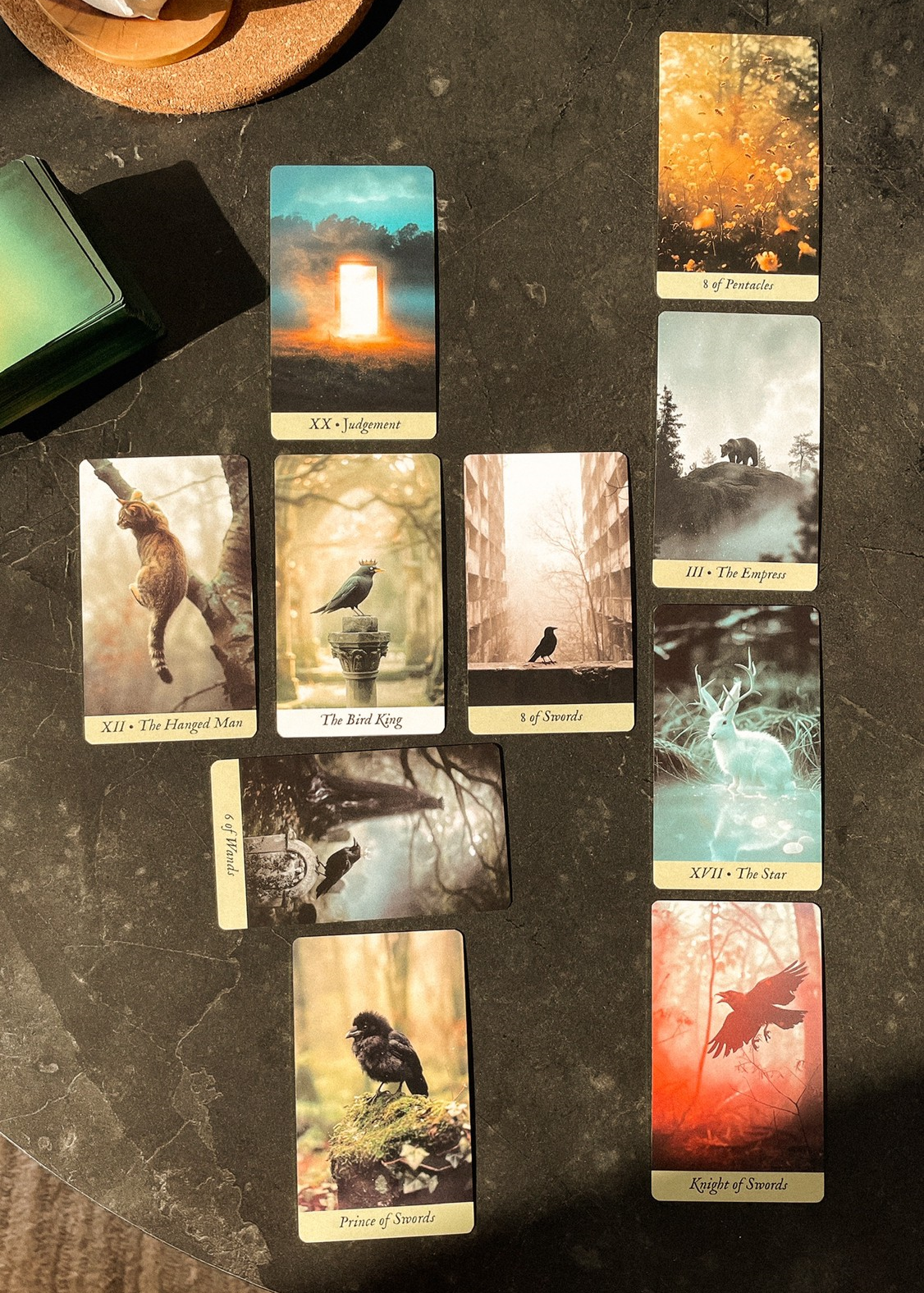 Much of the progress I have made in my tarot reading skills will always be due to the mistakes or the lessons that I have learnt along the way. I still remember the reading vividly. My querent, anxious about a career change, had a beautiful Nine of Pentacles (success, abundance) land in the Outcome (Card 10). But just below it, in the Hopes and Fears (Card 9) position, was the crushing anxiety of the Ten of Swords.
"It looks like you will succeed," I told her, "but you're terrified you will fail."
The reading, however, fell flat. It didn't tell her how to reconcile the crippling fear with the promised victory. My standard sequential reading, following from Card 1 to Card 2 to Card 3, had failed to capture the actual conflict. I realised I was not reading the spread holistically and intuitively.
I needed to stop seeing the ten cards in isolation and start seeing them dynamically, as a geometric battleground where her inner self (Card 7) was actively fighting her environment (Card 8), all driven by that paralysing fear. This is the moment I decided to move beyond merely reading the position and began to embrace dynamic analysis.
If you have ever stared at a Celtic Cross spread and felt the answer was just beyond your reach, this is for you. In this post, I will explore new angles for approaching the Celtic Cross tarot spread, offering profound and actionable insights to act on its advice honestly.
Historically, the exact origin of the Celtic Cross spread is uncertain; it is thought to have originated in Europe and was first mentioned in A.E. Waite's 1910 Tarot introduction. While it is among the most documented spreads in history, it is also among the most frequently misunderstood. Let's break down the architecture of this ten-card layout to understand not just what the cards mean, but also how to look at them from a new angle.
The Macro View: Two Spreads in One
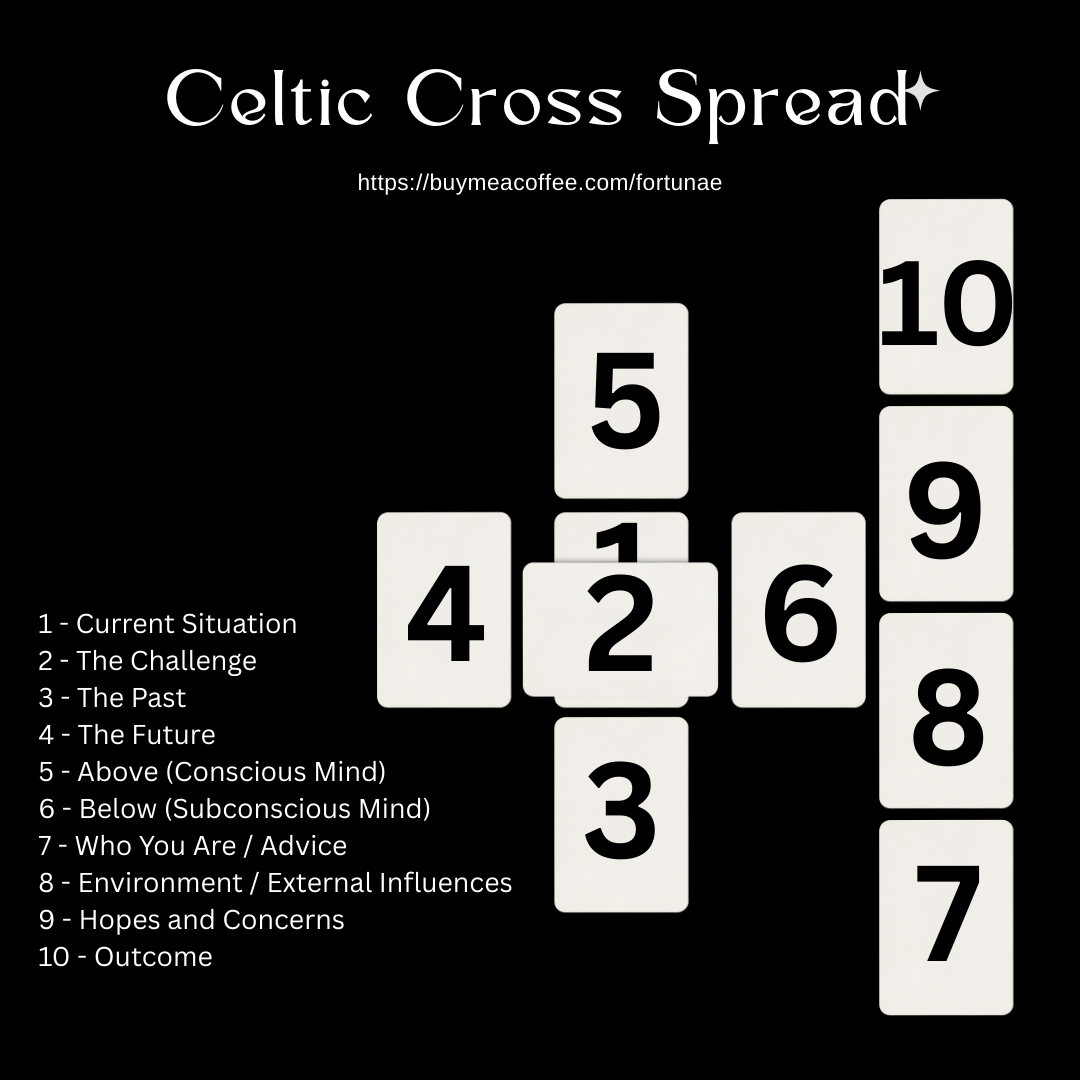
At a glance, this spread looks complex. Could you look at the shape of the spread? It consists of two distinct shapes.
The Central Cross (Cards 1-6): This represents the internal reality. It is the "subjective world": what is happening inside the querent's head, their heart, and their immediate timeline.
The Staff (Cards 7-10): The vertical column on the right represents the external reality. It is the "objective world" in which the environment, other people, and the trajectory of fate interact with the querent.
 Part I: The Central Cross
Card 1 (The Present): This is the anchor as it represents where the querent's current situation right now and their current state of mind. Everything else in the spread orbits around this card.
Card 2 (The Challenge): The card that crosses sideways over the first card, which represents the central friction of the reading. This position is tricky as it represents the immediate obstacle, meaning that even if you pull a "good" card here such as The Sun or Ace of Pentacles, you must interpret it as a challenge. It asks: How is this "good" thing actually getting in your way?
Card 3 (The Past): Here, we could see the events that led us to this moment. This is the root cause. We cannot understand the Present (Card 1) without acknowledging the momentum of the Past (Card 3).
Card 4 (The Future/Next Steps): This card is the opposite of the past. While some may read this as an outcome, in this layout, it serves more as a bridge. It explains why the current condition exists and hints at the immediate next step (in weeks, not years). It is the transitional phase.
Card 5 (Above/Conscious Mind): This position represents the "best case scenario" in the querent's mind. It is usually their expectation, their goal, and what they are actively working toward. It is the logic and the ambition.
Card 6 (Below/Subconscious Drive): The subconscious opposes the conscious mind. This card reveals the underlying emotions, hidden drivers, or immediate future influences that the querent may not even be aware of.
***Note: The tension between Card 5 is what they say they want with Card 6, what their gut is actually doing. The gap between these two often reveals the real problem.
Part II: The Pillar
Once we understand the internal situation, we look at the vertical staff on the right to see how it fits into the wider world.
Card 7 (The Self/Advice): This is the mirror which reflects who the querent is within the context of this specific problem. It can also be read as direct advice: given the current challenges, this is the attitude or role that the querent needs to embody to succeed.
Card 8 (The Environment/External Influences): No one is an island. This card represents the stage in which the drama plays out. It signifies family, friends, office politics, or energies that are beyond the querent's control.
Card 9 (Hopes/Concerns): This is widely considered the most challenging position to interpret because hope and fear/concerns are two sides of the same coin. A card here shows what we desperately want to happen, thereby revealing what we are terrified won't. It acts as a psychological check-in before the final result.
Card 10 (Outcome): This is the destination. It is the logical consequence of Card 1 (The Present) moving through Card 2 (The Challenge). However, this is not a fixed fate. It is a projection. It tells a querent that if they continue of their current path without changing anything, this is where they arrive. If the card is negative, the querent has the free will to go back to Card 7 (the self/advice) or Card 5 (conscious mind) and adjust their course.
So I have broken down the Celtic Spread into two distinct shapes: The Celtic Cross and the Staff to make it easier to digest. However, instead of reading the cards sequentially, there are other methods of reading Celtic Cross spread.
Dynamic Reading Method
The Narrative Flow Read
This approach treats the reading like a story, focusing on the cards that propel the situation forward.
Starting with The Past (Card 3), move to the Present (Card 1), analyse the Challenge in Card 2, and project to the immediate future (Card 4), and finally the Outcome (Card 10). This creates a compelling narrative line while treating other cards (5, 6, 7, 8, 9) as supportive context.
How does it work? It answers the fundamental question: "How did I get here, what's blocking me, and where is the current path heading?"
Conflict/Opposition Reading
Past (Card 3) vs Explanation (Card 4): Is the past dictating the future, or is the future breaking free from historical patterns?
Conscious (Card 5) vs Subconscious (Card 6): If what the person wants (Card 5) clashes versus the hidden needs or instincts (Card 6), the outcome may be messy.
Self (Card 7) vs Environment (Card 8): Is the querent's internal identity (Card 7) in harmony or in conflict with the people/forces around them (Card 8)? This highlights where to focus their energy.
Challenge (Card 2) vs Outcome (Card 10): How closely related is the nature of the immediate challenge to the ultimate result? For example, Two of Swords in Card 2, leading to a Justice Card, shows that the challenge is overcome.
Elemental and Numerical Domination
Before you even look at the meaning of an individual card, count the suits and the Major Arcana.
Suit Domination: If 6 out of 10 cards are Swords, the problem is driven is intellectual, driven by anxiety, logic, or communication conflict. If 6 are cups, the reading is fundamentally about emotionally well-being, relationships or intuition.
Major Arcana Weigh-In: If five or more Major Arcana appear, the issue is not petty or easily solved. It signifies a major life lesson, karmic influence, or a destiny point (a time where choices have massive, long-lasting consequences).
The "Outcome Pivot" Read
If the outcome (Card 10) is negative or undesireable, you do the reading in reverse.
State the undesireable outcome to the querent.
And then ask: "If you want to avoid Card 10, what must change?"
Then, you can just read Card 7 (The Self/Advice) and Card 2 (The Challenge) as the necessary points of intervention. The spread becomes a warning label, not a prediction.
The "Reversal Filter" Technique
If you use reversed cards (cards that fall upside down), this is a filtering technique you can use.
Ignore the upright cards initially, then scan the entire spread by looking only at the reversed cards.
The reversed cards represent the areas where energy is blocked, delayed or misapplied.
This quickly isolates the core dysfunctions that need to be addressed before any of the positive potential of the upright cards can manifest.
My Creative Adaptation to Celtic Cross—The Tree of Life Spread
When I was staring at the Celtic Cross spread, it looked to me like a tree. So you turn the spread 90 degrees clockwise so the vertical staff becomes horizontal. This spread is highly valuable for ancestral reading and tracing your spiritual journey.
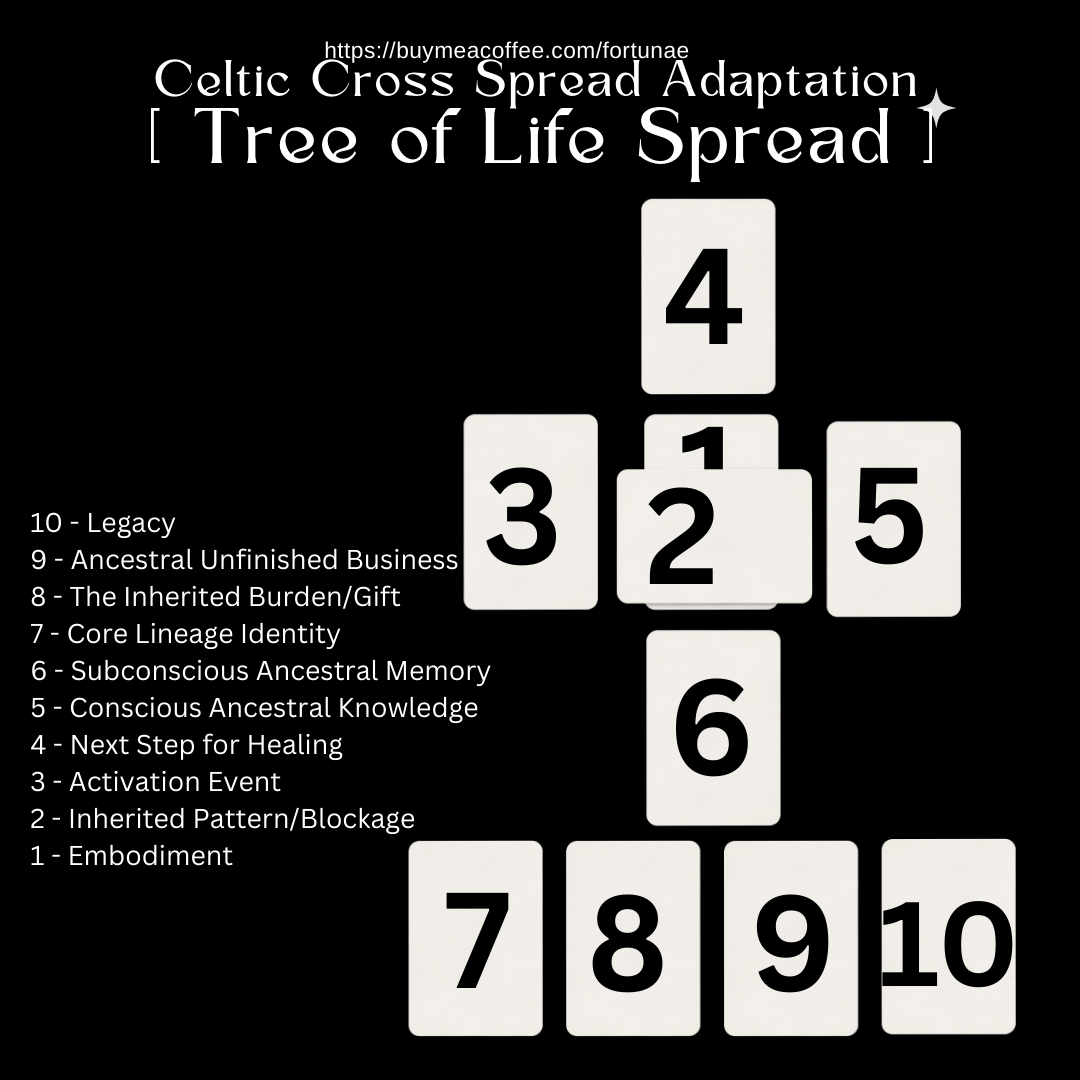 So you will start with Card 10-7 to understand the deep roots of your lineage.
Card 10 (outcome): This card represents the legacy that you are supposed to sustain from your ancestral line. This is the calling, and the outcome from working with your ancestors and going deeper into your spiritual journey.
Card 9 (hopes/concerns): This card represents ancestral unfinished business, which is the collective hope or unresolved trauma (fear) of the ancestors that still seeks resolution through you.
Card 8 (the environment/external): This is the inherited burden or gift, specifically family karma, blessing, or external circumstances such as artistic talent, poverty, or military service that still impacts your life.
Card 7 (the self/advice): This is the core lineage identity, which is your essential strength, skill, or primary cultural energy passed down to you. This can also represent what is waiting for you to unlock.
Then you continue with Card 1-6 as the trunk and branches to the querent's life. It defines how the root system is currently affecting the querent's present reality and path to healing.
Card 6 (Below/Subconscious Mind): The hidden driver is a deep subconscious ancestral memory or emotion currently driving your behaviours without your awareness.
Card 6 (Above/Conscious Mind): This represents what you intellectually know, believe, or have researched about your ancestors or your inherited trauma.
Card 4 (The Future): This signifies the next step for healing—the immediate potential for clearing, honouring, or resolving the inherited pattern revealed in Card 2.
Card 3 (The Past): This card presents activation events. A recent event or memory that consciously or subconsciously triggered the ancestral pattern into visibility. What brings you here?
Card 2 (The Challenge): This is about your inherited pattern or blockage. This is about specific ancestral wounds, patterns of self-sabotage, or fear, such as trust issues, avoidance or addiction, that are blocking your spiritual growth.
Card 1 (The Embodiment): This is about who you are supposed to embody to be aligned with your ancestral energy, to fully step into a more grounded and balanced version of you who is capable of stepping into ancestral work.
So to recap:
The Celtic Cross spread may have a reputation for being challenging to master, but the mechanism of reading this spread is so much more simpler and dynamic (I hope) when you finally grasp it. It can be read in so many different ways, and you can always experiment with a dynamic way of approaching this spread. For me, that's what makes this tarot spread fascinating to work with.
If this deep dive helped you unlock new clarity in your tarot reading, consider buying me coffee :) Your support fuels more structural deconstruction of the arcane.
For further reading:
Blackmond, A. G. (2022). The Ultimate Guide to Tarot. ORANGEPEN PUBLICATIONS.
Carrie. (2020). Decoding the Celtic Cross | Carrie Mallon. Carriemallon.com. https://carriemallon.com/blog/decoding-the-celtic-cross/
Gong, T. (2025, May 29). The Celtic Cross Tarot Spread - Exploring the Classic 10 Card Tarot Spread. Labyrinthos. https://labyrinthos.co/blogs/learn-tarot-with-labyrinthos-academy/the-celtic-cross-tarot-spread-exploring-the-classic-10-card-tarot-spread
HowStuffWorks. (2023, August 19). Unlock Your Future with the Celtic Cross Spread Tarot Reading. HowStuffWorks; HowStuffWorks. https://science.howstuffworks.com/science-vs-myth/extrasensory-perceptions/celtic-cross-spread.htm
Reed, T. (2024, May 5). Breaking Down the Celtic Cross. The Tarot Lady. https://www.thetarotlady.com/breaking-celtic-cross/
Taroscopes. (2019, April 14). How to Read Each Position of the Celtic Cross. Good Morning Aomori; Good Morning Aomori. https://goodmorningaomori.wordpress.com/2019/04/15/how-to-read-the-celtic-cross/