

 By a former NI employee and former TestStand instructor
Engineers looking for a TestStand alternative, a modern test executive, or a Python-based test automation framework have more choices today than before. While TestStand remains the dominant industrial solution, and for very valid reasons, platforms such as OpenTAP and newer Python-native approaches like PyTestFlow are challenging traditional assumptions about how automated test systems should be built.
For years, TestStand represented the default answer for serious automated test sequencing.
And honestly, there were good reasons for that.
The platform solved real industrial problems:
deployment
operator workflows
parallel execution
reporting
hardware integration
process standardization
In the 2000s and early 2010s, that mattered enormously.
The industry needed structure.
But the environment has changed.
Today, the bottleneck in many engineering organizations is no longer raw execution capability.
It is:
engineering iteration speed
maintainability
onboarding
understanding
adaptation speed
integration with modern software workflows
And now a second major shift is arriving:
AI-assisted engineering.
To NI's credit, the company clearly recognizes this trend. The introduction of Nigel AI for both TestStand and LabVIEW demonstrates that AI is no longer a future possibility for test engineering—it is becoming part of the workflow.
AI in test is here to stay.
The more interesting question is which architectures will benefit most from it.
The question is no longer:
"Which sequencer has the most features?"
The real question is:
"Which system best accelerates engineering learning and adaptation?"
Today, three approaches stand out:
Each represents a different philosophy.

The Industrial Veteran
TestStand remains one of the most mature test executives ever built.
That maturity matters.
People sometimes underestimate how many painful industrial lessons are embedded inside its architecture.
Process models, deployment handling, reporting, execution flow, operator interfaces—these were not accidental features. They solved real scaling problems.
And for organizations deeply invested in:
LabVIEW
PXI
NI hardware
manufacturing validation
TestStand can still be extremely effective.
Where TestStand Still Excels
TestStand performs best when:
procedures are stable
processes are formalized
hardware infrastructure already exists
organizational standardization matters
Very few platforms have accumulated this much real-world operational experience.
Where the Friction Is Growing
The industry itself has shifted toward:
Python
Git-native workflows
CI/CD
cloud tooling
AI-assisted development
This creates increasing impedance.
The challenge is not that TestStand is weak.
The challenge is that its optimization target belongs to a previous engineering era.
An era where centralized tooling dominated and software development itself was often the bottleneck.
AI may change that equation.

The Modular Open Alternative
OpenTAP occupies an interesting middle ground.
It keeps the explicit sequencing philosophy of traditional test executives while embracing a more open ecosystem.
Conceptually, it feels like modernized industrial sequencing.
What OpenTAP Gets Right
Its plugin architecture is one of its strongest characteristics.
Separating:
execution
instruments
reporting
packages
workflows
creates flexibility without fully abandoning structure.
OpenTAP also understands the realities of physical test systems:
unstable instruments
calibration dependencies
asynchronous failures
operator interaction
Many software-centric frameworks underestimate these challenges.
Where OpenTAP Struggles
The architecture is powerful.
But understanding the architecture takes time. The whole OpenTAP is built on powerful C#, is more a software engineering product designed for hardware tests than a "simple" sequencer. Users need a good deal of training to get into the inner working and structure of OpenTAP.
And increasingly, engineering throughput depends on reducing cognitive load.
OpenTAP improves openness and flexibility, but it still fundamentally an architecture that needs to be fully grasped and understood to be effetive with it.
The AI-Era Architecture: A Python-Based Test Executive
Built on Prefect, that provides a solid industry proven execution and orchestration engine, PyTestFlow approaches the problem from a different direction. For engineers searching for a free TestStand alternative or a Python-native test executive, this approach may be particularly attractive.
Instead of starting from:
"How do we build a sophisticated sequencing environment?"
it starts from:
"How do we reduce friction between working engineering code and usable test orchestration?"
The philosophy is intentionally simple. For engineers searching for a free TestStand alternative or a Python-native test executive, this approach may be particularly attractive.
Take a script that already works. Put it into a test sequence with minimal friction. The original measurement code remains largely unchanged.
A lightweight decorator defines how outputs should be interpreted, while the framework handles:
limit checking
reporting
result collection
sequencing
data handling
without forcing engineers to redesign measurement logic. Historically, moving from a working measurement script to a production test executive often required substantial restructuring. The script worked. The framework required something else. Engineers spent time adapting software rather than gathering measurements.
PyTestFlow attempts to minimize that transition cost.
The goal is simple:
minimal cognitive workload
rapid integration
short feedback loops
fast transition from measurements to interpretable data
Why This Matters Now
Python's momentum is not simply a language story.
It is an ecosystem story.
Modern AI systems have been trained on enormous amounts of Python code, documentation, tutorials, examples, GitHub repositories and community knowledge.
This creates a powerful feedback loop.
 Engineers learn Python more easily.
AI assists Python development more effectively.
More code gets written in Python.
The ecosystem grows further.
Combined with a zero-cost entry point, this creates a level of accessibility that proprietary environments struggle to match.
This does not necessarily imply abandoning LabVIEW investments.
In fact, for many organizations, the fastest path forward may be a hybrid architecture.

LabVIEW can continue doing what it already does exceptionally well:
instrumentation
hardware integration
measurement
while orchestration, reporting and workflow management move into a Python-centric environment.
Technologies such as the JKI Python bridge make this increasingly practical.
The result is evolution rather than replacement. This is suggested and even tested by test engineers with decades of experience in Test&Measurement like Sam Taggart or Himmet Gencer
Final Thoughts
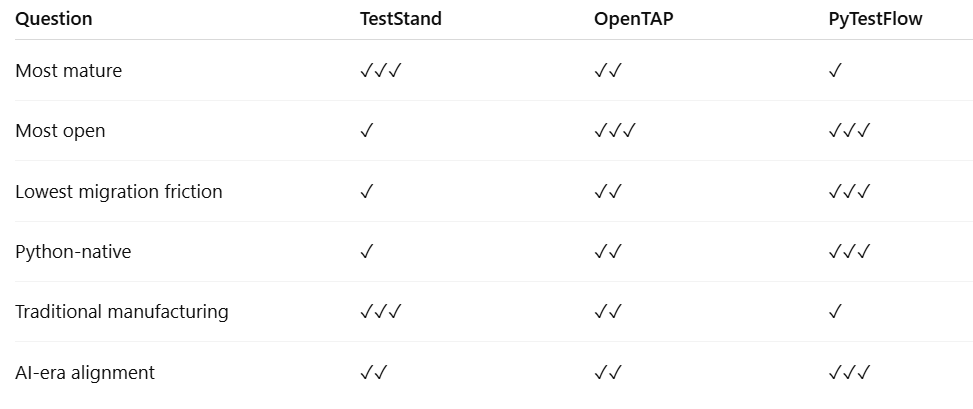
For engineers evaluating test executive software today, the choice is no longer limited to a single commercial platform. Depending on requirements, organizations may choose TestStand for mature industrial deployments, OpenTAP for an open and modular architecture, or Python-native frameworks such as PyTestFlow for rapid development and AI-assisted workflows.
TestStand remains highly capable. The industry de-facto standard.
OpenTAP offers a strong open alternative, backed by Keysight and supported by a growing ecosystem of hardware test automation users.
PyTestFlow represents a newer free and open philosophy. Built around reducing friction and accelerating iteration.
But the larger story is not about any individual product. The larger story is that AI is changing the economics of test automation.
As implementation becomes cheaper, cognitive overhead becomes more important.
As AI becomes better at generating code, maintainability and adaptability become more valuable.
As engineering teams become more software-centric, integration with mainstream ecosystems matters more.
Which platform ultimately leverages these trends best remains to be seen.
It could be TestStand enhanced by Nigel AI.
It could be OpenTAP.
It could be PyTestFlow.
It could even be hybrid architectures that combine LabVIEW, Python and AI-assisted workflows.
What seems increasingly clear is that AI in test is not a temporary trend. It is becoming part of the engineering toolbox.
And the winning approaches will likely be the ones that reduce the distance between a working measurement and actionable information.
