

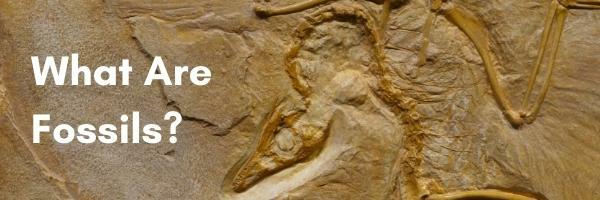
Fossils are the preserved remains of plants, animals, fungi, and single-celled creatures. Fossils are not the remains of the organism itself! They are rocks.
For an organism to be fossilized, the remains usually need to be covered by sediment (volcanic ash, sandy seafloor, or even tar) soon after death. Over time, minerals in the sediment seep into the remains. The hard, bony body parts, such as skeletons, teeth, or shells become fossilized and are called body fossils.
There is another type of fossil, called trace fossils, which are preserved evidence of biological activity. Some examples of trace fossils include footprints, nests, burrows and coprolites.
Here's some cool resources to help you learn more about fossils:
🔎 What is a Fossil? - Learn more about prehistoric life by identifying the types of fossils: amnh.org/learn-teach/curriculum-collections/dinosaurs-activities-and-lesson-plans/what-is-a-fossil
📰 Fossil Fact Sheet: https://www.geolsoc.org.uk/~/media/shared/documents/education%20and%20careers/Resources/FactSheets/Fossil%20Factsheet%20for%20kids%20April%202017%20-%20final.pdf?la=en
🎥 Fossil Hunting 101 - Watch this video and read the corresponding blog post below to learn about going on an expedition to search for fossils: vimeo.com/185656705
📰 Blog Post - Fossil Hunting 101: fieldmuseum.org/blog/fossil-hunting-101
🔎 What Teeth Tell Us - Interactive activity and worksheet from the American Museum of Natural History: amnh.org/content/download/1915/25369/file/dino07teeth.pdf
🎥 What's the best place to look for dinosaur fossils? https://www.youtube.com/watch?v=Th8qbRWVslo
🔎 If Fossils Could Talk - Problem solving activity using modeling clay for children ages 7-9: explorify.uk/en/activities/problem-solvers/if-fossils-could-talk (Please note: You will need to create a free account on this website to be able to access this material)
🎥 Video - What do Fossils Teach Us?: naturalhistory.si.edu/education/teaching-resources/paleontology/what-do-fossils-teach-us
Happy Fossil Hunting! 🦴
Vanessa