
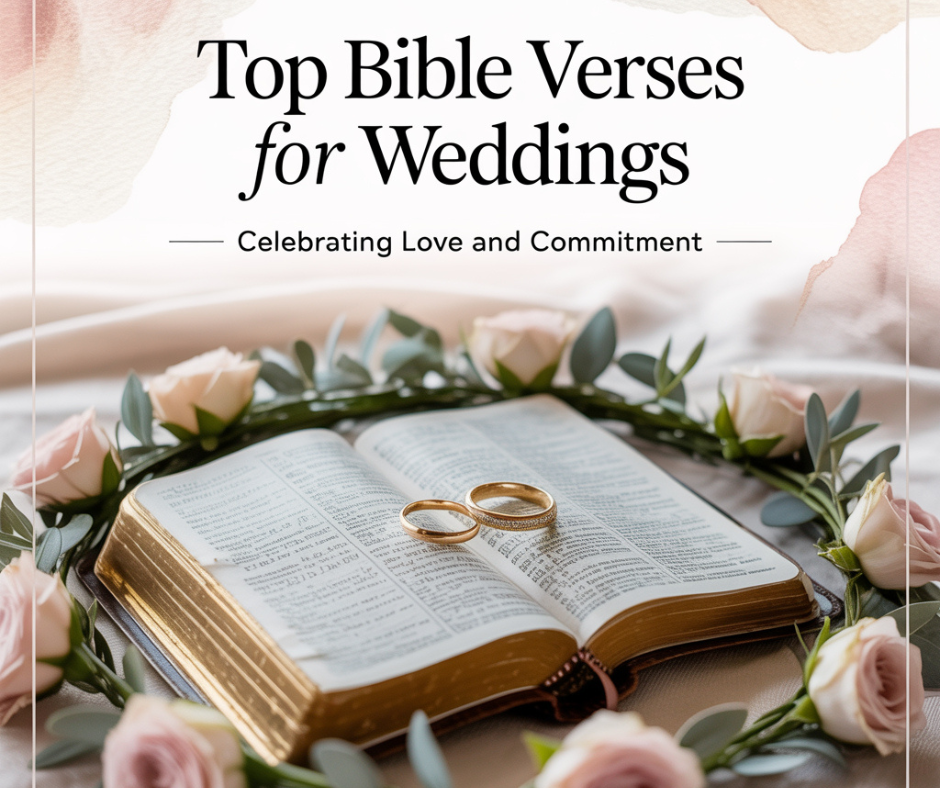
A wedding is more than a ceremony—it’s a sacred covenant reflecting God’s heart for marriage. Including Scripture in a wedding service, invitation, or program offers timeless truths that anchor a couple’s commitment in divine wisdom. The Bible brims with passages about love, unity, faithfulness, and covenant. Below are some of the most fitting verses for weddings, each accompanied by context and why it works beautifully on such an occasion. Whether you’re the couple, a wedding planner, or a friend crafting a meaningful tribute, these selections can guide you in weaving God’s Word into your celebration.
1. Genesis 2:24
“Therefore a man shall leave his father and his mother and hold fast to his wife, and they shall become one flesh.”
Why it’s appropriate:
Genesis 2:24 lays the foundation for marriage by affirming that, in God’s design, a husband and wife leave their families to form a new, united household. Each wedding marks this departure and the forging of a new “one flesh” identity. This verse reminds couples—and their guests—of the divine institution of marriage. It declares that a husband and wife’s bond extends beyond mere emotion or ceremony; it is a covenant modeled after God’s own faithfulness. Reciting Genesis 2:24 during vows or including it in a wedding program emphasizes the couple’s decision to prioritize each other above all familial ties.
2. 1 Corinthians 13:4–7
“Love is patient and kind; love does not envy or boast; it is not arrogant
or rude. It does not insist on its own way; it is not irritable or resentful;
it does not rejoice at wrongdoing, but rejoices with the truth.
Love bears all things, believes all things, hopes all things, endures all things.”
Why it’s appropriate:
Often called “the love chapter,” 1 Corinthians 13 epitomizes Christian understanding of love. Verses 4–7 outline attributes a spouse should exhibit: patience, kindness, humility, and perseverance. Many couples choose to read these words during the ceremony—sometimes as a standalone reading or integrated into personal vows—because they vividly portray how love is best lived out. Rather than romantic cliché, this passage challenges couples to pursue sacrificial love that bears and endures. For wedding invitations or programs, these verses serve as a constant reminder that love in marriage is less about feelings and more about faithful action.
3. Ecclesiastes 4:9–12
“Two are better than one, because they have a good reward for their toil.
For if they fall, one will lift up his fellow. But woe to him who is alone when
he falls and has not another to lift him up! Again, if two lie together, they
keep warm, but how can one keep warm alone? And though a man might prevail
against one who is alone, two will withstand him—a threefold cord is not
quickly broken.”
Why it’s appropriate:
Ecclesiastes 4:9–12 speaks to the practical benefits of partnership: mutual support, warmth, and strength in adversity. At a wedding, these verses encourage the couple to view marriage as an enduring partnership—one that is stronger when two people work together under God. The image of a “threefold cord” (husband, wife, and God) highlights that marital strength is rooted in Christ. Couples often include these verses in their unity ceremonies, printed programs, or wedding décor to underscore that their union is meant to flourish through mutual care and reliance on God’s presence.
4. Ephesians 5:21–33
“Submit to one another out of reverence for Christ. Wives, submit to your own
husbands, as to the Lord. For the husband is the head of the wife even as Christ
is the head of the church… Husbands, love your wives, as Christ loved the church
and gave himself up for her, that he might sanctify her… In the same way husbands
should love their wives as their own bodies. He who loves his wife loves himself.”
Why it’s appropriate:
Ephesians 5 describes the mutual submission and sacrificial love that should characterize Christian marriage. At first glance, its language about headship and submission can feel challenging, but read in context, it reveals a picture of mutual respect: wives value husbands’ leadership modeled after Christ, and husbands emulate Christ’s self-giving love. Couples sometimes read selections from Ephesians 5:21–33 during their ceremony—either the entire passage or key excerpts such as verse 25 (“Husbands, love your wives, as Christ loved the church”). This underscores marriage’s holy call: to reflect Christ’s relationship with the church. Including these verses invites each spouse to embrace responsibility and devoted love.
5. Song of Solomon 8:6–7
“Set me as a seal upon your heart, as a seal upon your arm,
for love is strong as death, passion fierce as the grave.
Its flashes are flashes of fire, the very flame of the Lord.
Many waters cannot quench love, neither can floods drown it.
If a man offered for love all the wealth of his house,
he would be utterly despised.”
Why it’s appropriate:
The Song of Solomon celebrates romantic love in poetic, sometimes sensuous imagery. These verses (8:6–7) are frequently used in weddings to express the depth and unquenchable nature of true love. Saying, “Love is as strong as death,” communicates that marital love transcends all trials. The phrase “the very flame of the Lord” ties that passion directly to God’s own character. Many couples include Song of Solomon 8:6–7 as part of their ceremony or wedding materials to evoke the romantic beauty and divine dimension of their union.
6. Colossians 3:14
“And above all these put on love, which binds everything together in perfect harmony.”
Why it’s appropriate:
In Colossians 3, Paul lists virtues—compassion, kindness, humility, gentleness, patience—before culminating with “above all these put on love.” In a wedding context, Colossians 3:14 can serve as a succinct exhortation for the couple: no matter what, love must be the thread that weaves every other quality together. This verse is especially fitting for wedding programs, invitations, or a bulletin insert, reminding couples and guests alike that love is foundational to a harmonious marriage.
7. Proverbs 18:22
“He who finds a wife finds a good thing and obtains favor from the Lord.”
Why it’s appropriate:
Proverbs 18:22 is a concise statement of gratitude and blessing. Often used in toasts, wedding invitations, or as a decorative wall piece at the reception, this verse celebrates the blessing of a godly spouse. It can be read during the ceremony or included in printed materials to affirm that marriage is, in itself, a gift from God. Both spouses—husband and wife—can lean on this promise as a reminder of the favor the Lord bestows through marital companionship.
8. Hebrews 13:4
“Let marriage be held in honor among all, and let the marriage bed be undefiled, for God will judge the sexually immoral and adulterous.”
Why it’s appropriate:
Hebrews 13:4 underscores both the sacredness of marriage and God’s standard of faithfulness. On a wedding day, this verse can be read or displayed to remind the couple and guests that marriage is to be honored, celebrated, and kept pure. It serves as both encouragement and admonition, placing God’s holiness at the center of the new household. Preachers or officiants may incorporate Heb. 13:4 into a homily or exhortation, reinforcing the lifelong commitment and moral integrity marriage demands.
9. Ruth 1:16–17
“But Ruth said, ‘Do not urge me to leave you or to return from following you.
For where you go I will go, and where you lodge I will lodge.
Your people shall be my people, and your God my God.
Where you die I will die, and there will I be buried.
May the Lord do so to me and more also if anything but death parts me from you.’”
Why it’s appropriate:
Ruth’s declaration of loyalty to Naomi has become symbolic of steadfast commitment in marriage. Although Ruth was pledging allegiance to her mother-in-law, her words—“Where you go I will go… May the Lord do so to me if anything but death parts me from you”— mirror the essence of marital vows: “for better or worse, until death do us part.” Many couples choose Ruth 1:16–17 for their readings to emphasize unwavering fidelity. It can also be included in wedding programs or as part of a unity ceremony to signify total devotion.
10. Mark 10:6–9
“But from the beginning of creation, ‘God made them male and female.’
‘Therefore a man shall leave his father and mother and hold fast to his wife,
and the two shall become one flesh.’ So they are no longer two but one flesh.
What therefore God has joined together, let not man separate.”
Why it’s appropriate:
Mark 10:6–9 records Jesus’ teaching on marriage, affirming Genesis 2:24 with authoritative weight. At a wedding, reading Mark 10:6–9 underlines that marriage is not merely a human contract but a divine union. The phrase “What therefore God has joined together, let not man separate” can be especially powerful when spoken immediately after vows, signaling the irrevocable nature of the covenant. This passage underscores that couples are to regard their marriage as sacred in God’s sight.
11. 1 John 4:7–12
“Beloved, let us love one another, for love is from God, and whoever loves has been
born of God and knows God. Anyone who does not love does not know God, because
God is love. In this the love of God was made manifest among us, that God sent his
only Son into the world, so that we might live through him. In this is love, not that
we have loved God but that he loved us and sent his Son to be the atoning sacrifice
for our sins. Beloved, if God so loved us, we also ought to love one another.
No one has ever seen God; if we love one another, God abides in us and his love is
perfected in us.”
Why it’s appropriate:
Since marriage is a reflection of Christ’s love for the church, 1 John 4:7–12 is highly fitting for weddings. These verses remind the couple that true love originates from God and is ultimately revealed in Christ’s self-sacrifice. When read during the ceremony, 1 John 4:7–12 calls spouses to love each other “as God so loved us.” It also provides a theological grounding: marital love is not just personal affection—it is a participation in divine love. These words can be included as a congregational reading or printed in the wedding program.
12. Practical Tips for Incorporating Scripture into Your Wedding
1. Select 2–3 Passages: Rather than overwhelming guests with multiple long readings, pick a few key verses that resonate most deeply with your story and hopes for marriage.
2. Use Variety: You might read one passage during the ceremony itself, another as part of a unity ritual (e.g., lighting a unity candle or planting a tree), and yet another in your printed materials.
3. Invite Loved Ones to Read: Choose family members or friends to honor them by reading your selected verses. Hearing a familiar voice add a personal touch.
4. Include in Invitations or Programs: Printing a favorite verse on invitations, save-the-dates, or the wedding program serves as both decoration and devotional encouragement.
5. Display Verses at the Reception: Frame a chosen verse at the guestbook table, on the welcome sign, or as centerpieces. This keeps the focus on God’s Word throughout the celebration.
Conclusion: Letting God’s Word Guide Your Marriage
Choosing Scripture for a wedding is not mere tradition; it is an opportunity to ground your vows, celebration, and future home in God’s revealed truth. Verses like Genesis 2:24, 1 Corinthians 13, and Ephesians 5 remind couples that marriage is a divine gift calling for sacrificial love, unity, and lifelong commitment. By weaving these passages into the ceremony, programs, or décor, you proclaim to guests—and yourselves—that your union is built on more than human emotion: it is anchored in the unchanging Word of God.
May these “Top Bible Verses for Weddings” equip you, inspire you, and fill you with grace as you embark on the adventure of marriage together. Congratulations, and may “the two of you . . . become one flesh,” loving one another “as Christ loved the church.”
Closing Prayer
Sovereign Lord, we thank You for the gift of marriage—as a reflection of Your steadfast love and unity in the Trinity. Bless every couple here planning to wed, that their love may mirror the sacrificial love of Christ. May they build their home on Your Word, practicing patience, kindness, and forgiveness. Guide them through life’s joys and challenges, and keep them faithful to the vows they have spoken. As they say, “I do,” may they mean, “I trust You, God, to lead us.” In Jesus’ name, Amen.