

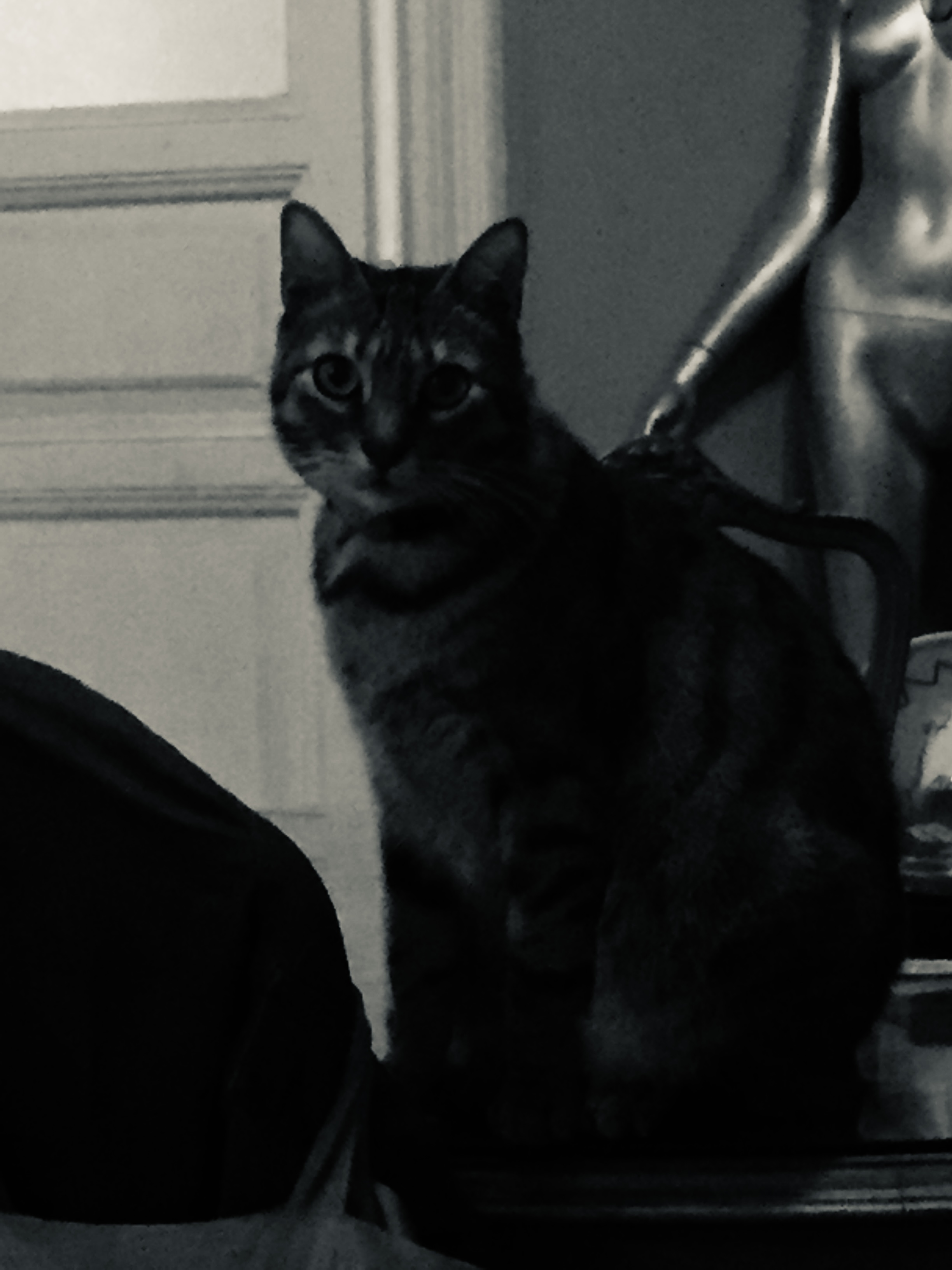
The cat appeared without announcement, the way mildew or a crack in a wall does. One day it was not there and then it was.
I cannot say when exactly. Time in the building had already soften around the edges—days marked by power cuts, by the generator’s cough, by the call to prayer bouncing faintly from another neighborhood. And the cat slid into this looseness easily.
It was a remarkably unremarkable tabby. Brown-grey, short-haired, neither pretty nor ugly. The kind of cat you would fail to describe if asked later. No collar. No injury worth noting. One ear nicked, common as dust. It slept on the landing between the second and third floors, tucked against the wall where the paint peeled in thin curls.
I almost stepped on it the first time I saw it.
But it did not move. It did not startle. It simply opened one eye, regarded me without interest, and closed it again. I remember thinking—not believing, just thinking—that it had been there longer than I had noticed.
In our neighbor, cats were not an unusual sight. They slept on car hoods, on garbage lids, on the warm cement near the bakery downstairs. The concierge, Abu Fadi, left scraps for them in a cracked bowl near the entrance. Children knew their names, or at least invented names for them. Women complained about fleas yet still bent down to scratch their heads. Once, during the war years, a cat had lived in the elevator shaft for weeks, surviving on pity and leftovers. This was Lebanon. Cats were part of the architecture.
This cat, however, did not belong to the outside. It did not sit by the entrance or linger near the trash. It did not cry to be let in. It lived inside, as if it owned the place.
At first, no one remarked on it.
People stepped around it without comment. Someone laughed once when they nearly tripped. “This cat will kill someone,” they joked. The cat slept on.
It had a talent for choosing places that slowed you down.
Corners. Landings. In front of doors where you paused to listen before knocking. At the foot of stairs where you adjusted your grip on the railing. It never blocked the way outright. It simply occupied it.
I began to notice that when people hesitated, the cat was often there.
Then I began to notice the small things that went wrong.
First, the old man on the second floor—Mr. Nassar, who watered his plants at dawn and wore pressed trousers even to take out the trash—fell in the stairwell. He said he hadn’t slipped, but his foot had simply failed him. He broke his wrist. The cat had been sleeping one floor below, I remembered later, tucked against the wall like a bundle of rags.
Then Rima forgot the kibbeh in the oven and filled her apartment with smoke. Nothing burned badly, but she cried in the hallway, embarrassed and shaken. The cat sat beside her door, licking its chest.
A week later, the electricity failed during a storm, and a woman from the building across the street slipped on the wet tiles at the entrance and hit her head. An ambulance came. The cat was by the front door, seemingly just watching the rain.
None of these things were extraordinary. Accidents happened. People forgot things. We lived in a country where far worse occurred daily without explanation. And yet, I began to feel watched—not by the cat itself, but by the spaces it occupied.
Nothing dramatic. Nothing that demanded meaning.
I told myself this repeatedly.
Still, I began to feel that the building was narrowing. Not physically—no walls moved—but the space in which decisions could be made felt compressed, as if something invisible had leaned closer.
I tried to talk to Abu Fadi about it.
“The cat,” I said, as he swept the entrance one morning. “Do you know where it came from?”
He squinted at me. “Which cat?”
“The one inside.”
He leaned on his broom and laughed. “You mean that cat. He’s been here forever.”
“No, he hasn’t,” I said, irritated despite myself. “I’ve lived here ten years.”
“And the cat has lived here longer,” he said, amused. “Longer than you, longer than me.”
“That’s not possible.”
He shrugged, already losing interest. “If you don’t like cats, close your door.”
The cat started appearing on different floors without ever being seen moving. One day it slept outside the elevator. Another day it was on the fourth floor, stretched along the corridor like a discarded scarf. Once, when the elevator doors opened, it was sitting inside, centered precisely, its reflection dull in the metal.
I did not get in until the doors were already closing.
It never begged. Never meowed. Never acknowledged food. Once, foolishly, I placed a bowl of water beside it. The next time I passed, the bowl was overturned, the water absorbed into the concrete, leaving a dark stain like a shadow that refused to dry.
People began to talk about it without really talking about it.
“That cat again,” someone muttered.
“Careful,” another said. “You’ll trip.”
No one asked where it came from. No one wondered how it survived.
The building absorbed it the way it absorbed leaks and mold.
I dreamt of the cat before I understood I was afraid of it.
In the dream, the building was empty of people but full of sound—the walls breathing, a low hum beneath the floors. The cat moved freely, unhurried, its paws silent. Wherever it sat, the light dimmed slightly, as if the air thickened around it.
I woke with my jaw clenched, my tongue pressed hard against my teeth.
One evening, the power went out when it wasn’t supposed to. I opened my door to check the fuse box. The cat sat directly outside my apartment, facing inward, waiting. The emergency light caught its eyes briefly—flat, reflective, unreadable.
“Go,” I said quietly, self-consciously aware that it sounded futile.
It did not move.
I closed the door and slid the bolt, though I knew it would not keep the cat out.
After that, the cat began appearing inside apartments.
Not violently. Not breaking in. Just appearing.
It was found sleeping on couches, on beds, on folded laundry. People laughed it off. “It must have slipped in,” they said, even when the windows were closed and the doors locked.
No one found it eating.
No one found it drinking.
One night, shouting erupted from the apartment below mine. A couple who lived in a state of permanent fracture. Glass broke. A woman screamed once, sharply, then went quiet. I stood in my hallway, my hand on the door, my phone heavy in my palm.
The cat sat on the landing.
It faced the stairs, ears forward, body perfectly still. It did not look at me. It did not look toward the noise. It simply remained.
Something about its stillness convinced me the moment had already passed.
I closed my door.
The next day, the woman was gone. The man said she had left him. His knuckles were bruised. The cat slept in the stairwell, its belly rising and falling gently.
That was when I understood—not clearly, not all at once—but enough to feel sick.
The cat did not act.
It stayed.
It positioned itself where something might happen, and waited to see if it would. It did not influence. It did not interfere. It did not prevent.
Its ordinariness was its power. Nothing could be blamed on it. Nothing ever would be.
I tested this knowledge, though I pretended not to.
My mother called one afternoon. I saw her name light up my phone and felt the familiar tightening in my chest. I was tired. I did not want to reassure her. I did not want to listen. I stood in my doorway, phone in hand.
The cat lay on the landing, half-asleep.
I let the phone ring.
That night, I learned my mother had fallen. Nothing serious. Just enough to frighten her. Enough to make her voice small when she asked why I hadn’t answered.
The cat moved floors the next day.
I tried to remove it once. I brought a box, coaxed gently, then less gently. The cat stood, stepped between my feet, brushed past me. Its flank was warm. Solid. Real.
Animal control could not find it.
“You’re imagining it,” Rima said kindly. “We all are these days.”
I stopped speaking about the cat.
The building’s misfortunes continued, small and survivable and relentless. A stroke. A miscarriage. A theft. A boy beaten by his father. Always the cat nearby, always the pause before action, always the moment where someone might have done something else.
I began to dread the thought of the cat leaving.
Without it, there would be no witness. No structure. No illusion that these moments were being recorded somewhere, even if only by indifference.
Then, one night, the cat was not on the stairs.
Not on any floor.
My apartment felt hollow when I entered it, as if something essential had been removed. I stood in the dark, listening, my skin prickling.
The cat lay on my bed.
Curled tightly in the center, pressed into the sheets as if claiming the shape of my body in advance. My room smelled faintly of dust and fur. I did not approach. I sat on the floor and waited.
After a long time, the cat rose. It stretched, slow and deliberate, then jumped down. It brushed my knee as it passed, leaving behind a lingering warmth that made my stomach turn.
It left.
The next morning, the building was without it. People asked once or twice. Then they forgot.
Yet, things continued to happen.
And slowly, without planning to, without choosing to, I found myself lingering in hallways. Sitting on landings. Standing near doors that were not mine. Watching. Staying still.
It took me some time to understand what the cat had been teaching.
Now, when something happens—when someone hesitates, when a choice collapses into silence—I am often there.
I do nothing.
I stay.