

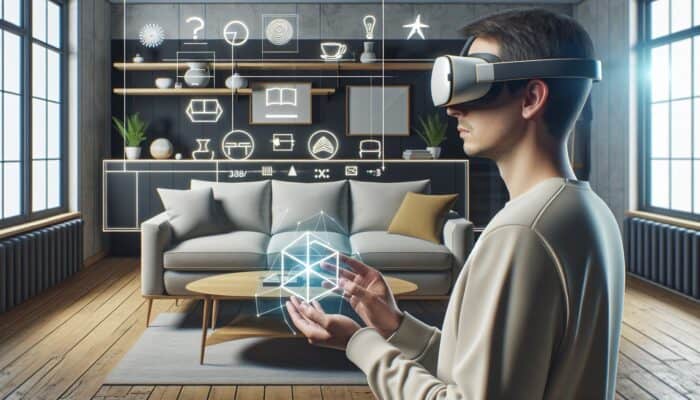
 Augmented Reality technology transforms the shopping experience, superimposing digital information and images directly onto the user's physical surroundings.
This innovative integration crafts an interactive and captivating environment for consumers, quickly becoming adopted across retail and other major sectors.
Devices utilizing cameras and sensors detect and interpret the surrounding environment; users manipulate and interact with virtual objects as if the products truly exist in their immediate space.
Computer vision technology enables these devices to comprehend real-world environments, while depth-sensing accurately assesses the spatial relationships between virtual images and physical objects.
Real-time rendering provides smooth, responsive AR experiences, instantly displaying virtual elements and dynamically adjusting them as users move or engage.
Integrating AR into product try-ons actively revolutionizes the online retail landscape, driving substantial positive changes for businesses.
When consumers visualize products in their environment or see virtual items on themselves, they tend to have a higher inclination to interact, leading to more informed purchasing decisions.
This immersive process directly translates into higher conversion rates, as customers gain confidence in their selections before checkout.
Furthermore, brands leverage AR to achieve a significant reduction in return rates, as customers virtually try on items, ensuring their choices align perfectly with their preferences.
This functionality not only reduces return costs but also significantly enhances customer satisfaction, fostering lasting brand loyalty.
Brands execute successful AR initiatives by selecting robust hardware and intuitive software compatible with their marketing goals.
Users require devices supporting AR technology, typically smartphones, tablets, or specialized AR glasses, equipped with powerful processing capabilities and high-quality cameras.
Choosing the correct AR software remains vital for success, as it demands solutions that are compatible with the chosen hardware and offer customization options to tailor the AR experience to specific brand needs.
Popular platforms support essential functionalities like 3D modeling, animation, and real-time tracking. Marketers utilize appropriate lighting, often employing three-point setups, to clearly illuminate products.
They stabilize cameras using tripods or gimbals, preventing shaky video and allowing the augmented reality elements to shine without distraction
Local specialists actively support small businesses and in-house teams across the UK, helping them deploy advanced augmented reality strategies.
Web designers and SEO experts provide critical support in localized markets, focusing on organizations in specific regions, such as Glastonbury, Chipping Sodbury in Gloucestershire, Sidmouth, Sherborne, Gillingham, and Chard.
Looking forward, brands anticipate major innovations that will transform the utility of AR, including more realistic rendering techniques and AI-driven personalization tailored specifically to individual user data and behaviors.
Preparing for these advancements involves consistently testing new features and staying informed about emerging trends to ensure the business capitalizes on the evolving requirements of the local and global consumer base.