

APIs (Application Programming Interfaces) are essential components that enable software applications to communicate and exchange data with each other. APIs facilitate information sharing, enable the use of functions across applications, and support data exchange. In the world of web development, APIs form the foundation for inter-application interactions.
For example, a weather application can retrieve current weather data by using a weather API. Social media applications allow users to find friends and share posts with other applications through APIs. E-commerce websites utilize payment processor APIs for payment transactions.

Table of contents
In the first part of this article series, we will provide a general overview of Modern API Architectures and delve deep into SOAP (Simple Object Access Protocol) as the initial topic.
Throughout this article series, we will cover the following key topics: SOAP, REST, GraphQL, gRPC, WebSocket, Webhook, MQTT, and AMQP.
Let’s start with Modern API Architectures, beginning with SOAP:
What is SOAP, and How Does it Work?
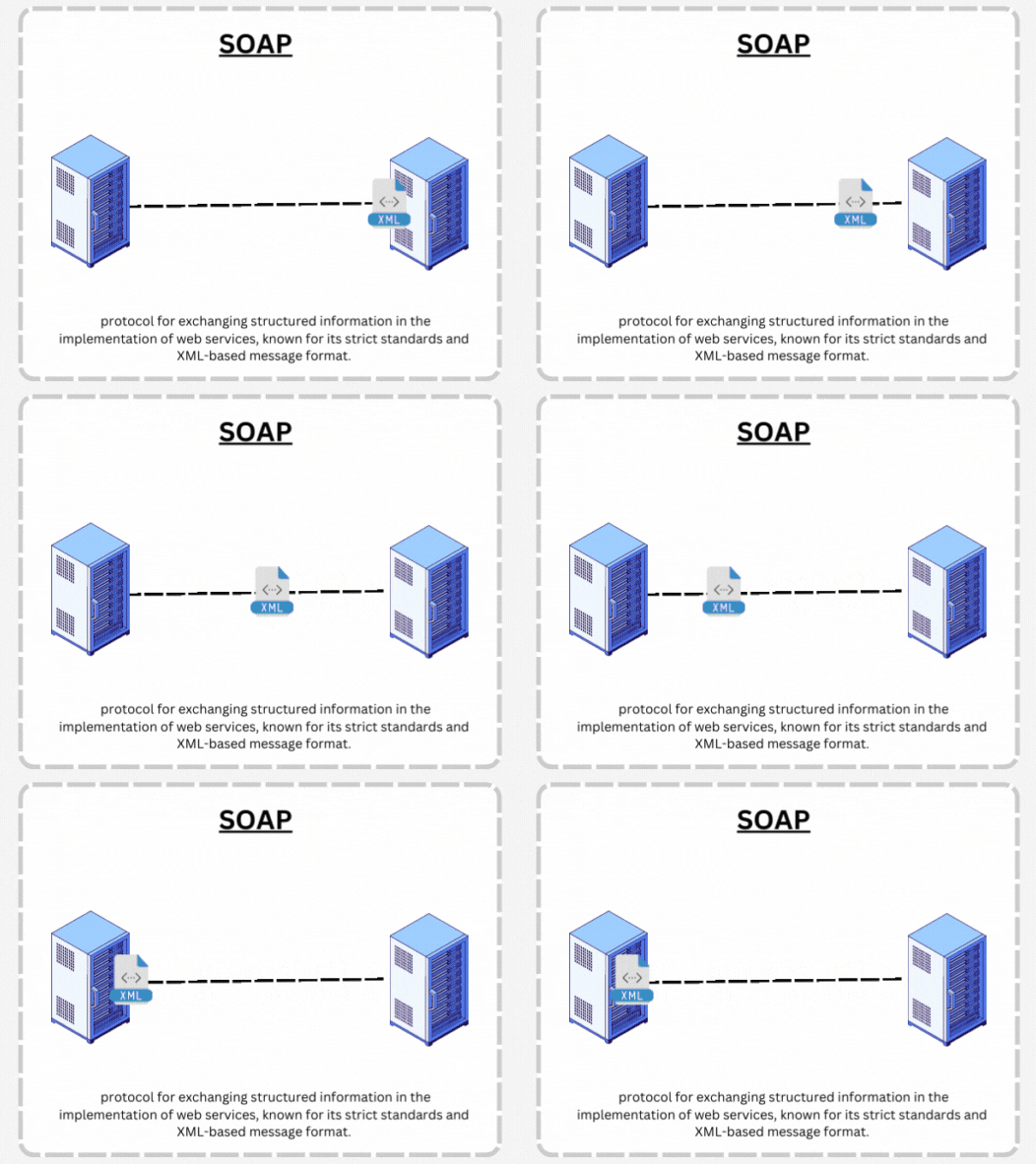
SOAP is a protocol used to transmit Remote Procedure Call (RPC) requests. In this section, we will explain the fundamental principles of SOAP and demonstrate how SOAP is structured. Specifically, we will cover:
Key Features of SOAP
XML-Based Message Format
SOAP Server and Client
Advantages and Disadvantages of SOAP
Key Features of SOAP:
SOAP possesses the following significant characteristics as a communication protocol:
Platform Independence: SOAP can function independently across different platforms, making it ideal for communication between systems using different programming languages or operating systems.
XML-Based: SOAP messages use the XML (Extensible Markup Language) format to transport data, ensuring that data is human-readable and machine-readable.
Protocol Independence: SOAP can operate over various communication protocols, including HTTP, SMTP, TCP, making it suitable for data exchange across different communication channels.
Language Independence: SOAP is programming language-independent, allowing a SOAP client written in one language to communicate with a SOAP server written in another language.
XML-Based Message Format:
SOAP messages are carried in an XML-based format. A typical SOAP message includes the following components:
Envelope: The primary component that envelops the SOAP message, determining its beginning and end.
Header: Optionally used to contain additional message information, such as security authentication details or transaction tracking.
Body: Carries the main content of the SOAP message, including the actual transaction data.
Fault: Contains error details if an error occurs.
Here is an example of a SOAP message:
<soapenv:Envelope xmlns:soapenv="http://schemas.xmlsoap.org/soap/envelope/" xmlns:web="http://www.example.com/webservice">
   <soapenv:Header/>
   <soapenv:Body>
      <web:GetUserInfo>
         <web:UserID>12345</web:UserID>
      </web:GetUserInfo>
   </soapenv:Body>
</soapenv:Envelope>
The example above illustrates the essential components of a SOAP message:
<soapenv:Envelope>: The Envelope is the main wrapping component for the SOAP message.<soapenv:Header>: Optionally used for additional message information (empty in this example).<soapenv:Body>: Contains the core content of the SOAP message, which includes actual transaction data.<web:GetUserInfo>: Represents a specific operation in the real transaction.<web:UserID>: One of the parameters of the GetUserInfo operation, specifying the user ID.
This example depicts a SOAP request sent to query user information in a web service. SOAP uses structured XML messages like this for data exchange.
SOAP Server and Client:
SOAP operates on a server-client model. The SOAP server receives SOAP requests from clients, processes them, and sends responses back to the clients. Clients create SOAP requests, send them to the server, and process the SOAP responses.
Advantages and Disadvantages of SOAP:
SOAP has several advantages, including:
Security: SOAP can ensure secure communication, making it particularly useful for scenarios requiring enhanced security.
Error Handling: SOAP provides standards for error handling, allowing errors to be handled gracefully.
Independence: SOAP can work across different platforms and is language-independent.
However, SOAP also has its disadvantages, such as:
Complexity: SOAP messages, often XML-based, can lead to increased data size and complexity.
Speed: SOAP’s use of XML for data transport may make it slower compared to other formats.
SOAP Examples and Usage Scenarios:
To better understand SOAP, we will proceed with examples and demonstrate SOAP usage through real-world scenarios. We will explain when and why SOAP should be preferred. In these examples, we can cover the following topics:
Creating and Deploying a SOAP Web Service:
An organization may want to create a SOAP web service to manage customer data. Here’s how the process can unfold:
Creating the Web Service: First, the organization will need a database to store customer data. A backend service that provides access to this database needs to be created.
Database Connection: The SOAP web service should retrieve customer data from the database and transmit it to clients. This involves establishing a connection to the database and adding data querying capabilities.
Creating the SOAP Web Service: To transmit the data, a SOAP web service must be created. This service accepts SOAP messages, retrieves data, and sends SOAP messages as responses to clients.
Deployment: The web service is deployed to the organization’s servers and made accessible through a specific URL.
Integrating Client Applications with a SOAP Web Service:
Another organization may wish to fetch customer data from another organization’s SOAP web service. Here’s how to proceed in this scenario:
Understanding the Web Service: Initially, it’s necessary to understand the SOAP web service of the other organization. This involves determining how the service is used, what functions it offers, and which data access permissions it provides.
Creating a Client Application: An application for fetching customer data needs to be developed. This client application creates SOAP messages, sends them to the SOAP web service, and processes incoming SOAP responses.
SOAP Messages: The client application must fill in data to create SOAP messages. SOAP messages are used to query the desired data.
Data Processing: The client application processes incoming SOAP responses and makes customer data usable.
Data Exchange and Security with SOAP:
SOAP can be employed for secure data transmission, especially for sensitive data in fields such as finance and healthcare. Here are relevant aspects:
Data Encryption: Data transmitted via SOAP can be encrypted for protection. Communication between the client and server can be encrypted using security certificates.
Authentication: SOAP supports identity authentication. Clients can provide identity information to the server for authorization.
Error Handling: SOAP provides standards for error management. If an error occurs, error details are conveyed in the SOAP message, allowing for troubleshooting.
Conclusion:
In this article, we thoroughly explored SOAP in the first part of the Modern API Architectures series. We covered what SOAP is, how it works, provided examples, and discussed its advantages and disadvantages. In the next part of the series, we will delve into REST architecture and compare these two approaches.
If you want to acquire more information and details about SOAP Web Services, you can review the following resources:
W3Schools SOAP Tutorial: W3Schools is an excellent source that provides fundamental information and examples about SOAP. W3Schools SOAP Tutorial
What is SOAP? — Tutorialspoint: For more comprehensive knowledge about SOAP presented in structured sections, you can explore detailed SOAP content here. SOAP — Tutorialspoint
Architecturemaker — SOAP Architecture: To delve into SOAP architecture details and gain further insights into the comparison between SOAP and REST, you can read this article. What Is Soap Architecture?
These resources will assist you in gaining a deeper understanding and knowledge of SOAP and related topics.
Keep Reading
To continue reading the rest of this article or to explore more articles in this series, you can visit my Medium profile. There, you’ll find a collection of insightful content on various programming topics.
Thanks for your interest, and happy reading!