In my last post, I explored an intriguing ancient idea surrounding the staff.
Scripture gives us at least one example of names being written upon staffs representing ancestral houses. Later Jewish tradition went considerably further, remembering a particular staff that passed through generations: Abraham to Isaac, Isaac to Jacob, Jacob to Joseph, eventually finding its way into the hands of Moses.
We cannot establish that tradition as history.
But if we allow the tradition to inform our imagination for a moment, it creates an extraordinary scene in Exodus.
Because one day God asked Moses a very simple question:
“What is that in your hand?”
Moses answered:
“A staff.”
Perhaps it was just a shepherd's staff.
But according to later Jewish tradition, Moses was holding something much older.
Abraham had carried it.
Isaac had carried it.
Jacob had carried it.
Joseph had carried it into Egypt.
And now Moses was holding it in the wilderness.
If so, Moses was quite literally holding his history in his hand.
Then God said something unexpected.
“Throw it on the ground.”
Moses did.
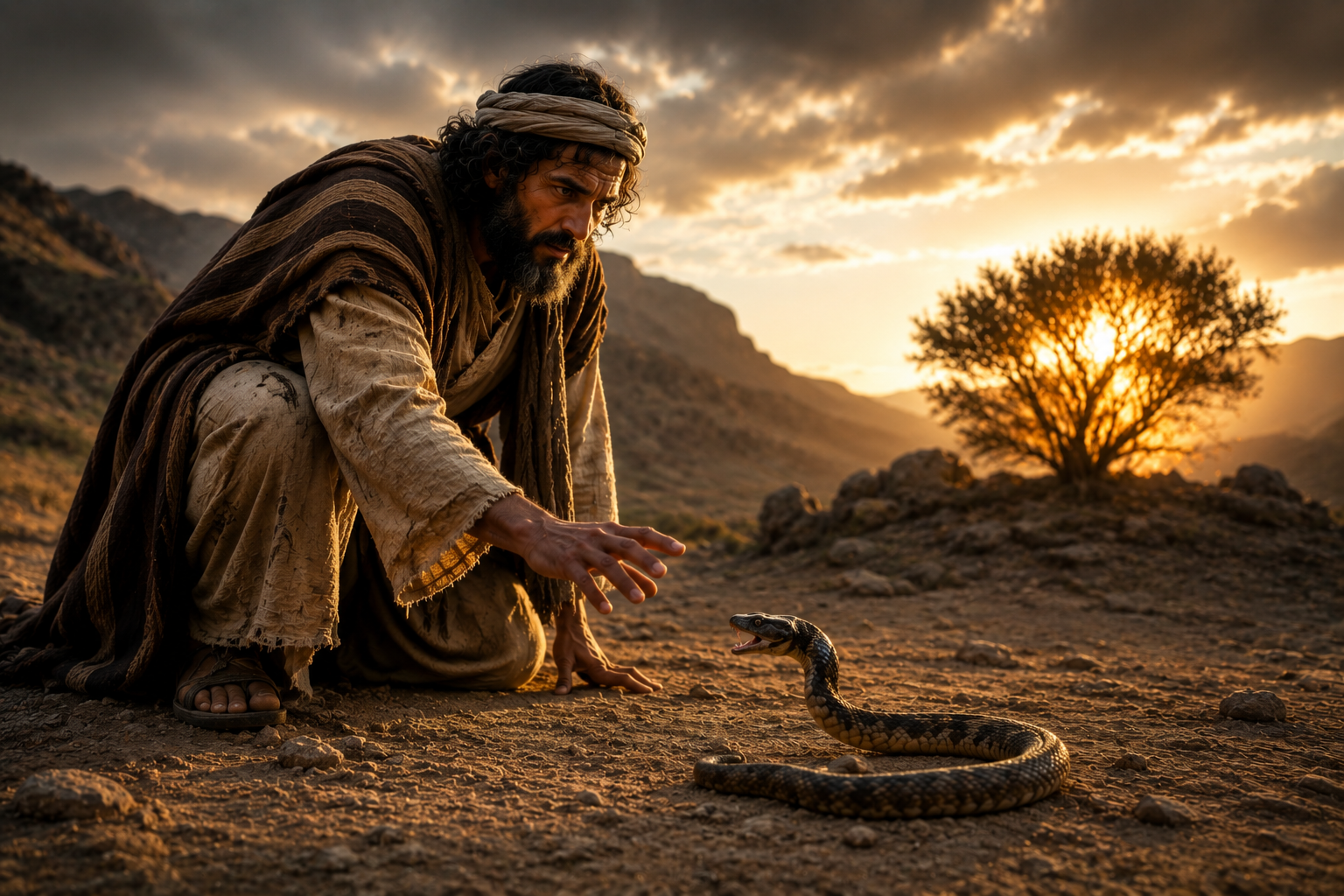
And his staff became a serpent.
Then Moses ran from it.
Sometimes Your Past Looks Different on the Ground
I find that detail a bit comical, and... worthy of closer inspection.
Moses had been carrying that staff without apparent concern.
It was familiar.
Useful.
Ordinary.
But when he threw it down and looked at it from a distance, suddenly it terrified him.
Sometimes our history is like that.
We carry it for years because we have to.
Then one day something causes us to really look at it, and what we see scares us.
Moses certainly had a history capable of doing that.
He entered the world under a death sentence.
Pharaoh had commanded that Hebrew sons be thrown into the Nile.
His mother hid him as long as she could before placing him in a basket among the reeds.
Then, through one of the strangest twists imaginable, Moses was raised inside Pharaoh's own household.
Think about the contradictions contained in that man's identity.
Hebrew by birth.
Egyptian by upbringing.
Born among slaves.
Raised among royalty.
His people were making bricks while he was growing up in the household of the man who enslaved them.
Then everything fell apart.
Moses killed an Egyptian.
The act became known.
Pharaoh wanted him dead.
And Moses ran.
By the time we meet him at the burning bush, the prince has become a shepherd.
Egypt is behind him.
Midian is home.
Forty years have passed.
And then God says:
Go back.
No wonder Moses has objections.
Who am I?
What if they don't believe me?
What if they ask Your name?
I don't speak well.
Send somebody else!
We often read those objections merely as insecurity, and maybe some of them were.
But Moses had legitimate reasons to be afraid.
There were people in Egypt who had wanted him dead.
In fact, God specifically reassures him:
“Go, return to Egypt; for all the men who sought your life are dead.”
Moses wasn't a coward. His past really did contain serpents.
Pick It Up
God doesn't allow Moses to keep running.
The staff is writhing on the ground, and God says: “Reach out your hand and take it by the tail.”
That is an interesting way to pick up a snake, with the business-end swinging freely.
Moses obeys.
And the moment he takes hold of it, it becomes a staff again in his hand.
Don't move too quickly past that.
God didn't kill the serpent for Moses--something I would have asked Him to do.
He told Moses to pick it up.
And perhaps there is something here for those of us who have spent years running from pieces of our own story.
Sometimes we want redemption to mean erasure.
We want God to remove the ugly chapter.
Delete the failure, undo the years...
Give us another childhood, or marriage, or opportunity, or history...
But God doesn't always give us another staff.
Sometimes He tells us to pick up the one we dropped.
The past that frightened you does not necessarily have to disappear.
It may simply need to come back under the authority of God.
Because in Moses' hand, the serpent became a staff again.
The Serpent of Egypt
There is another detail here that Moses would have understood far better than most of us.
The serpent was not an insignificant image in Egypt.
The rearing cobra, known as the uraeus, was one of the great symbols of Egyptian royalty. Pharaoh wore it prominently upon his forehead.
The cobra represented royal authority, divine protection and destructive power.
It was an image that effectively said:
The king is protected. His enemies will be destroyed.
Moses grew up around that imagery.
He knew what it represented.
And now, while God is preparing him to return to Pharaoh, Moses watches his own staff become a serpent.
He runs from it.
Then God tells him to take hold of it.
Later, standing before Pharaoh, the sign happens again.
Aaron throws down the staff.
It becomes a great serpent.
Pharaoh summons his magicians, and their staffs become serpents as well.
Then something extraordinary happens.
Aaron's serpent swallows theirs.
To an Egyptian court surrounded by the imagery of royal serpents, the symbolism must have been provocative.
Pharaoh's power was real.
Egypt's power was real.
Moses knew that better than most, but it wasn't ultimate.
The thing Moses once fled from would eventually swallow the symbols of the power he feared.
What Was Written on Moses' Staff?
If the later Jewish tradition is allowed to frame the scene, something even more beautiful happens.
According to that tradition, this staff had passed through Abraham, Isaac and Jacob.
And immediately after Moses takes hold of the serpent and it becomes a staff again, God explains the purpose of the sign:
“That they may believe that the LORD God of their fathers, the God of Abraham, the God of Isaac, and the God of Jacob, has appeared to you.”
Abraham, Isaac, and Jacob.
The very men through whom, according to the tradition, the staff had passed.
Again, Exodus never tells us that Moses was carrying Jacob's staff. We should not turn a later tradition into biblical fact.
But the picture snares me. It's beautiful.
Moses takes his history back into his hand, and God immediately identifies Himself as the God of that history.
Maybe that is the part we sometimes miss.
God is asking Moses to embrace Egypt honestly.
Moses was raised a prince, and God isn't erasing the prince.
He's going to use what the prince learned.
God isn't erasing the shepherd.
He's going to use what the shepherd learned, too.
Moses' life looks fragmented when viewed naturally.
Forty years in Egypt.
Forty years in Midian.
Two lives that seemingly have nothing to do with one another, but God needs both men.
The man who understands Pharaoh's court, and the man who knows how to survive in the wilderness.
The Rod of God
Then comes one of my favorite details in the story.
At the beginning of Exodus 4, God asks:
“What is that in your hand?”
Moses says:
“A staff.”
It is simply Moses' staff.
But after Moses has thrown it down...
after he has run from it...
after God has told him to turn around...
after Moses has taken hold of the frightening thing...
after it has become a staff again...
Moses begins his journey back toward Egypt.
And Exodus 4:20 calls it something different:
“And Moses took the rod of God in his hand.”
I love that.
Same piece of wood.
Different description.
It was Moses' staff, but now it is the rod of God!
And from this point forward, that ordinary piece of Moses' history becomes associated with extraordinary things.
It will confront Pharaoh.
It will stretch over the waters.
It will be raised over the Red Sea.
It will strike the rock.
It will be lifted while Israel fights Amalek.
The thing Moses threw down and ran from becomes an instrument of deliverance after he has the courage to pick it back up.
Maybe God didn't need to give Moses something new.
Maybe He needed Moses to surrender what he already had.
What Are You Running From?
In the first post, the question was:
What's written on your staff?
This time the question is different.
What are you running from?
Maybe there is something in your history that looks frightening when you put it down and really look at it.
Something you regret.
Something done to you.
A failure.
A rejection.
A season you believe was wasted.
A version of yourself you'd rather forget.
Maybe you've spent years asking God to remove it from your story.
But perhaps redemption doesn't always mean God removes the story.
Sometimes redemption means the story changes hands.
Moses' staff did not become powerful because Moses finally made peace with his childhood.
It became powerful because Moses put what was in his hand under the authority of God.
And that's different.
God doesn't call evil good.
Sometimes the thing on the ground really is frightening.
But He may ask you to stop running from it.
Turn around.
Reach down.
Take hold of it.
Because the history that looks like a serpent lying behind you may become a staff when surrendered to God and carried forward.
Your past may contain Egypt.
It may contain Midian.
It may contain palaces you lost and wildernesses you never intended to enter.
But God has an astonishing ability to redeem all of it.
The prince.
The shepherd.
The fugitive.
The failure.
The years you thought didn't fit.
He wastes neither.
So perhaps the question isn't whether there are serpents in your past.
There probably are.
The question is whether you will spend the rest of your life running from them.
Or whether, when God says it is time, you will turn around...
and pick it up.