

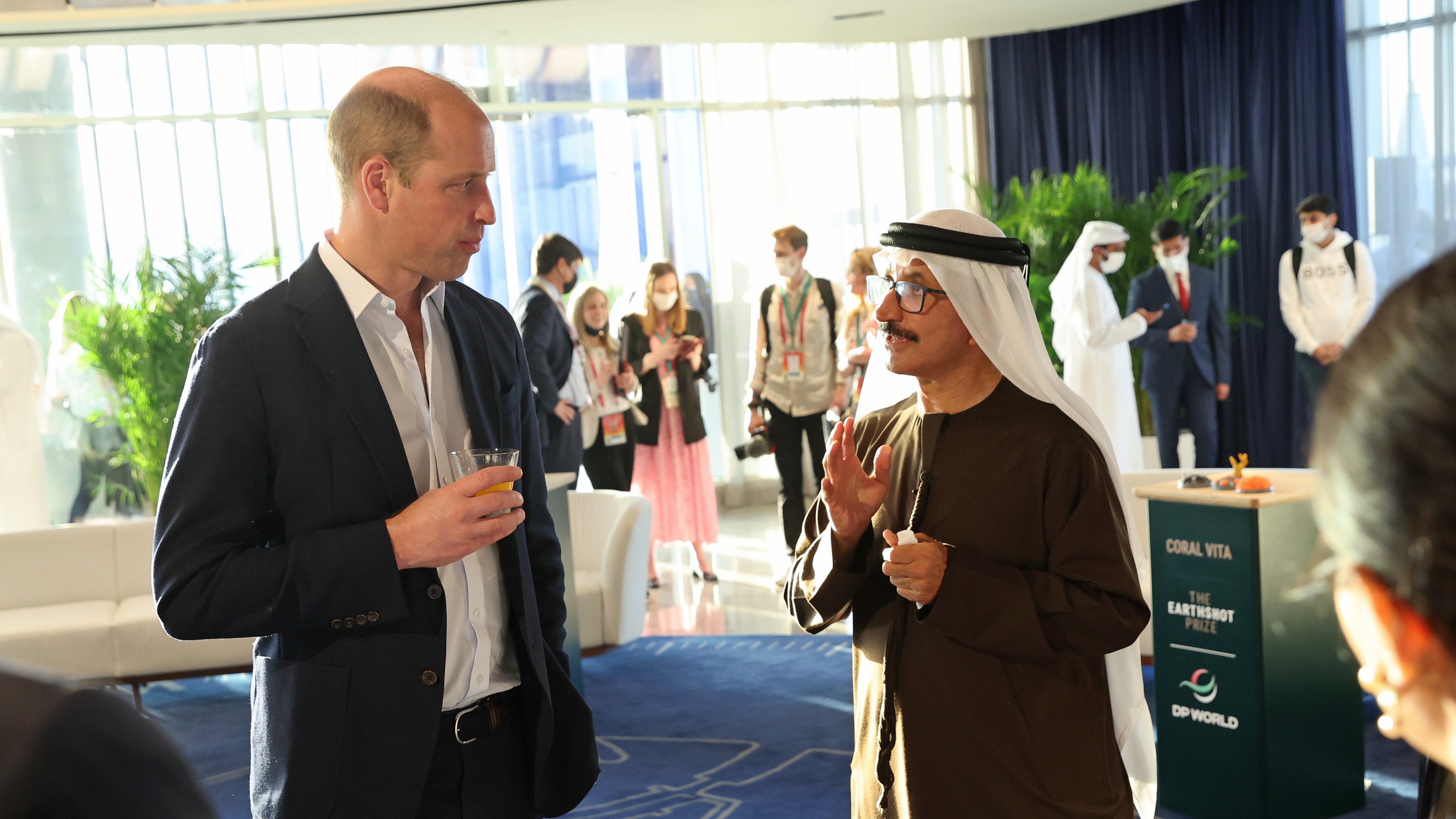
When the words “Prince William,” “Epstein documents,” and “Charity Commission investigation” appear in the same headline, people understandably react fast.
But the details matter.
Let’s break this down properly.
Prince William’s Earthshot Prize his flagship environmental initiative, is facing scrutiny after a complaint was filed with the UK Charity Commission.
The Earthshot Prize, launched in 2020, awards £1 million each to five winners every year until 2030. It’s designed to fund climate innovation ocean protection, air quality, environmental restoration, climate solutions. It has attracted global corporate partners and philanthropic backers.
One of those partners is DP World a Dubai-based logistics company.
In 2022, DP World donated £1 million to the Earthshot Prize and was listed as an official partner. Its chairman and CEO, Sultan Ahmed bin Sulayem, has appeared publicly alongside Prince William at Earthshot events.
So far, that’s straightforward philanthropy.
The issue arises because bin Sulayem’s name appeared in documents connected to Jeffrey Epstein.
Specifically, emails released through U.S. Department of Justice disclosures included messages from Epstein to a recipient later identified in reporting as bin Sulayem. One 2009 email sent while Epstein was serving a jail sentence in Florida contained disturbing language referencing a “torture video.”
Additional emails from 2013 and 2015 referencing explicit material were also linked in reporting to “Sultan bin Sulayem.”
Now pause.
Being named in documents connected to Epstein does not automatically imply criminal wrongdoing.
There is, as of now, no public charge, conviction, or formal allegation of criminal conduct against bin Sulayem in relation to Epstein.
And that distinction is crucial.
However, the reputational risk of any association with Epstein even indirect is significant. We’ve seen institutions across finance, academia, politics, and media face scrutiny for far less direct connections.
Enter Republic a British anti-monarchy group.
Republic has filed a formal complaint with the UK Charity Commission asking for a “full and comprehensive investigation” into Earthshot’s relationship with DP World and bin Sulayem.
Their argument is not that Earthshot itself engaged in wrongdoing.
Their argument is about due diligence.
They are questioning whether sufficient background checks were conducted and whether continued association is appropriate given the reputational sensitivity of Epstein-linked disclosures.
The Charity Commission has acknowledged the complaint. A spokesperson has stated they are assessing the information to determine next steps and whether there is a regulatory role for them.
That does not mean wrongdoing has been found.
It means a regulator is reviewing whether governance standards were met.
That’s very different from an accusation.
It’s also worth noting: other institutions have begun reassessing ties to DP World. Canada’s La Caisse pension fund has reportedly paused future dealings while emphasizing the importance of distinguishing between the company and the individual.
That nuance is important.
Large global corporations often have multiple stakeholders, executives, and governance structures. Regulatory review doesn’t automatically translate to corporate misconduct.
Now let’s zoom out.
Prince William founded Earthshot as a long-term climate initiative. It is one of the most ambitious projects associated with the modern monarchy positioned as forward-looking, global, and solution-driven.
This is also happening in a broader context where the royal family has already faced prolonged scrutiny due to Prince Andrew’s past association with Jeffrey Epstein.
So even though this situation does not involve allegations against William personally, the Epstein shadow remains politically and reputationally sensitive for the monarchy as a whole.
That context amplifies everything.
It’s also important to understand the role of Parliament in this story.
Some of the emails referencing bin Sulayem were cited publicly by members of Congress under parliamentary protections that shield lawmakers from defamation claims during official proceedings.
That means statements made in that context can be legally reported without constituting defamation but again, citation is not conviction.
And in reputational matters, the difference between legal exposure and public perception is massive.
So what are the core questions here?
First: Did Earthshot conduct appropriate due diligence before accepting the donation?
Second: If new information has surfaced, does that change the appropriateness of the partnership?
Third: What is the threshold for severing ties when a donor is named but not charged in controversial documents?
These are governance questions.
Not criminal findings.
Not proof of wrongdoing.
Governance.
And charities, particularly high-profile ones tied to public figures are expected to maintain rigorous standards because their credibility is central to their mission.
So far, neither Kensington Palace nor DP World has issued a formal comment in response to the complaint.
The Charity Commission is reviewing.
That’s where things stand.
Now here’s the broader tension.
Modern philanthropy often depends on wealthy corporate donors. Climate innovation at scale requires serious capital. That capital frequently comes from multinational corporations and global business leaders.
But the Epstein case permanently altered the risk calculus around elite networks.
Associations that once might have passed without comment now trigger immediate scrutiny.
Even being named in released documents can create reputational waves regardless of legal liability.
So this story isn’t necessarily about criminality.
It’s about reputational due diligence in a post-Epstein world.
For Prince William, whose public image is built around integrity, long-term leadership, and environmental stewardship, any suggestion of questionable associations however indirect creates a communications challenge.
And for anti-monarchy groups like Republic, this represents an opportunity to question transparency and accountability within royal-linked charities.
Both dynamics can exist simultaneously.
As of now:
There are no allegations of criminal conduct against Prince William.
There are no charges against Sultan Ahmed bin Sulayem related to Epstein.
The Earthshot Prize continues to operate.
The Charity Commission is reviewing a complaint.
That’s the factual position.
What happens next will depend on whether the regulator believes governance standards were breached not on public outrage alone.
But in today’s media climate, scrutiny alone can be powerful.
Because when institutions trade on trust, perception matters almost as much as legality.
And that’s why this story is being watched closely.
Not because conclusions have been reached.
But because in the Epstein era, associations, even indirect ones, are never neutral.
And for a charity built on global credibility, that makes every partnership count.