

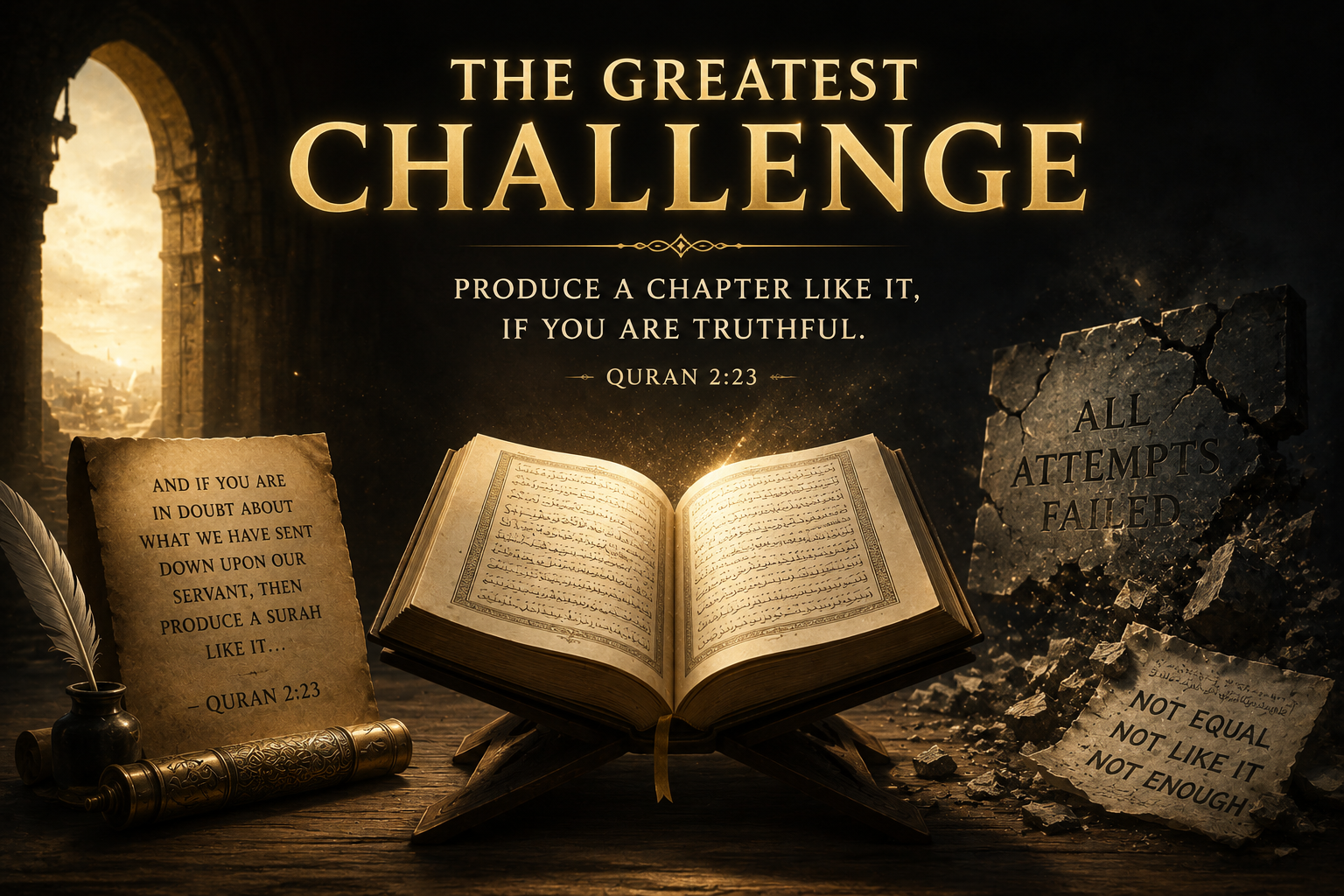
 The facets of inimitability (I‘jāz) in the Noble Qur’ān are vast and continuously explored by scholars, linguists, and thinkers. The more one reflects upon it, the more dimensions emerge—whether in its language, structure, rhetorical force, legal and philosophical coherence, preservation, or transformative impact on civilization.
Among the most profound verses related to this reality is the statement of Allah in Sūrah Fuṣṣilat:
(سَنُرِيهِمْ آيَاتِنَا فِي الْآفَاقِ وَفِي أَنفُسِهِمْ حَتَّىٰ يَتَبَيَّنَ لَهُمْ أَنَّهُ الْحَقُّ ۗ أَوَلَمْ يَكْفِ بِرَبِّكَ أَنَّهُ عَلَىٰ كُلِّ شَيْءٍ شَهِيدٌ)
“We will show them Our signs in the horizons and within themselves until it becomes clear to them that it is the truth. Is it not sufficient concerning your Lord that He is, over all things, a Witness?” (Qur’ān, Sūrah Fuṣṣilat, 41:53)
However, this article will focus on one particular aspect of the Qur’ān’s inimitability: the open challenge issued by the Qur’ān itself. Allah says in Sūrah Al-Baqarah:
(وَإِن كُنتُمْ فِي رَيْبٍ مِّمَّا نَزَّلْنَا عَلَىٰ عَبْدِنَا فَأْتُوا بِسُورَةٍ مِّن مِّثْلِهِ وَادْعُوا شُهَدَاءَكُم مِّن دُونِ اللَّهِ إِن كُنتُمْ صَادِقِينَ فَإِن لَّمْ تَفْعَلُوا وَلَن تَفْعَلُوا فَاتَّقُوا النَّارَ الَّتِي وَقُودُهَا النَّاسُ وَالْحِجَارَةُ ۖ أُعِدَّتْ لِلْكَافِرِينَ)
“And if you are in doubt about what We have sent down upon Our Servant, then produce a surah like it and call upon your witnesses other than Allah, if you are truthful. But if you do not do it—and you will never be able to do it—then fear the Fire whose fuel is men and stones, prepared for the disbelievers.” (Qur’ān, Sūrah Al-Baqarah, 2:23–24)
Between Two Explanations
Those who reject revelation generally fall into one of two broad explanations regarding the Prophet Muḥammad ﷺ:
He knowingly fabricated prophethood.
He sincerely believed he was a prophet while being mistaken or deluded.
Many accusations throughout history—poet, magician, madman, political leader, and so on—ultimately return to one of these two explanations. Yet, the Qur’anic challenge creates a profound difficulty for both.
A deliberate deceiver may fool people temporarily, but it is extremely difficult to explain why such a person would issue an open-ended challenge to humanity itself, tying the truth of his religion to the inability of future generations to imitate the text he brought. The challenge is not limited by geography, ethnicity, century, or civilization; it remains open permanently. No matter how confident a deceiver may be in his own ability, he cannot be certain that future generations will not produce someone more intelligent and capable than himself. The more calculating a fraud is, the more cautious he would be about staking his entire message on an unknown future—yet this is exactly what the Qur'anic challenge does.
On the other hand, if one claims the Prophet ﷺ was merely sincere but deluded, another question emerges: why has this challenge endured for centuries despite the enormous number of critics, opponents, philosophers, linguists, polemicists, and civilizations that have attempted to undermine Islam? Time itself becomes part of the discussion.
What Does “Produce a Surah Like It” Mean?
One of the most common misunderstandings surrounding the Qur_ānic challenge is the assumption that it refers to a single isolated feature, such as rhyme or poetic beauty. The challenge is not merely:
Writing rhymed prose,
Imitating Qur'anic vocabulary,
Or constructing emotionally moving language.
Rather, classical scholars understood the inimitability of the Qur’ān as a convergence of qualities that appear together in a unique way: rhetorical precision, semantic depth, structural coherence, linguistic balance, memorability, stylistic uniqueness, legal and philosophical consistency, emotional impact, and transformative power.
The Qur’ān does not fully resemble poetry, ordinary prose, speeches, or classical rhymed Arabic prose (sajʿ). Its style forms a literary category of its own. This is precisely why imitation proved difficult even for the most eloquent Arab linguists and poets of the Prophet’s time—the very people most qualified to challenge it.
The Earliest Audience
A critic may argue that Muslims reject all attempts automatically because the Qur’ān has become sacred and massively transmitted (mutawātir). However, Sūrah Al-Baqarah was revealed early in the Madinan period, when Islam was still politically weak and Muslims were a minority.
The challenge was first presented directly to pagan Arab poets, tribal orators, eloquent linguists, and Jewish critics familiar with scripture and rhetoric. These opponents shared the same language, lived in the same society, understood the literary standards of Arabic, and possessed strong motivation to defeat the Prophet ﷺ intellectually.
If producing something equivalent were straightforward, the simplest path to ending Islam would have been to meet the challenge directly rather than wage military and political conflict. Yet history records accusation after accusation against the Qur’ān—but not a single successful literary response recognized by the linguistic culture in which the challenge originated. The same society, the same language, the same people—yet the challenge was not met.
An Existential Challenge
The significance of the challenge is extraordinary. The Qur’ān does not ask opponents to produce another religion, another civilization, or another scripture of equal length. It asks for a single surah—and even the shortest chapters remain part of the challenge.
Consider Sūrah Al-Kawthar, the shortest chapter in the Qur’ān: three verses, only 42 letters in total. The entire Qur’ān contains roughly 323,000 letters—meaning the chapter placed before every critic, in principle, represents a tiny fraction of the whole. And yet, across fourteen centuries, no one has produced even this much and had it recognized as meeting the challenge.
This is important because the challenge is not merely quantitative. The issue is not producing a large amount of text but producing something that carries the same distinctive qualities that made the Qur’ān unique to its first audience and that have continued to distinguish it ever since.
The logic of the challenge is, at its core, very simple: if the Qur’ān is truly inimitable, then no one can produce it's like. If someone does produce its like—and have it recognized as such—then it was never inimitable to begin with. In principle, if a genuinely equivalent surah were produced and broadly recognized as meeting the challenge on equal footing, the basis of the Qur’ān’s claim to inimitability would be fundamentally undermined. This is what makes the challenge existential in nature: the entire truth-claim of the religion rests on a condition that, in theory, requires only a few sentences to overturn.
Call Upon Whoever You Wish
The Qur’ān intensifies the challenge further:
(قُل لَّئِنِ اجْتَمَعَتِ الْإِنسُ وَالْجِنُّ عَلَىٰ أَن يَأْتُوا بِمِثْلِ هَٰذَا الْقُرْآنِ لَا يَأْتُونَ بِمِثْلِهِ وَلَوْ كَانَ بَعْضُهُمْ لِبَعْضٍ ظَهِيرًا)
“Say: If mankind and jinn gathered together to produce the like of this Qur’ān, they could not produce the like thereof, even if they assisted one another.” (Qur’ān, Sūrah Al-Isrā’, 17:88)
This transforms the challenge from an individual test into a collective one. The Qur’ān does not restrict opponents from seeking assistance—it openly invites collaboration, support, and cooperation. When a challenge permits its target to recruit unlimited help and still declares failure in advance, the challenge becomes broader, more public, and more enduring.
Failed Attempts and the Nature of Imitation
A number of imitation attempts have appeared throughout history. The most famous is that of Muslimah, a contemporary of the Prophet ﷺ who claimed prophethood himself and produced his own would-be “revelation,” including lines such as:
“O frog, daughter of two frogs, croak as you croak; your lower half is in the water, your upper half on dry land…”
Rather than standing as a rival to the Qur’ān, this composition became historically remembered as the clearest evidence of what a failed imitation looks like—to the point that Musaylimah himself became known in history simply as “the Liar” (Al-Kadhdhāb).
Other, more modern attempts often rely heavily on directly borrowing Qur'anic vocabulary, rhythms, and structures while rearranging them into altered sentences. However, critics of these attempts argue that this resembles imitation through dependence rather than the production of an original literary equivalent.
This raises an important distinction: there is a stark difference between borrowing stylistic fragments from a text and producing a work that independently matches its overall literary and rhetorical force. The former demonstrates dependence; the latter is what the challenge actually requires—and it is precisely this that has never been produced.
Why Comparisons to Human Art Fail
Some critics compare the Qur'anic challenge to famous works of art, such as the Mona Lisa—arguing that just because no one has replicated it does not make it miraculous. The comparison is weak for several reasons:
First: Leonardo da Vinci never issued an open challenge to humanity declaring that no one could ever produce something comparable to his work.
Second: The value of the Mona Lisa developed historically over centuries through cultural recognition and artistic prestige. The Qur'anic challenge, by contrast, was presented immediately at the moment of revelation—to an audience with every motive to dismantle it.
Third: Even a perfect artistic imitation of the Mona Lisa would not invalidate the painting’s originality or value. But the Qur'anic challenge explicitly places the truth-claim of revelation itself into discussion through imitation: successfully meeting it would mean the theological collapse of Islam’s central claim.
No human being issues a challenge that, if met, would invalidate the very belief system they are staking their life on. The comparison therefore fails to capture the true nature of the Qur'anic claim.
The Arabic Language and the Context of the Challenge
The challenge was first directed toward the Arabs because the Qur’ān was revealed in Arabic, a language whose literary culture placed an enormous premium on eloquence, rhetoric, poetry, and expression.
Pre-Islamic Arabia possessed highly developed traditions of poetry, memorization, public recitation, and rhetorical competition. Language occupied a central role in Arab society, unlike many other contemporary civilizations whose greatest cultural pride emerged more strongly in areas such as architecture, philosophy, or political administration.
This context matters historically. The Qur’ān emerged directly within a culture deeply sensitive to linguistic excellence and immediately confronted that culture with an ultimate challenge at the absolute peak of its literary confidence.
The Force of the Challenge
One of the most striking elements of the Qur'anic challenge is that it does not merely challenge its opponents—it also foretells the outcome in advance. Allah says:
(فَإِن لَّمْ تَفْعَلُوا وَلَن تَفْعَلُوا فَاتَّقُوا النَّارَ الَّتِي وَقُودُهَا النَّاسُ وَالْحِجَارَةُ ۖ أُعِدَّتْ لِلْكَافِرِينَ)
“But if you do not do it—and you will never be able to do it—then fear the Fire whose fuel is men and stones, prepared for the disbelievers.” (Qur’ān, Sūrah Al-Baqarah, 2:24)
This is remarkable because most challenges wait for history to determine success or failure. The Qur’ān, however, openly declares the definitive inability of its opponents in advance, while leaving the challenge permanently open. The verse does not simply say, “Try.” Rather, it states, “You will never succeed.” This transforms the challenge from a temporary rhetorical contest into a perpetual, testable claim extending across generations.
For believers, this forms part of the Qur’ān’s enduring sign. For critics, it raises an important historical question: why has a text that openly invited imitation maintained such a unique position across history, despite continuous scrutiny, criticism, and opposition?
Conclusion
The Qur'anic challenge is not simply “write beautiful Arabic,” nor “produce emotional prose.” It is a broader claim concerning a unique convergence of literary, rhetorical, structural, and civilizational qualities, presented in the form of an open and permanent challenge—one whose outcome was declared before it was even tested.
Return, then, to the two explanations with which this article began. A deliberate fraud does not bet his entire legacy on the failure of every future generation. A sincerely mistaken man does not produce a claim that grows stronger, not weaker, the longer it is tested. Both explanations are placed under a strain that neither comfortably bears—and the challenge remains exactly where it was fourteen centuries ago: open, unmet, and unanswered.
Whether one ultimately accepts the theological conclusion or not, the challenge itself remains one of the most remarkable and historically enduring claims in religious history. Few texts in human civilization have publicly invited imitation, tied their truth-claim to that imitation, declared in advance that opponents would fail, and continued to stand at the center of global debate for over fourteen centuries.