

Gaza researchers awarded a pittance.
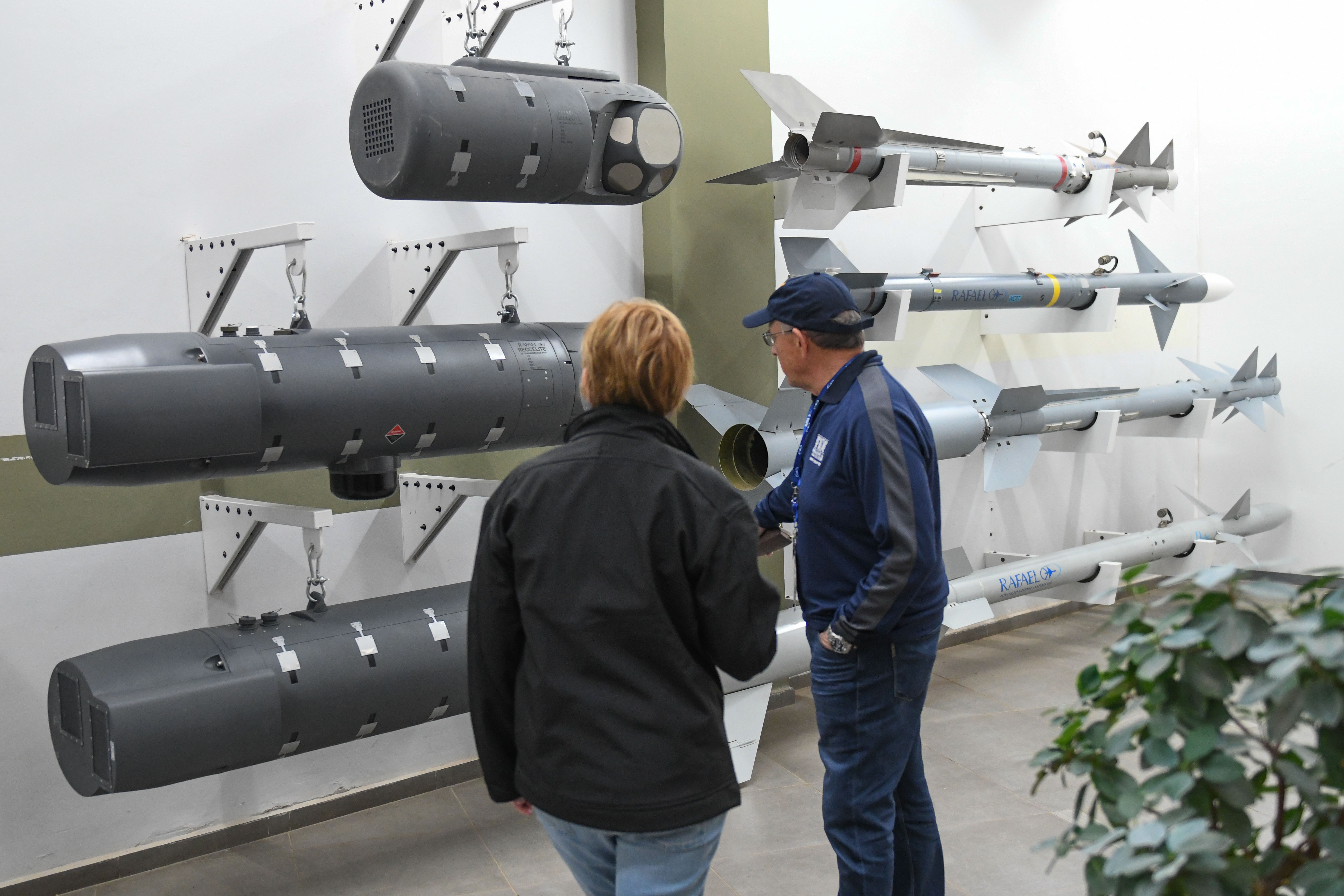 Israel’s arms industry enjoys support from Europe. (Shahar Azran)
When they are challenged about cooperation with Israel in scientific research, European Union representatives trot out the same excuse: All the work being financed is civilian, rather than military.
I now have proof that EU representatives are saying something quite different behind the scenes.
An internal paper states that the results of EU research projects “may further develop.” The developments can take place outside the scope of the projects “either immediately or with some adaptation, even if they were originally intended and funded for purely civilian applications,” the document adds.
The document – obtained through a freedom of information request – was drawn up so that Marc Lemaître, a top-level EU official, would be well-briefed for a discussion with Avi Nir-Feldklein, an Israeli ambassador, in February this year.
The points made about how the results of research “may further develop” come under the heading “defensives.” That term is often used by officials or politicians if they are expected to defend a particular policy.
The framing is instructive. It illustrates that EU officials are willing to give Israel assurances amid the ongoing Gaza genocide.
Once you read between the lines, the message becomes clear: The EU labels its cooperation with Israel as “civilian” but there is nothing to stop the fruits of that cooperation from being used in weaponry.
Lemaître heads the research department in the European Commission, the EU’s executive.
Over the past few years, a sizable number of his colleagues in the Brussels bureaucracy have been campaigning for sanctions against Israel. In December last, the group EU Staff for Peace requested that research grants to Israeli firms and institutions be halted.
Replying to that appeal, Lemaître insisted that cooperation with Israel through Horizon Europe – the EU’s research program – remains “fully in force.”
His tough-guy attitude toward his own colleagues contrasts with the more soothing tone the European Commission has adopted in its dealings with Israel.
In October 2025, Israel’s Association of University Heads sent a letter on research cooperation to the European Commission. It complained about how some universities and university networks within Europe were “acting either alone or in concert to exclude Israeli scientists and research institutions” from projects.
The letter noted how the European Commission had previously categorized boycotts targeting Israel as discrimination on the basis of nationality.
That point is reiterated in the briefing document prepared for Marc Lemaître’s meeting with the Israeli ambassador.
The document claims that “we have strong respect for the principle of academic freedom.” Decisions by universities to suspend joint activities with Israeli firms or institutions “remain at their own discretion,” it says.
Nonetheless, it warns that withdrawing from a research project in protest at the involvement of an Israeli firm or institution could be viewed as “improper.”
“Top performer”
A more explicit threat can be found in a document prepared for Maria Cristina Russo, deputy head of the European Commission’s research department.
In January, she welcomed a delegation from the Israel Innovation Authority to Brussels.
Russo’s briefing notes for that discussion say that the European Commission’s line on boycotts is “very clear.” The document suggests that terminating the involvement of an Israeli firm or institution in an EU research project “based on nationality” would be “prohibited.”
“Possible legal and financial consequences” could ensue, the paper adds.
“In fact, we believe that a blanket exclusion of Israeli entities would be counterproductive, as international scientific cooperation has the potential to lead to positive change in the region,” the briefing document says.
While the kind of “positive change” that may be envisaged isn’t spelled out, the document does give some details about why scientific cooperation with Israel is deemed valuable.
Israel is described as “a top performer” when calls for research proposals are issued.
The Israeli approach to innovation is regarded as impressive by EU insiders who seldom utter a sentence which doesn’t contain the words “competitiveness” or “enterprise.” Israel spends more than 5.5 percent of its gross domestic product on scientific research, whereas the average for the EU’s 27 countries is 2.2 percent.
Michael Mann, the EU’s Tel Aviv envoy, celebrated this week how Israel’s participants have received more than $1 billion from the Horizon Europe program.
EU representatives habitually congratulate themselves on how they are extremely kind to Palestinians.
The briefing papers for the discussions with Israeli visitors cite an example of such munificence: Gaza’s researchers have recently been allocated approximately $1 million under Horizon Europe.
Mathematics was never my forte. But I do know that a billion equals 1,000 million.
Researchers from Israel – the state carrying out a genocide – are therefore getting 1,000 times more in EU science grants than researchers from Gaza, where the genocide is being carried out.
How very generous!
•First published by The Electronic Intifada, 9 September 2026.