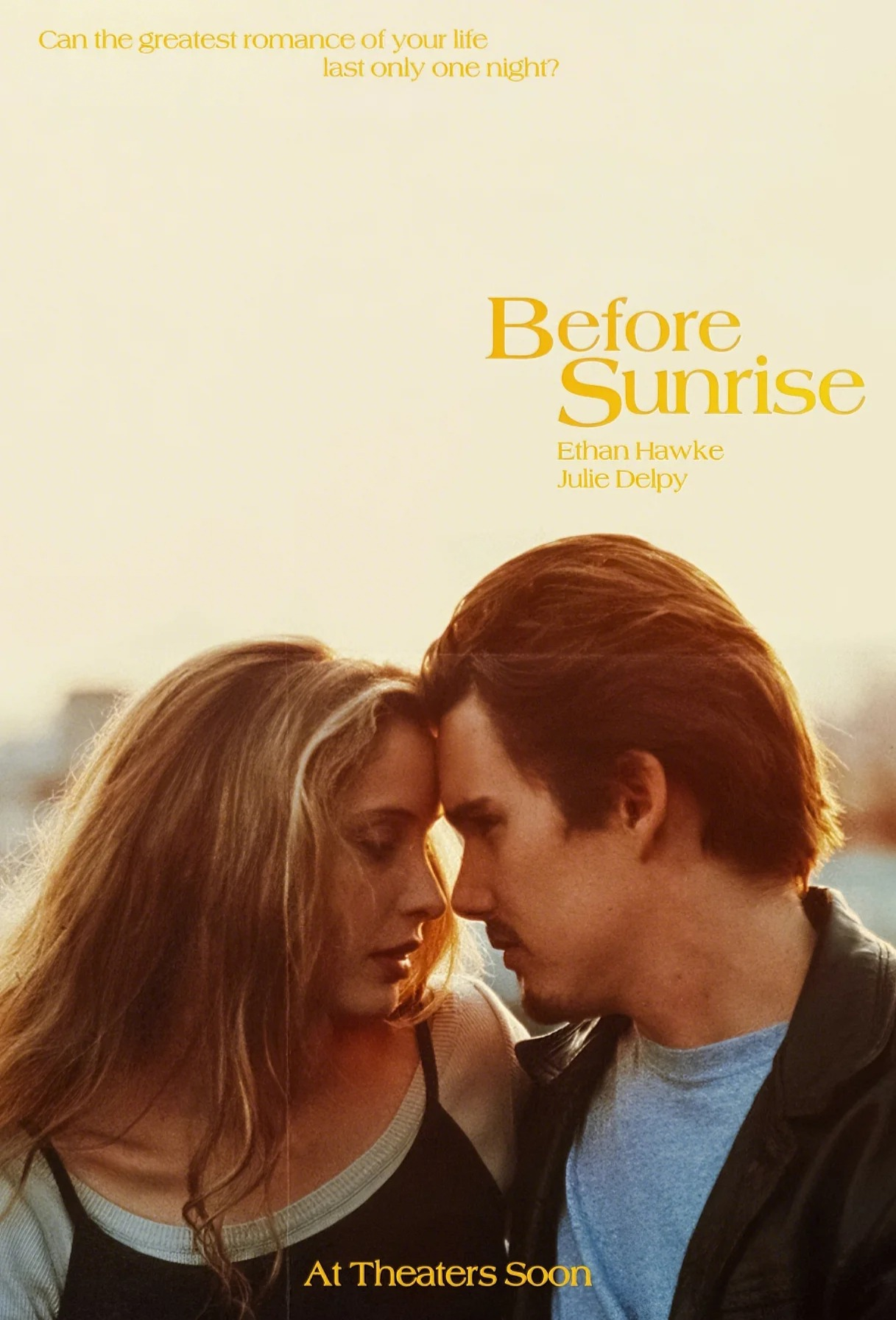

I think what’s so devastating about Before Sunrise isn’t simply that it’s a great love story. It’s that it accidentally became a historical document. You’re not just watching Jesse and Céline fall in love. You’re watching two people inhabit a world that feels impossibly available to itself. No phones. No feeds. No algorithms mediating experience. Just boredom, curiosity, chance, conversation, and the terrifying possibility that a stranger might completely change your life.
The film captures a Europe that feels half-real and half-mythological now, a continent reached by trains and intuition rather than GPS and notifications. The analog grain of the film stock only deepens the ache. Every frame feels like something already disappearing while you’re looking at it. That’s why it hurts. You’re not only mourning the youth of the characters. You’re mourning a version of Vienna and the world in which mystery had more room to breathe. Watching it can feel less like nostalgia than grief for a future that never realized it was already becoming a memory.
Part of what makes the film almost unbearable is that Jesse and Céline are still innocent of what time does. Not naïve exactly. Both are intelligent enough to understand heartbreak, disappointment, and death in the abstract. But they haven’t yet accumulated the sediment of decades. They do not yet know how many versions of themselves they will become. They do not yet know how many cities will be left behind, how many friendships will evaporate, how many dreams will quietly change shape without asking permission. The audience knows all of this. We watch them the way older people sometimes watch children playing in a sprinkler, aware of something they cannot yet understand.
And then there is the conversation itself. So much of the film is simply two people talking. Imagine trying to pitch that now. No superheroes. No apocalypse. No mystery box. Just two human beings paying exquisite attention to one another. The film feels radical because attention itself has become radical. Their dialogue unfolds with the confidence of people who believe there is nowhere more important to be than exactly where they are. They’re not documenting the experience. They’re not curating it. They’re not performing it for an invisible audience. They are inhabiting it.
The older I get, the more I suspect that what the film is really about is not romance at all, but impermanence. The entire story is haunted by transience. A train ride. A single night. A city neither of them belongs to. The understanding that dawn is coming and that everything beautiful is already slipping away even as it arrives. The romance matters because it becomes a vessel for a larger truth. Nothing lasts. Not youth. Not beauty. Not cities. Not conversations. Not even the versions of ourselves doing the loving.
But I think there’s something even deeper happening beneath all of that. The film feels painful because it confronts us with a possibility that our culture increasingly struggles to imagine: that another human being might be more interesting than the machinery surrounding them.
We live in an age of optimization, branding, content, metrics, positioning, and performance. Every experience arrives pre-interpreted. Every feeling is quickly converted into identity. Every mystery is subjected to immediate explanation. Before Sunrise quietly refuses all of it. It treats conversation as sacred. It treats attention as a form of devotion. It treats another person as an undiscovered country.
That may be why the film feels almost occult to me now.
As I’m sure you’ve heard, likely spoken aloud by some insufferable cybermancer, the word occult simply means hidden. And what is hidden in the modern world is not information. Hell, we have more information than any civilization in history. What has become hidden is presence. The ability to disappear into a moment without immediately extracting value from it. The willingness to meet another person without reducing them to a category, a demographic, a dating profile, a political tribe, or a psychological diagnosis. Jesse and Céline encounter each other as mysteries. They leave room for enchantment. In a cynical age, that borders on rebellion.
And perhaps that’s what so many of us are actually grieving when we watch it. Not merely our youth. Not merely the nineties. Not merely Europe before smartphones. We’re grieving the slow disappearance of conditions under which wonder naturally occurred. The world has become more connected and, in some strange way, less available. We know more about each other and encounter less of one another. We’re surrounded by communication and starving for communion.
Before Sunrise refuses to become cynical. That may be its greatest act of courage. It dares to suggest that intimacy is real. That strangers can still transform one another. That a conversation can alter the trajectory of a life. That mystery remains alive beneath the machinery. It offers no irony to protect itself. No distance. No smirk. It risks sincerity completely.
And maybe that is why it feels so dangerous. Because sincerity is always dangerous.
To love another person is to stand defenseless before impermanence. To remain open to wonder is to reject the fashionable certainty that everything has already been explained. To believe that a stranger on a train might matter is to reject the logic of a disposable world.
For those of us trying to make sense of life in the late stages of whatever this Kali Yugan civilization is becoming, Before Sunrise feels less like a romantic film than a dispatch from a lost kingdom. A message in a bottle from a reality where people still had time to get lost, still had patience for mystery, still believed another soul might be worth an entire evening.
And maybe the ache it leaves behind is not sadness at all. Maybe it’ s a reminder. Maybe somewhere beneath the algorithms, the cynicism, the acceleration, and the noise, the world remains as enchanted as it has always been: Waiting for us to pay attention.