
“Be Not Fearful.”
He says it quietly now, almost under his breath, like something he’s still testing for truth. These words don’t come easily; not like the the ones he writes. These words move through him the way a blade moves through cloth, meeting resistance, catching on something unseen. Fear, for him, is not an idea. It’s a presence. It has a body. It has learned the architecture of his throat and taken residence there, a small, enduring thorn lodged just beneath the tongue. It sings sometimes. Not loudly, not in ways others would notice, but it hums with a kind of low, persistent liturgy, a psalm he never chose and somehow memorized anyway.
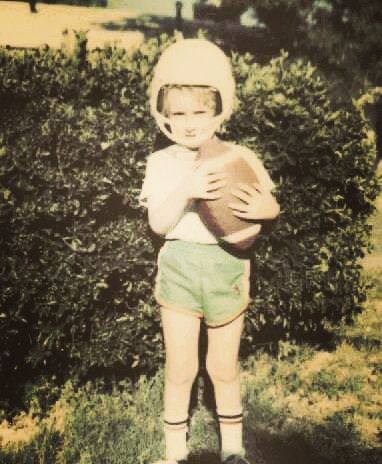
There was a child once. He can still see him if he closes his eyes long enough. The boy stands in a field of late afternoon light, holding a football; the air warm and forgiving, the sky an open and endless blue. In that world, sunlight was a kind of covenant. It meant something. It promised something. It suggested that the world, for all its strangeness, was fundamentally safe. The boy believed this. He believed adults were guardians of that safety, that rooms held by walls were places of protection, that laughter was evidence of joy and not something that could turn, suddenly, into something else. He hadn’t yet learned that there are wildernesses that wear the shape of ordinary places, that wolves can carry names and speak in familiar voices.
When the moment came, and it did come without ceremony, without warning, he called for help. Not always with words. Sometimes the body calls before language can form. Sometimes the plea is in the eyes, in the stiffness of a small spine, in the way breath begins to fracture. But he called, in every way a child can call when something is wrong. And nothing answered. Not God. Not family. Not teachers. Nothing. The room didn’t stop. It continued its quiet breathing, its indifferent existence. The world, as it does, remained intact. There were sounds, laughter even, but they arrived out of place, misaligned with what was unfolding. Mercy, which should’ve entered and knelt beside him, didn’t appear. Something else did.
A lesson entered early, like winter through an unsealed door, cold and immediate and impossible to ignore. It settled into him before he had the language to resist it, before he even knew resistance was an option. It taught him that silence can masquerade as holiness, that entire systems can be built around not seeing, that truth is negotiable in the presence of comfort. It taught him that a child can be made to carry something that does not fit inside any available words. And so he carried it. Not because he chose to, but because there was nowhere else for it to go.
Years passed, as they do, but the body kept its own ledger. What the mind edited for survival, the body archived in sensation, in posture, in breath. Memory didn’t behave like a story with a beginning and an end. It behaved like weather. Storm systems circled the same invisible coordinates. Pressure built and dissipated, only to return. There were days of relative calm, and then there were days when something shifted in the atmosphere and everything darkened at once, a grief without a clear source, a tension without a visible cause. And still, somewhere within that same body, within that same field of storm and static, something else remained.
A hand, older now, broken, but resting on six strings. The first time he held the guitar, it didn’t announce itself as salvation. It was just wood and wire, weight and shape. But when he played, when he allowed his fingers to move, awkward and searching at first, something answered. Not from outside, but from within. The instrument hummed against him, a second heart learning the rhythm of the first. Sound emerged, imperfect and raw, but unmistakably his. It wasn’t language, not in the conventional sense, but it was communication. It was a way of giving shape to what had previously been formless. A small altar assembled itself there, in vibration and breath, in the fragile act of staying present long enough to finish a song. Call it prayer. Call it defiance. Call it the slow resurrection of a voice that had every reason to disappear and chose, instead, to remain.
Over time, he began to understand something no one had taught him: The sacred is not located in untouched places. It’s not preserved in sterile rooms or polished doctrines. It lives, stubbornly, in the soil that has been broken open, in the field after fire, in the unlikely insistence of something green pushing up through ash. Suffering doesn’t sanctify anything by default, but it reveals the terrain where sanctification can occur. And he learned something else, something he carries now with a clarity that borders on conviction: A child isn’t saved by belief, nor by reputation, or by the careful fictions adults tell themselves to preserve the world as they prefer it to be. A child is saved when someone sees, truly sees, and doesn’t turn away. Anything less, and the silence continues its quiet liturgy. Anything less, and the wound doesn’t end. It evolves. It adapts. It becomes something that can be passed, invisibly, from one life into another.
He made a slow, painful decision, though he didn’t yet have the words for it when it first took root. It ends with me. Not the pain, not the memory, those are more complicated, more persistent, but the inheritance of silence, the reflex to look away, the instinct to minimize or bury. Those things, he wouldn’t pass forward. He wouldn’t become another room that kept breathing without answering.
Now, sometimes, he stands in open spaces on purpose. This isn’t easy for him. Light, even now, can feel like exposure, like something that reveals too much, too quickly. But he stays, for as long as he can endure it. He practices it. He allows himself to be seen by the very thing he once feared. He is learning, still, to become something his younger self needed but never received, a witness who does not leave, who doesn’t laugh and deflect at the wrong moment, who doesn’t trade truth for comfort.
He still searches for the sun. Not in the naive way he once did, not as something guaranteed, not as something owed. He understands now that there are long stretches where it doesn’t arrive, where the sky remains overcast, where warmth must be imagined before it can be felt. But he also understands something he could not have known then. Sometimes the sun doesn’t come. Sometimes it’s not given. Sometimes, slowly, painfully, through acts so small they almost escape notice, it’s made. And sometimes, he’s learned, you have to slowly become it. And in those moments, brief, fragile, real, he feels it. Not above him, but within him.
And he says it again, more steadily this time: Be not fearful.