

FORENSIC EDUCATIONAL POST
ONLY FOR FORENSICS STUDENTS
A 28-year-old white man was driving a car at a speed of approximately 80 km/h on a country road, when the vehicle hit a man who was in an upright position on the road. The body of the pedestrian was found 375 m from the rear of the car, whereas the head of the pedestrian was recovered on the passenger seat (Fig. 1) of the car.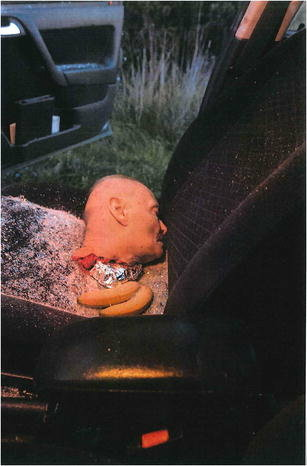
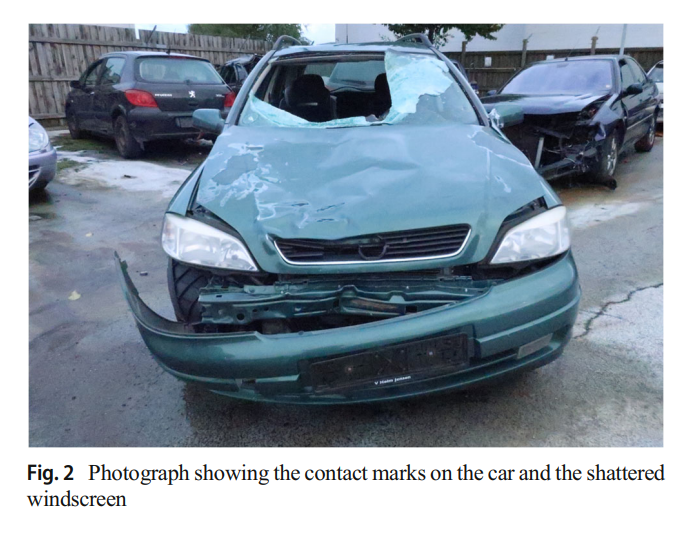
The car involved, an Opel Astra, appeared to be wrecked entirely on the frontal right side; the fender and the head-light were damaged, the windscreen was shattered, and a contact mark was evident on the roof (Fig. 2).
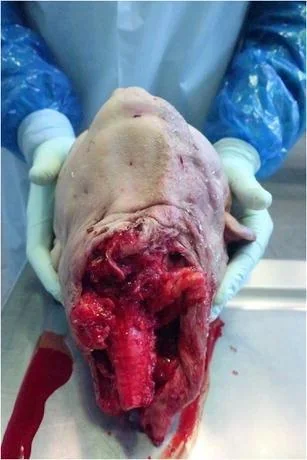
Bloodstains were observed on the windscreen and on the front passenger seat. The victim was a 57 year-old man, whose medical record showed a history of drug abuse. The man was also suffering from lung cancer with brain metastasis, and was undergoing treatment with radiotherapy. A PMCT was performed and showed multiple rib and pelvis fractures on both sides of the body, a closed fracture of the right fibula and the left clavicle, two vertebral column fractures (T1-T5), as well as complete decapitation at C1-C2. It was noted at external examination that there was a complete decapitation between the first and the second cervical vertebra with a single circumferential skin laceration with irregular ragged edges, showing the transected trachea and the neck structures (Fig. 3).
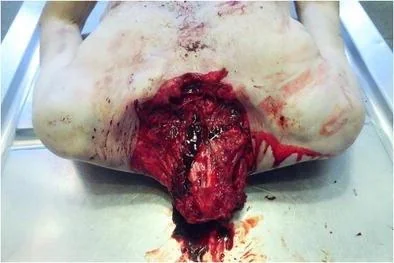
Several glass fragments were observed on the victim’s clothes, as well as on his head and neck. Multiple abrasions were present on his face and tiny sharp injuries were evident on the scalp, the forehead and on the nasal pyramid, as well as all around the supra-clavicular skin. The cervical spine was visible from the degloving neck injury (Fig. 4).
A large abdominal blunt injury was also present. Furthermore, the external examination showed two lacerations on the posterior side of the right leg adjacent to the knee, and a bruise of the left knee. Internal examination of the head revealed an unharmed cranial vault. The dura mater was undamaged and the epidural and subdural spaces clear. The skull base was intact. No macroscopic abnormalities or traumatic findings of the brain were detected. There were multiple fractures to the bony thorax including all ribs and the left clavicle. Multiple pulmonary contusions were revealed and a tumor of the left upper lobe was found. Additionally, the esophagus, the liver, and the spleen, were lacerated, as was the diaphragm. The thoracic aorta was completely ruptured adjacent to the aortic arch and the abdominal aorta showed intimal lacerations. The pelvis was massively destroyed and the thoracic spine was broken in two points (T1-T5). There were no remarkable histological findings. The manner of death was deemed to be either accident or suicide.
Angelino, Amalia & Knudsen, Peter & Leth, Peter. (2018). Unusual accidental decapitation in a road traffic incident. Forensic Science, Medicine and Pathology. 14. 10.1007/s12024-017-9935-9.