

##The Moment Everything Changed
It's 2026, and somewhere in a gleaming laboratory hidden behind unmarked doors, a human brain sits suspended in a crystalline chamber. Not a brain from a textbook or a computer simulation, but an actual human brain. Your brain. My brain. Someone's mother's brain. And it's still alive. Still thinking. Still processing. Or is it?
This isn't the opening scene of a dystopian thriller. This is happening right now, in this very moment, and it's rewriting everything we thought we knew about life, death, consciousness, and what it means to be human.
Welcome to the world of Bexorg, a neurotechnology company that has accomplished something so profound, so unsettling, and so utterly transformative that it's forcing humanity to confront questions we've been avoiding since the beginning of time. They've figured out how to keep human brains alive outside of bodies. And the implications will haunt you long after you finish reading this.
## The Impossible Made Real
Imagine you're a neuroscientist. You've spent decades studying the human brain, watching it deteriorate in Petri dishes, observing it through computer models that feel hollow and incomplete. You've tested thousands of drugs on mice, on rats, on artificial neural networks. But nothing quite captures the truth of what happens inside a real human brain when it encounters disease, when it meets medication, when it faces the unknown.
Then one day, someone hands you the key to something extraordinary. They hand you an actual human brain. Not a fragment. Not a simulation. The whole thing. Complete with all its memories encoded in its neural pathways, all its complexity intact, all its mystery preserved.
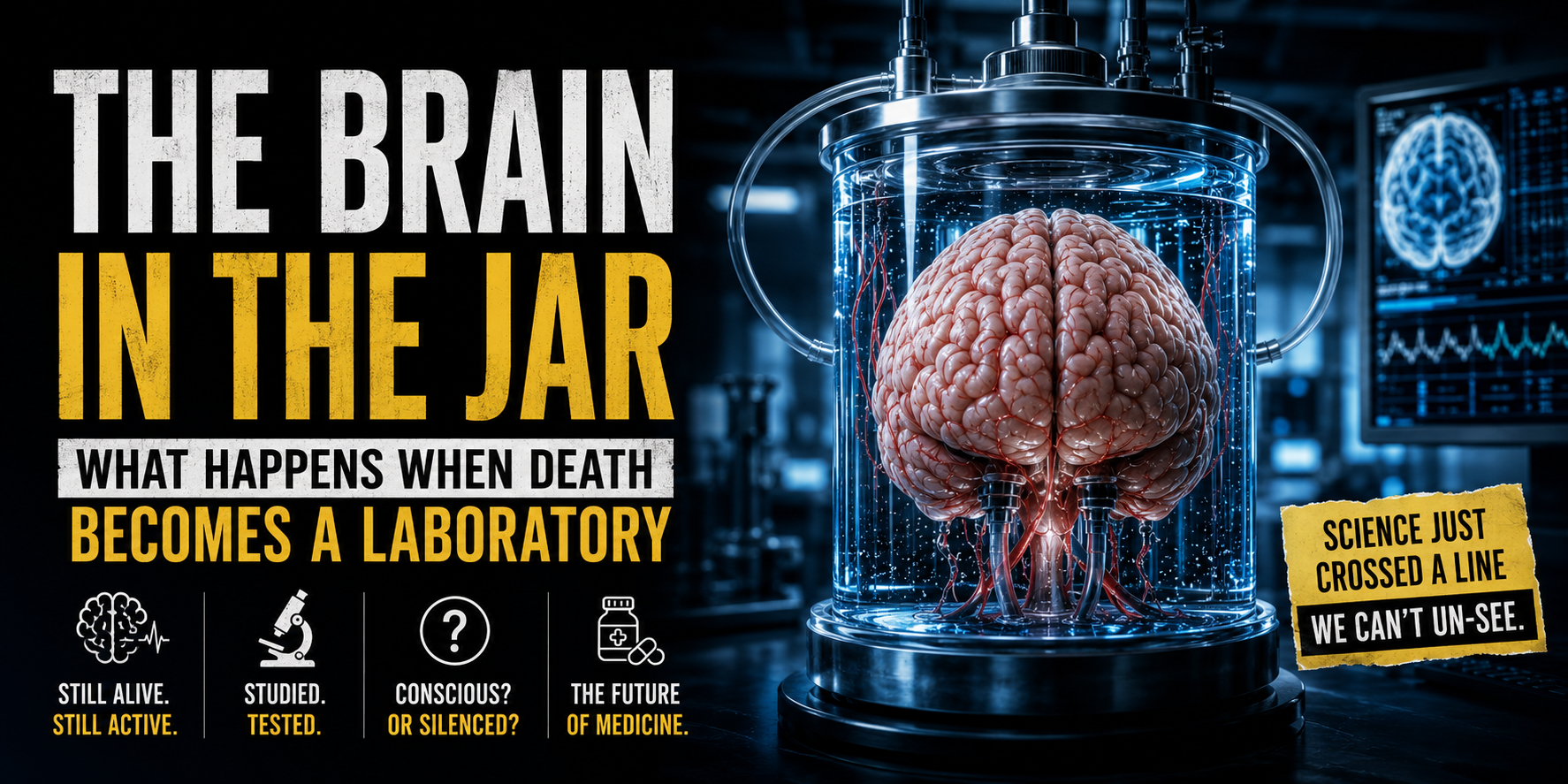
This is what Bexorg's revolutionary BrainEx platform offers to the world. It's a life support system so sophisticated, so meticulously engineered, that it can sustain a donated human brain for approximately 24 hours after death. During that window, the brain continues its cellular dance. Neurons still fire. Metabolic processes continue. The organ that makes us who we are keeps functioning, kept alive by tubes and pumps and carefully calibrated nutrients circulating through its tissue.
For researchers desperate to understand how experimental drugs affect real human neurology, this is nothing short of miraculous. For the rest of us, it's something far more troubling. It's the moment when science stops asking "can we?" and starts proving that yes, we absolutely can. The question of whether we should is a different matter entirely.
## The Consciousness Question That Keeps You Awake at Night
Here's where things get genuinely unsettling. When Bexorg keeps these brains alive, when they're circulating oxygen and glucose through neural tissue, when electrical activity is being measured and monitored and studied, is something happening in there? Is there awareness? Is there suffering? Is there a ghost in the machine, trapped and screaming silently while researchers take notes?
Bexorg insists the answer is no. They keep the brains under deep anesthesia, suppressing electrical activity, preventing any coordinated neural firing that might constitute consciousness. They've studied over 700 brains while working closely with bioethicists to ensure that these organs cannot regain consciousness. The company presents this as a safeguard, a moral boundary they've carefully drawn and committed to respecting.
But here's what keeps philosophers and ethicists awake at night: How can we possibly know for certain? Our understanding of consciousness remains one of the deepest mysteries in all of science. We can't even fully explain how consciousness emerges in living, breathing humans with intact bodies and sensory input. How can we claim with absolute certainty that a disembodied brain, kept in a state of artificial suspension, has no inner experience whatsoever?
What if consciousness isn't what we think it is? What if it doesn't require a body? What if it doesn't require sensory input? What if, in the darkness of that laboratory chamber, something is experiencing something that we have no framework to understand or measure?
Bioethicists have already begun grappling with this nightmare scenario. They're proposing that if these biocomputers somehow achieved consciousness, they would possess what's called "moral status." That single phrase opens a Pandora's box of legal, ethical, and philosophical complications. If a brain in a jar has moral status, then what? Do we have the right to study it? To experiment on it? To keep it alive against its will? These aren't abstract thought experiments anymore. They're questions that demand answers, and we're running out of time to find them.
## The Promise: A World Without Neurodegenerative Disease
But before we descend entirely into existential dread, let's talk about why Bexorg's work matters so profoundly. Let's talk about the millions of people whose lives are being stolen by diseases that we currently have no way to stop.
Alzheimer's disease is erasing minds one synapse at a time. Parkinson's is stealing movement and dignity from people in the prime of their lives. ALS is locking people inside their own bodies, trapping brilliant minds in paralyzed flesh. These diseases are catastrophes. They're personal apocalypses happening in hospitals and nursing homes and family living rooms across the world every single day.
For decades, we've tried to fight back. We've tested drugs on animal models, hoping that what works in a mouse will work in a human. We've created computer simulations, running algorithms through digital neural networks, trying to predict how medications will behave in the human brain. But here's the brutal truth: animals aren't humans. Simulations aren't reality. A mouse brain is fundamentally different from a human brain. A computer model can't capture the staggering complexity of a real organ that has lived a full human life, accumulated a lifetime of experiences, been shaped by genetics and environment and decades of medication and disease progression.
This is where Bexorg's breakthrough becomes genuinely revolutionary. When you can test an experimental drug directly on actual human brain tissue, when you can observe in real time how it interacts with real human neurons, when you can see how it responds to the specific genetic makeup and disease state of a particular person's brain, you get data that's impossible to obtain any other way.
Pharmaceutical companies have already figured this out. They're lining up to use Bexorg's platform. Biohaven, a major pharmaceutical company, is already evaluating their experimental therapies using 130 of Bexorg's brains. These aren't theoretical exercises. These are real drugs being tested on real human neural tissue. And the results could reshape the entire landscape of neurodegenerative disease treatment.
The numbers tell the story. The global neurotechnology market was worth $19.19 billion in 2026, and it's projected to explode to $32.93 billion by 2034. That's not just money changing hands. That's the world's scientific and pharmaceutical establishment betting everything that this technology is the future. That this is the path forward.
## The Moment Everything Gets Complicated
But here's where the story gets truly complex. Because Bexorg's breakthrough isn't just a scientific achievement. It's a mirror held up to humanity, and what we see reflected back is deeply uncomfortable.
We're living in an age where we can keep brains alive in jars. We can study them. We can learn from them. We can potentially save millions of lives using the knowledge we gain from them. But we're also living in an age where we have to ask ourselves some very hard questions about what we're willing to do in pursuit of progress.
Every brain that Bexorg studies came from a person. That person had a life. They had dreams and fears and relationships and memories. They had a family who grieved them. And now their brain is in a laboratory, being experimented on, being studied, being used to advance science. Is that a violation? Is that sacred? Is that the future we want?
The ethical frameworks we've built over centuries of medical research are suddenly inadequate. The rules we created for testing drugs on animals don't quite apply here. The regulations we wrote for human subjects research don't quite fit a brain that's no longer technically a human subject. We're in uncharted territory, and we're making it up as we go.
Some people will look at Bexorg's work and see pure hope. They'll see the promise of cures for Alzheimer's, of treatments for Parkinson's, of finally, finally having a way to fight back against the diseases that steal our loved ones from us. They'll see a future where neurodegenerative disease is a footnote in history books, a disease we conquered.
Other people will look at the same work and see something darker. They'll see the commodification of human remains. They'll see the blurring of lines between life and death, between research subject and human being. They'll see a future where the dead are harvested for their brains, where consciousness itself becomes a question mark, where we've crossed a line we can never uncross.
The truth, as it always is, probably lies somewhere in between. But the fact that we're even asking these questions, the fact that we're forced to confront them, the fact that Bexorg's breakthrough has made them impossible to ignore, that's what makes this story so profoundly important.
## The Moment We Have to Choose
We're standing at a crossroads. Behind us is a world where we could only guess at how drugs would affect the human brain. Ahead of us is a world where we can know for certain. But the path forward is lined with questions we've never had to answer before.
What does it mean to be human when your brain can be kept alive in a jar? What does consciousness mean when we can't even define it? What does death mean when the most essential part of us can continue functioning in a laboratory? What does progress mean when the cost might be our fundamental understanding of what it means to be alive?
These aren't rhetorical questions. These are the questions that will define the next chapter of human civilization. And they're being asked right now, in laboratories like Bexorg's, by scientists and ethicists and philosophers who are trying to figure out how to move forward responsibly.
The story of the brain in the jar is ultimately a story about us. It's about what we value. It's about what we're willing to sacrifice in pursuit of progress. It's about whether we can create the future we want without losing the humanity that makes us who we are.
And the most unsettling part? We don't know the answer yet. We're writing this story in real time, and every decision we make, every line we draw, every compromise we accept, is shaping what comes next.
So the question isn't really about the brains in the jars. The question is about us. What kind of future do we want to build? And what are we willing to do to get there?
The answer to that question will echo through history.
## The Numbers Behind the Revolution
The neurotechnology market is exploding. In 2026, it reached $19.19 billion. By 2034, it's projected to hit $32.93 billion. That's not just growth. That's exponential transformation. That's the entire world's scientific establishment betting that technologies like Bexorg's BrainEx platform are the future of medicine.
Over 700 human brains have already been studied through Bexorg's platform. Hundreds of pharmaceutical companies are waiting in line to use it. The infrastructure for this new world is already being built. The precedents are already being set.
The future is already here. We're just adjusting to it.
## References
[1]: https://www.vice.com/en/article/why-this-biotech-company-is-keeping-bodiless-human-brains-alive-in-a-lab/ "Prada, L. (2026, June 6). Why This Biotech Company Is Keeping Bodiless Human Brains Alive in a Lab. Vice."
[2]: https://www.science.org/content/article/not-alive-not-dead-disembodied-human-brains-used-drug-testing "Not alive, but not dead: disembodied human brains used for drug testing. (2026, May 20 ). Science."
[3]: https://bexorg.com/ "Bexorg. (n.d. )."
[4]: https://www.fortunebusinessinsights.com/neurotechnology-market-115830 "Neurotechnology Market Size, Share | Forecast Report [2034]. (2026, June 22 ). Fortune Business Insights."
[5]: https://www.linkedin.com/company/bexorg-inc "Bexorg, Inc. (n.d. ). LinkedIn."
[6]: https://pubmed.ncbi.nlm.nih.gov/42207877/ "Reardon, S. (2026 ). Disembodied human brains used for drug testing. PubMed."
[7]: https://www.nature.com/articles/s41598-026-43243-y "Boyd, J. L. (2026 ). Ethical concerns about embodied brain organoids shaped. Nature."