
FORENSIC EDUCATIONAL POST // ONLY FOR MEDICAL STUDENTS
PLEASE DO NOT SAD REACT ON FB AS IT'S BAD FOR THE ALGORITHM
Another reason for this post is to raise awareness about the fact that this situation can occur, so please educate others if you are in an area where this might happen.
A seven-year-old male child was found in a field near his home by his father and the police were subsequently informed. His relatives alleged that the child had died as a result of an animal attack (possibly a bear or a boar). After initial investigation, the police were inclined to agree and brought the corpse to Government Medical College & Hospital, Korba, Chhattisgarh, India for post-mortem examination. We noted the dead male child was of average build and wearing a purple t-shirt, blue half-pants and brown underwear. Clothes were dusty, and blood-stained in places. There were also some yellowish-brown stains present over the clothes which had multiple small roundish defects with burnt margins.
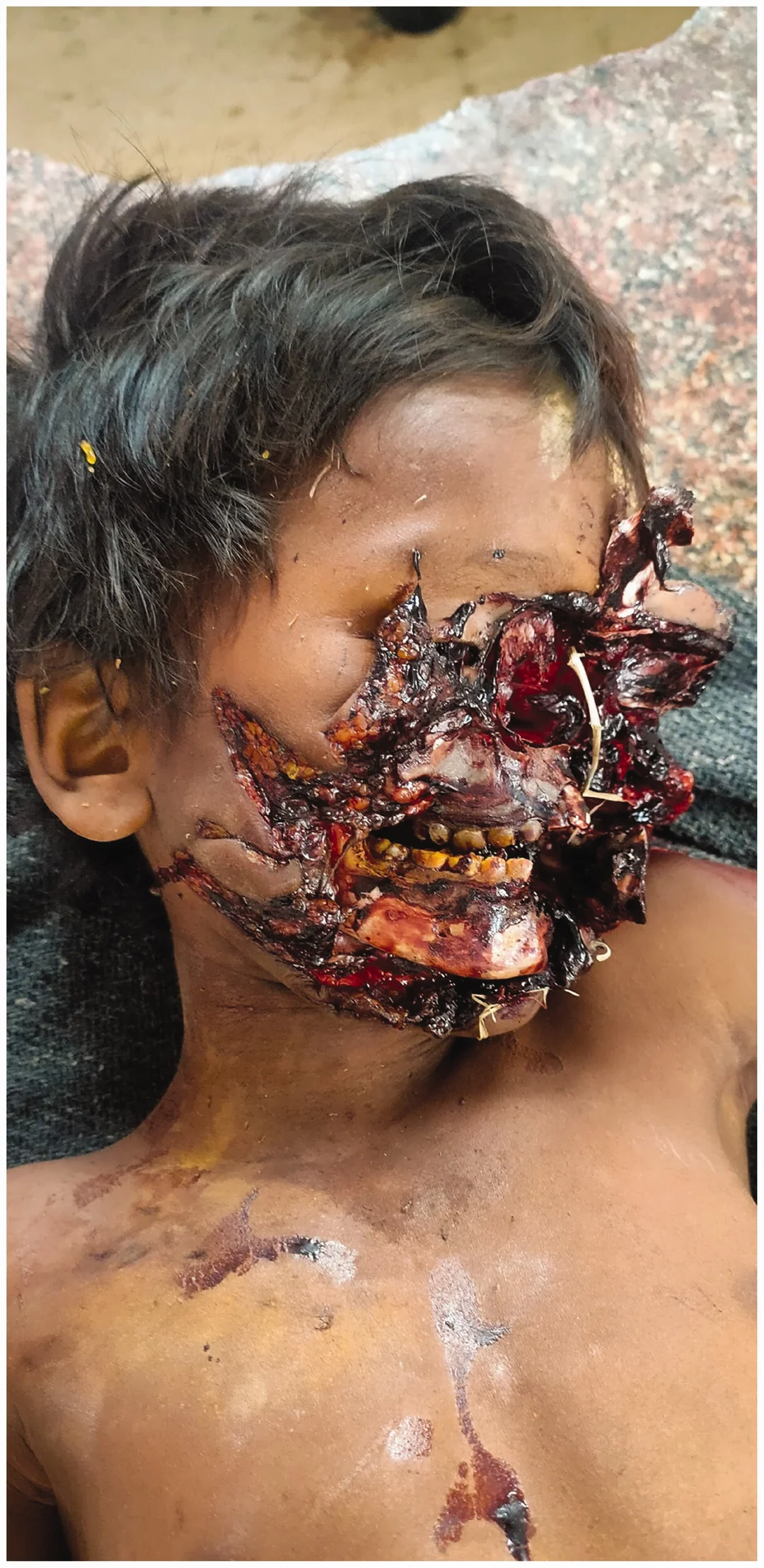
Multiple lacerated wounds were present over the face. All were radiating outwards from the mouth region. The margins and insides of these wounds were charred black in places. Yellowish powdery material was apparent over the face in places. Figure 1.
There were comminuted fractures of skull and jaw with infiltration of blood at fractured ends. Diffuse subdural and subarachnoid haemorrhage was present over the left cerebral hemisphere. Contused laceration was present over the antero-inferior region of the right frontal lobe of the cerebral hemisphere.
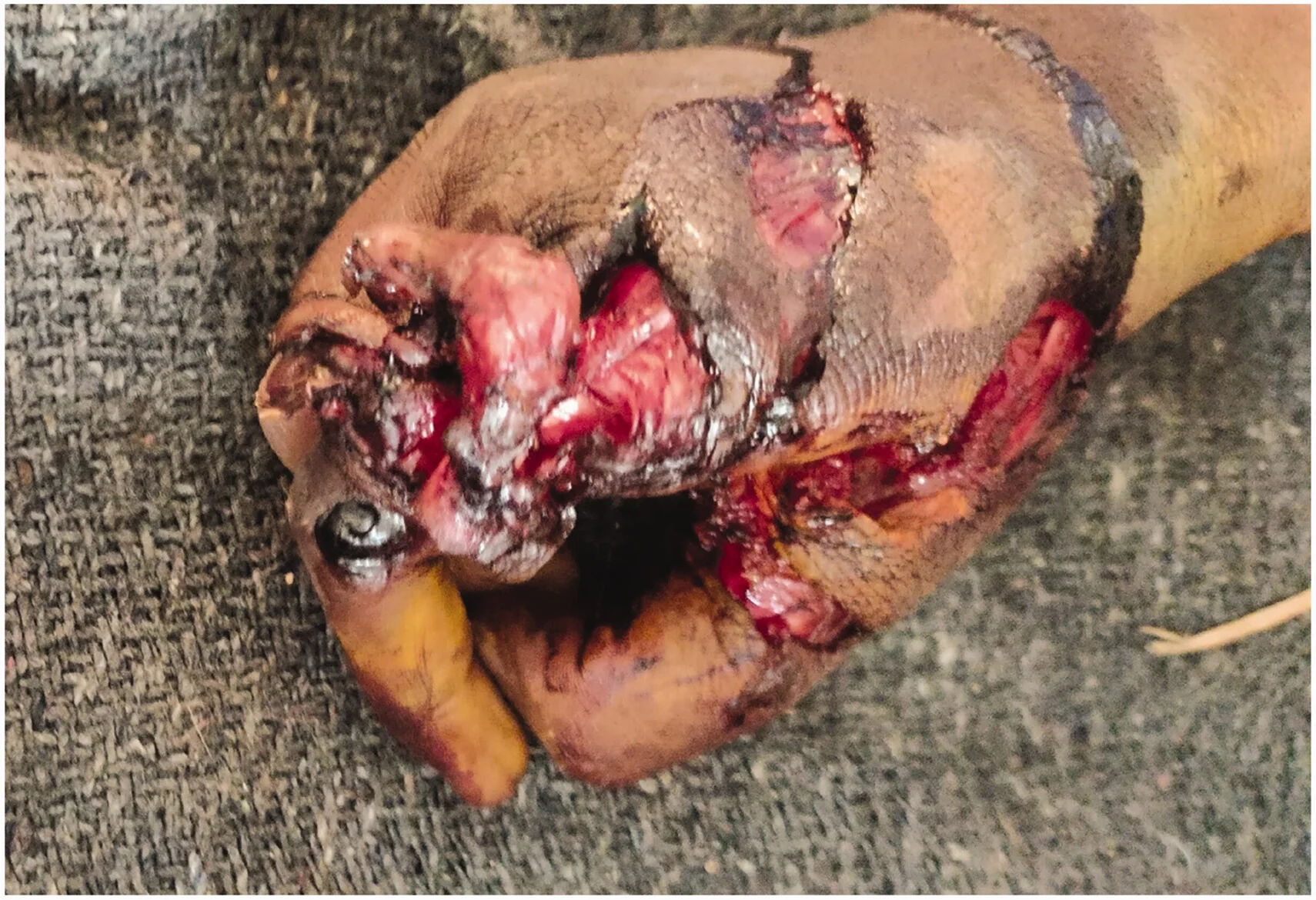
The right hand had a stellate lacerated wound involving thumb, index finger and middle finger which radiated to both dorsal and palmar aspect. Underlying bones were exposed in places. There was disarticulation of proximal interphalangeal, distal interphalangeal and metacarpophalangeal joints of the index finger. The margins of the wound were charred. Figure 2.
Both lungs were pale. Liver and kidneys were congested. Stomach contained whitish curd-like contents, mucosal wall was unremarkable. The cause of death was given as cranio-cerebral damage. The police were informed of the possibility of ballistic injury over the face and hand. Samples were sent for confirmation (swabs from different region and clothes).
Injuries sustained in animal attacks may be mistaken for homicidal injuries so it is important to differentiate an animal attack from other possible causes of death. The attack scenario differs from animal to animal and even between species, so, by comparing the pattern of injuries, it may be possible to describe the animal involved.
Bears are carnivores, can grow up to 8 feet, weigh 1000 pounds but are usually not known to attack humans until/unless provoked, surprised or threatened. Injuries by animals such as bear and wolf are dominated by biting, whereas moose and wild boar do not bite their victims. The bear may use its paws for either hitting or clawing. When hitting, it causes crush injury and fractures, and when clawing causes excoriations and possible penetrating injuries.³ Injuries by brown bears are confined to the head and neck regions.
Biting, gnawing and tearing injuries due to sharp teeth and claws does produce overwhelming injuries but these are seldom fatal. Injuries by the Himalayan black bear are confined to the face, and such attacks are not usually fatal, and the animal soon removes itself from the scene after the attack without showing any intention to eat the victim. Among the significant departures from reported patterns was a case of a Tibetan bear attack, wherein multiple injuries were present all over the victim's body and the bear had consumed some of the parts.
Boars, the wild ancestors of domestic pigs, can weigh up to 300 kgs, and are nocturnal animals. Boars are known to damage crops and their meat is considered a delicacy in some parts of India. Boars have four canine teeth which can grow as long as 20 cm and are used to inflict injuries when provoked. Boars avoid human contact and rarely attack unless they feel threatened. When provoked they attack repeatedly with their sharp canines, leading to multiple penetrating injuries. Even then these injuries are seldom fatal and usually located over lower parts of the body. Crush injuries and fractures are minimal or absent in attacks by wolf and wild boar. Domestic pigs on the other hand cause injuries due to trampling, kicking and biting.10
Injuries from animal attacks range from minor bruises and contusions to deeper extensive injuries such as puncture wounds, avulsions, extensive lacera- tions, blunt trauma to chest, and even amputations. By comparing the pattern of injuries, it is possible to identify the animal involved. In a ten-year study on evaluation of traumatic deaths associated with animal attacks, the authors concluded that intrathoracic organ damage and bleeding was the most common cause of death, with chest and back being the most commonly injured parts of the body. Most reported attacks were by cattle followed by horse, bear, wolf and boar.
In our case the injuries were confined to face and hand but had charred margins. Yellowish powdery material was present over forehead, teeth, right hand, and his clothes. A typical smell of sulphur was appreciable from the body. Animal hairs were not present over the body. All this raised suspicion. Clothes and swabs were sent for ballistic analysis. The report of ballistic analysis came out positive for potassium chlorate (potash) which is routinely used for making crackers. Potash is also a common constituent of homemade explosives used in tribal/village areas to either scare wild animals or in some cases to hunt them.
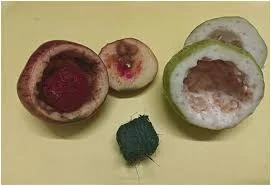
Further investigations by the police revealed the truth. In some areas of India, home fabricated explosives are concealed inside fruits to hunt wild boars which are protected animals (Figure 3). The child mistook such an explosive as a fruit and bit into it leading to the unfortunate incident.